

Learn the names and functions of every chandelier part, from hook to pendalogue, so you can restore, upgrade, or design with confidence and precision.
TL;DR:
- Understanding chandelier components and correct terminology ensures proper repair and restoration.
- Precise measurement and naming prevent ordering mistakes and project delays.
- High-quality crystals like Swarovski enhance the chandelier’s brilliance and visual appeal.
Chandeliers are among the most striking fixtures in any room, yet they can feel impossibly complex when you need to repair, restore, or upgrade one. Even experienced interior designers occasionally mix up a pendalogue with a prism, or confuse the canopy with the body dish. That confusion leads to wrong orders, project delays, and missed design opportunities. This guide walks you through every major chandelier component, from the ceiling hook down to the final decorative crystal, using clear names and practical context. Whether you are planning a full restoration or simply replacing a few crystals, knowing the right terminology puts you firmly in control.
Key Takeaways
| Point | Details |
|---|---|
| Clear component names | Knowing each part’s precise name streamlines repairs, upgrades, and ordering. |
| Distinct roles in structure and design | Mounting, lighting, and decorative parts all serve unique functions crucial to chandelier performance. |
| Crystal adds both form and function | Understanding crystal elements helps maximize beauty and light diffusion in your chandelier. |
| Proper terminology prevents mistakes | Correct naming avoids costly errors and ensures project success for homeowners and professionals. |
Chandelier mounting and support: Structuring the masterpiece
Every chandelier, regardless of its style or size, depends on a set of structural components that anchor it safely to the ceiling and define its overall silhouette. Understanding these parts first gives you a solid foundation before you ever think about crystals or lighting.

The mounting and support components include the hook, canopy, chain or rod, body dish, column, bottom bowl, bottom ball, and finial. Each one plays a specific role in load distribution and visual design.
Here is what each part does:
- Hook: The ceiling fixture that bears the chandelier’s full weight. It must be rated for the fixture’s load.
- Canopy: The decorative plate that covers the electrical junction box in the ceiling. It hides wiring and creates a clean transition.
- Chain or downrod: Adjusts the hanging height of the fixture. Chains offer flexibility; rods provide a cleaner, more modern look.
- Body dish: A decorative upper bowl that sits at the top of the chandelier body, giving it shape and elegance.
- Column or central stem: The vertical backbone running through the center of the fixture, housing the electrical wiring.
- Bottom bowl and bottom ball: Decorative closures at the base of the column.
- Finial: The ornamental piece that screws onto the very bottom, securing the assembly and adding a finishing touch.
| Component | Primary function | Design impact |
|---|---|---|
| Hook | Load bearing | Hidden, structural |
| Canopy | Covers junction box | Visible, sets tone |
| Chain/downrod | Height adjustment | Affects proportion |
| Finial | Secures bottom | Decorative accent |
Pro Tip: Before you replace chandelier parts, photograph each component from multiple angles. This visual record makes it far easier to match finishes and sizes when ordering replacements, especially for chandelier column parts that vary widely between manufacturers.
Common mounting styles include flush-mount canopies for low ceilings, sloped-ceiling canopies for angled surfaces, and extension rods for rooms with very high ceilings. Matching the right mounting hardware to your ceiling type prevents wobble and ensures safety.
Lighting components: Illuminating terminology and function
With the chandelier securely supported, the next layer is the lighting system itself, the parts that actually provide the glow. These components are what transform a decorative sculpture into a functioning light source.
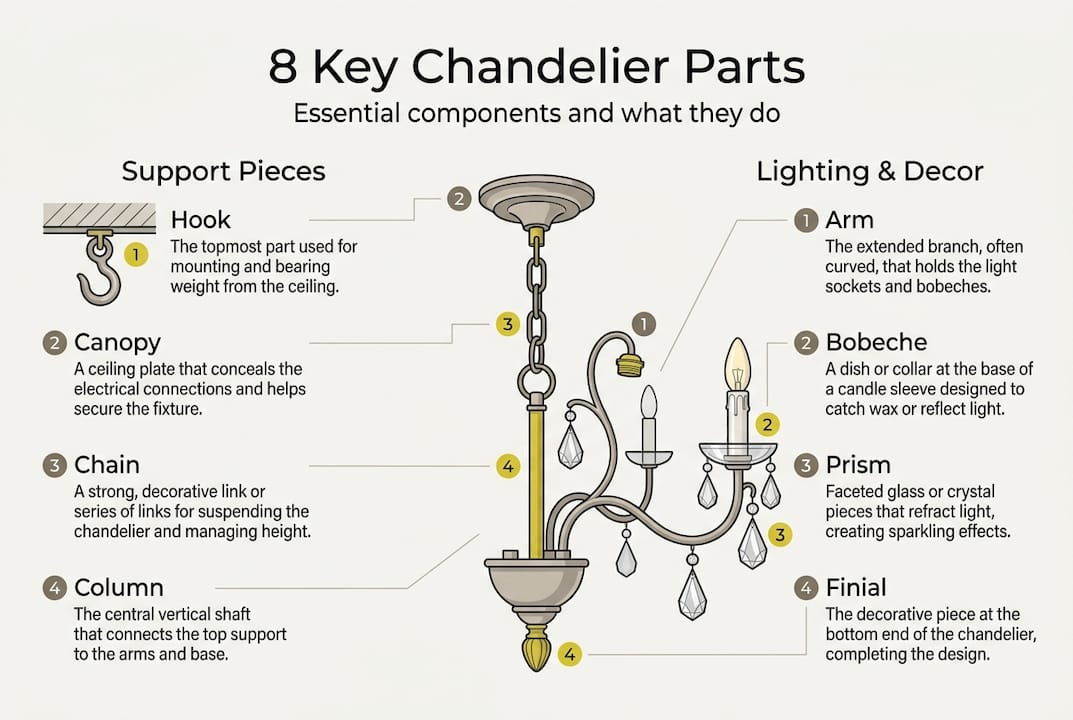
The core lighting components are the candle tube, candle cup, bulb or lamp, and arms. Each serves a distinct purpose in both function and appearance.
Here is how to identify them step by step:
- Arms: These are the extensions that branch out from the central column, supporting each light socket. They define the chandelier’s spread and silhouette.
- Candle cup: A small decorative collar that sits at the base of each arm’s socket, resembling the base of a real candle holder.
- Candle tube: A sleeve that slides over the socket itself, mimicking the look of a wax candle. It hides the electrical socket entirely.
- Bulb or lamp: The actual light source. In traditional chandeliers, flame-tip bulbs reinforce the candle illusion. In modern fixtures, LED capsules or globe bulbs may be used instead.
| Style | Candle tube | Bulb type | Visual effect |
|---|---|---|---|
| Traditional | Yes, fabric or wax-look | Flame-tip incandescent or LED | Warm, classic |
| Modern | No, or minimal | Globe or capsule LED | Clean, contemporary |
| Transitional | Optional | Dimmable LED flame | Flexible, versatile |
Knowing whether your chandelier uses a candle tube matters when ordering chandelier arm replacements, because the tube diameter must match the socket size precisely. A mismatch of even a few millimeters creates a sloppy look that undermines the entire fixture.
Pro Tip: Keep a chandelier parts checklist handy during any installation or repair. Noting the socket type, arm finish, and candle tube diameter before you start saves multiple trips to the supplier.
Crystal and decorative elements: Anatomy of brilliance
After understanding the lighting basics, attention often turns to what truly makes a chandelier shine: its decorative crystals and glass adornments. These elements are where artistry and light physics meet, and where terminology confusion is most common.
The main decorative crystal components are the bobeche, prism, pendalogue or pendeloque, beads and chains, and octagons. Each contributes differently to the fixture’s overall sparkle and style.
- Bobeche: A cup-shaped dish positioned directly below each candle socket. In crystal chandeliers, the bobeche is often made from lead crystal or Swarovski crystal and serves as the anchor point for hanging prisms and strands.
- Prism: A faceted crystal piece designed to refract light into spectral colors. Prisms come in dozens of shapes, including spear, icicle, and almond cuts.
- Pendalogue or pendeloque: A large, teardrop-shaped pendant that hangs in prominent positions, typically at the lowest point of a crystal cluster. Its size and placement make it a focal point.
- Beads and chains: Strands of small crystal beads that connect sections of the chandelier, adding movement and continuous sparkle.
- Octagons: Small, eight-sided faceted crystals used as links within bead chains. They catch light from every angle.
Crystal quality has a measurable effect on light output. High-lead crystal, such as authentic Swarovski, contains a minimum of 30% lead oxide, which dramatically increases refractive index and produces the rainbow dispersion that defines luxury chandeliers. Understanding what crystals are used in chandeliers helps you choose components that deliver genuine brilliance rather than flat, lifeless glass. For a deeper breakdown of shapes and grades, the crystal types explained guide covers every major option.
Common chandelier terminology mistakes (and how to avoid them)
With so many terms in play, it is easy to get tripped up. Here is where most people go wrong, and how you can get it right before placing an order or starting a repair.
The most frequent errors involve confusing similar-sounding or visually similar parts. The candle tube and candle cup are a perfect example. Both sit near the socket, but the tube covers the socket vertically while the cup is the decorative collar at the base. Ordering the wrong one means the part simply will not fit.
Here are the top mistakes and how to fix them:
- Bobeche vs. candle cup: The bobeche is the drip dish below the socket that holds hanging crystals. The candle cup is a decorative ring around the base of the socket. They are not interchangeable.
- Pendant vs. prism: People often call any hanging crystal a pendant. Technically, a prism is a faceted piece designed for light refraction, while a pendalogue is a specific teardrop shape. Using the wrong term when ordering can result in the wrong cut.
- Canopy vs. body dish: The canopy attaches to the ceiling and hides the junction box. The body dish is part of the chandelier body itself. Confusing them leads to ordering parts that belong to completely different sections of the fixture.
- Chain vs. rod: Chains allow height adjustment after installation. Rods are fixed. If your ceiling height changes or you are renovating, this distinction matters enormously.
Always measure twice and name precisely. Suppliers who specialize in chandelier parts use exact terminology in their catalogs, and a single wrong term can send your order in the wrong direction entirely.
Pro Tip: Before contacting a supplier, use a chandelier replacement tips guide to cross-reference your part names. A parts checklist to prevent mistakes is especially useful when you are finding chandelier crystal parts for older or discontinued fixtures.
Applying your knowledge: Choosing and sourcing the right chandelier parts
Knowing the correct terms is just the beginning. Here is how to use your new knowledge to select and source the perfect pieces for your specific project.
Start with a structured identification process. The mounting components such as the hook, canopy, chain, body dish, column, and finial define the fixture’s structure, while the crystal elements including bobeches, prisms, pendalogues, and octagons define its personality. Knowing which category a needed part falls into helps you search in the right place immediately.
Use this checklist before sourcing any part:
- Identify the part category: structural, lighting, or decorative crystal.
- Note the finish: brass, chrome, bronze, or painted. Finishes must match across all hardware.
- Measure the part: diameter, length, and hole size for crystals. Even 2mm differences matter.
- Confirm compatibility: check if the part is universal or brand-specific.
- Document the crystal type: Swarovski, Czech, or Chinese crystal each have different hole sizes and pin gauges.
| Part category | Key measurement | Common mistake | Fix |
|---|---|---|---|
| Structural (hook, chain) | Weight rating, link size | Ignoring weight limits | Check fixture’s total weight |
| Lighting (arm, tube) | Socket diameter, arm length | Wrong tube diameter | Measure socket before ordering |
| Crystal (prism, bobeche) | Hole size, pin gauge | Mixing crystal grades | Confirm supplier’s grade standard |
When communicating with suppliers, use the exact terminology from this guide. Reputable crystal suppliers, especially those who have been sourcing directly from authentic brands since the early 1990s, expect precise language. Vague descriptions like “the sparkly hanging piece” waste time and often result in incorrect shipments. Find crystal parts fast by having your measurements and part names ready before you make contact.
Perspective: Why precise terminology transforms your chandelier projects
After more than three decades of working with crystal chandelier components, we have seen one pattern repeat itself constantly: the projects that go smoothly are the ones where the client knows exactly what they need. Not approximately. Exactly.
Terminology is not just administrative housekeeping. When you call a pendalogue by its correct name, you signal to every supplier and installer that you understand quality and will not accept substitutes. That changes how people work with you. You get better recommendations, faster service, and fewer errors.
The real cost of terminology confusion is not just a wrong shipment. It is the delay while you wait for a return, the mismatch in crystal grades when you rush a replacement order, and the visual inconsistency that undermines an otherwise beautiful room. We have seen homeowners spend weeks resolving what should have been a one-day project, all because a bobeche was ordered instead of a candle cup.
Treat your essential parts checklist as a creative document, not just a shopping list. The vocabulary of chandelier components is the vocabulary of light itself.
Elevate your chandelier with premium crystal components
Ready to put your new knowledge into practice? Crystal Place has been sourcing authentic crystal chandelier components directly from premium brands since 1992, and we offer free shipping on orders over $22 within the USA. Whether you are restoring a vintage fixture or designing something entirely new, having the right parts makes every difference.

Browse our full selection of crystal prisms for chandeliers to find the exact cut, size, and grade your project demands. For a stunning finishing touch, our Swarovski crystal suncatchers bring the same rainbow-refracting brilliance to windows and accent spaces. Every component we carry is selected for clarity, consistency, and compatibility with real chandelier hardware.
Frequently asked questions
What are the most important parts of a chandelier?
The most important parts are the mounting and support components including the hook, canopy, chain, column, and finial, plus the lighting arms and sockets, and decorative crystal elements such as prisms and bobeches.
How do I identify a bobeche on my chandelier?
Look for the cup-shaped dish positioned directly below each candle socket. The bobeche catches drips and serves as the anchor point for hanging crystal prisms and bead strands.
What is the difference between a prism and a pendalogue on a chandelier?
A prism is any faceted hanging crystal designed to refract light, while a pendalogue is specifically a large, teardrop-shaped pendant that hangs in a prominent position on the fixture.
Why does correct terminology matter when buying chandelier parts?
Using accurate part names ensures you receive the correct component with the right dimensions and finish, preventing costly returns and project delays.
Recommended
- Chandelier Parts Checklist That Prevents Mistakes – CrystalPlace
- What is a chandelier part: Identify and repair crystals – CrystalPlace
- How to replace chandelier parts: a 2026 DIY guide – CrystalPlace
- Chandelier Crystals & Parts Guide - Replacement Tips – CrystalPlace