

Discover chandelier finials meaning and their design impact. Elevate your décor by understanding these crucial elements that transform your lighting.
TL;DR:
- Finials are decorative elements that finish and enhance chandelier design, not just functional parts.
- They carry symbolic meaning and style cues depending on their shape, material, and finish.
- Proper selection and installation of finials elevate chandelier aesthetics and contribute to overall interior harmony.
That small ornament dangling from the bottom of your chandelier is not an afterthought. Most homeowners walk past it every day without a second glance, assuming it is a leftover bolt cover or a generic factory attachment. But chandelier finials are far more deliberate than that. They are the punctuation mark at the end of a design sentence, the detail that tells a room whether your chandelier belongs or merely hangs there. Understanding what finials mean and how to use them strategically can transform the way you approach every chandelier decision.
Key Takeaways
| Point | Details |
|---|---|
| Defining feature | Chandelier finials are the ornamental end pieces that complete the look at a chandelier’s base. |
| More than decor | Their presence adds sophistication and sometimes symbolic meaning to lighting design. |
| Material variety | Options span crystal, glass, and metal, matching any interior style from classic to modern. |
| Installation matters | Proper selection and secure attachment prevent functional issues and enhance visual impact. |
What is a chandelier finial?
A finial is a decorative cap or ornament that sits at the terminal point of a structure. On a chandelier, that terminal point is almost always the very bottom of the central stem. As noted in the antique lighting reference resource Chandeliers: Master Class, “chandelier finials are decorative elements located at the very bottom of the chandelier’s central stem, serving as a final ornamental flourish.” That placement is intentional. It is the lowest visible point of the entire fixture, and the eye naturally travels down toward it.
Think of the central stem as a column. No architect finishes a column with a raw, unadorned cut. There is always a capital, a base, or some finishing detail that signals intention and completion. A chandelier finial works the same way. Without it, the stem looks unfinished, almost careless. With the right one, the fixture reads as a cohesive, designed object rather than a collection of hanging parts.
Here is what you will typically find when looking at finials across different chandelier types:
- Bottom stem finials: The most common type, threaded onto the base of the central drop rod. These range from small geometric shapes to elaborate hand-cut crystal teardrops several inches long.
- Arm finials: Less common but found on certain European and traditional designs, placed at the tips of each arm to mirror the bottom ornament and add visual rhythm.
- Canopy finials: Occasionally found at the top fitting where the chandelier meets the ceiling canopy, though these serve a slightly different visual role.
- Decorative pendant drops: Sometimes used as interchangeable finials in more modern or customizable fixtures, allowing homeowners to swap out looks seasonally.
Beyond placement, finials vary enormously in size. A petite crystal teardrop might measure just one inch. An elaborate hand-blown Murano glass finial on a statement piece could exceed four inches and weigh enough to require a specific threaded fitting for stability.
“The finial is where craftsmanship is both most tested and most revealed. It is small enough to be overlooked but prominent enough that a poor choice undermines everything above it.”
If you want to go deeper on how finials contribute to overall fixture design, the resource on crystal elegance for home lighting breaks down how each component, including the finial, works together to create a cohesive look. Understanding that relationship between parts is what separates a thoughtful lighting choice from a generic one.
Aesthetic importance and symbolism
Now that you know what they are, let us look at why finials play a pivotal role in chandelier aesthetics and interior statements.
The clearest way to understand a finial’s role is to remove it mentally from any chandelier you have ever admired. The fixture immediately looks incomplete, almost like a sentence without its final word. That feeling of incompleteness is not accidental. According to Chandeliers: Master Class, the primary purpose is aesthetic: to provide a finished, impressive look that emphasizes the structure’s termination point. Designers understand this intuitively, but many homeowners have never had it explained plainly.
Beyond pure completion, finials carry symbolic weight that varies by style era and cultural context. In Georgian and Victorian interiors, elaborate urn or acorn shaped finials signaled prosperity and attention to craft. The acorn specifically appeared in English country house design as a symbol of strength and longevity. In Venetian tradition, elongated teardrop finials in hand-blown glass represented the mastery of glassmakers and served as a subtle signature of regional origin. Even today, when you choose a sleek brushed nickel cone finial for a modern chandelier, you are making a statement about restraint and contemporary values.
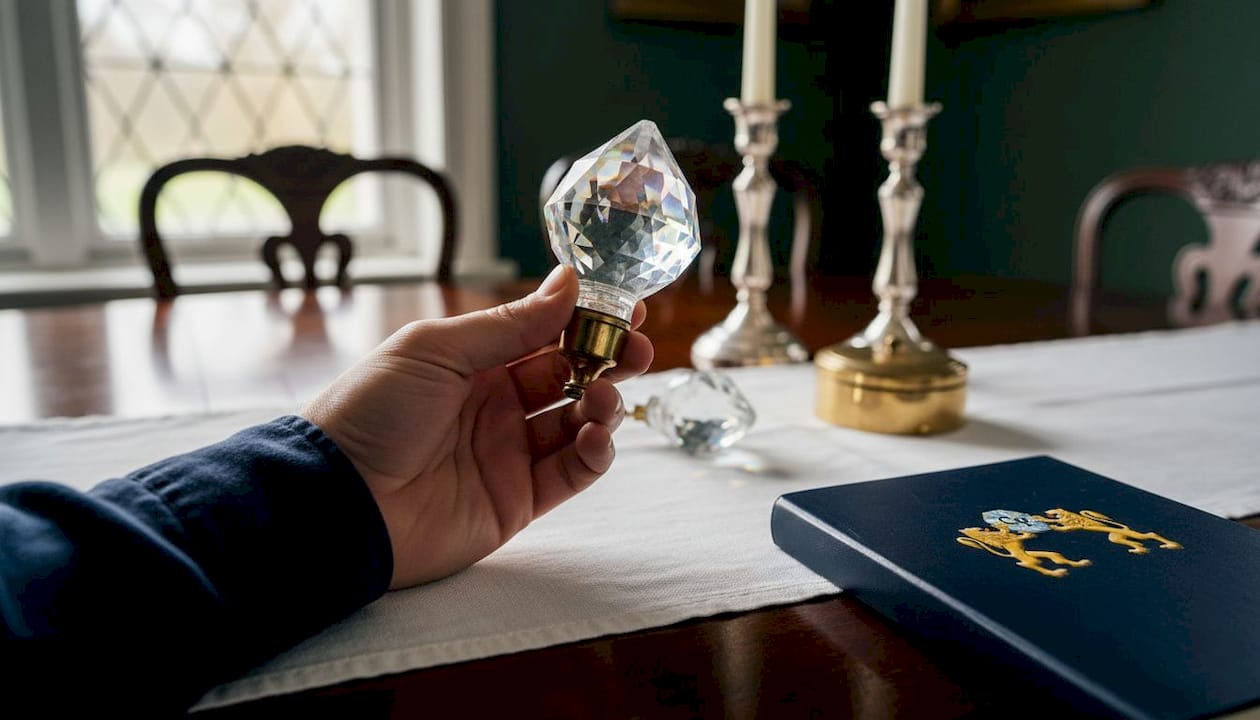
Pro Tip: If your chandelier is in a formal dining room or entryway, choose a finial that is at least proportional to the lowest arm tier. A finial that looks too small on a large fixture reads as an afterthought rather than a design choice.
The style categories where finials carry the most symbolic weight include:
- Traditional and classical designs: Urn, acorn, and pine cone shapes signal heritage and permanence.
- Crystal and Venetian glass designs: Teardrop, spear point, and egg shapes emphasize light refraction and artisan skill.
- Art Deco and mid-century designs: Geometric cones and stepped shapes signal modernity and precision.
- Transitional designs: Softened geometric forms that bridge traditional and modern, communicating versatility.
One detail that often surprises decorators: the finish on a metal finial carries as much weight as its shape. A bright brass finish on a traditional chandelier reads differently from an antique brass finish on the exact same shape. Bright brass feels formal and even grand. Antique brass feels warm, lived-in, and historically authentic. This is the level of nuance that separates a polished interior from one that just has nice furniture.
For a practical guide to selecting the right look for your space, the finials for sale guide offers curated options organized by style category, making it easier to match aesthetics without second-guessing.
Varieties of chandelier finials: Styles and materials
With their meaningful role established, it is time to discover the array of finial styles and materials you can use to your advantage.
Materials make an enormous difference in how a finial performs under light. Crystal finials, particularly those made from genuine lead-free crystal or authentic Swarovski material, scatter incoming light in all directions, adding a secondary layer of sparkle below the main fixture. Glass finials from traditional Venetian makers have a softer glow, less prismatic but warmer and more organic. Metal finials do not transmit light at all, so they read as solid sculptural accents, grounding the fixture visually rather than adding luminosity.
| Material | Light behavior | Best suited for | Maintenance level |
|---|---|---|---|
| Crystal (Swarovski/lead-free) | High refraction, prismatic | Formal dining, entryways | Low to moderate |
| Venetian hand-blown glass | Soft glow, warm tone | Traditional, European styles | Delicate handling |
| Brass or bronze metal | No light transmission | Industrial, traditional, transitional | Polish occasionally |
| Composite or resin | Minimal | Budget replacements | Easy |
As noted in the HandWiki chandelier reference, Venetian glass chandeliers feature additional small finials hanging from glass rings on the arms, not just the central stem. This layered approach creates a cascading decorative effect that is very difficult to replicate with other styles. The arm finials on a Venetian piece are not identical to the central finial; they are scaled down versions that maintain visual consistency without overwhelming the arms themselves.
Here is a numbered guide to navigating your material and style options:
- Start with your chandelier’s dominant material. A brass and crystal chandelier almost always calls for a crystal or metal finial, not a resin substitute.
- Consider scale before style. A large, dramatic fixture can support a bold four-inch crystal spear point. A smaller bedroom chandelier looks best with a two-inch teardrop or a simple metal cap.
- Match the finish to the existing hardware. The neck fitting, arm tips, and canopy should all speak the same metallic language as the finial.
- Test light behavior before committing. If possible, hold a crystal finial candidate beneath your fixture with the light on. The interaction between the bulb’s light and the crystal will tell you immediately whether it elevates or competes.
Pro Tip: When replacing finials on a Venetian chandelier, order one extra to keep on hand. The glass connections on arm finials are more vulnerable to vibration damage than center stem attachments, and having a spare prevents a visible gap in the design for months while you wait on a reorder.
For those navigating a repair or restoration project, the arm replacement parts guide covers compatibility specifics that save significant time and prevent costly mismatches.
How to choose and use chandelier finials in your home
With so many options, applying your knowledge to real spaces is the final step. Here is how you can make informed choices that hold up over time.
Before purchasing any finial, examine the bottom of your chandelier’s central stem carefully. The threading on the stem determines what will fit. Most American-made chandeliers use standard threading, but imported European fixtures, especially older French and Italian pieces, often use metric threading that will not accept standard American replacements without an adapter.
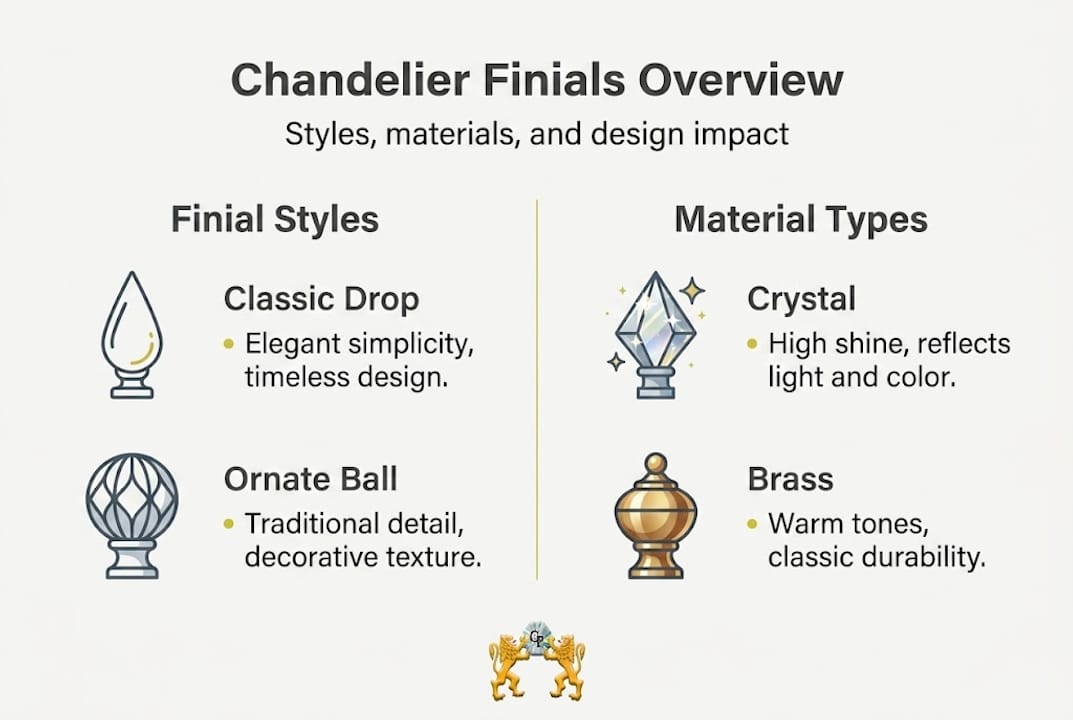
Here is a comparison to keep in mind when shopping:
| Situation | What to check | Common mistake |
|---|---|---|
| Replacing a lost finial | Thread size and stem diameter | Buying by look alone without measuring |
| Upgrading for style | Scale relative to overall fixture height | Choosing too small on a tall fixture |
| Venetian arm finials | Glass ring diameter and connection type | Assuming all arm finials are interchangeable |
| New installation | Coordinating finish with canopy and arms | Selecting finial last minute after ordering everything else |
The installation process itself is simpler than most people expect. For a center stem finial, you thread it clockwise onto the stem until it sits flush. The one mistake people make is overtightening, which can crack crystal or hairline-fracture glass finials. Hand-tight is almost always enough when combined with a small rubber washer to prevent wobble.
Follow this sequence for a clean result:
- Confirm thread compatibility before starting.
- Clean the stem tip with a dry cloth to remove any residue.
- Place a small rubber or silicone washer on the stem before threading the finial.
- Thread clockwise by hand until snug.
- Do not use tools. Hand pressure is sufficient for all crystal and glass finials.
As the Chandeliers: Master Class resource points out, Venetian arm finials add layered decoration but require secure attachment specifically to prevent detachment in high-vibration environments. If your home experiences regular vibration from foot traffic on upper floors or nearby HVAC equipment, use a tiny drop of removable thread-locking compound on arm finial fittings to keep them in place without making future removal impossible.
One of the most underrated benefits of understanding finials is the ability to refresh a dated chandelier without replacing the entire fixture. Swapping out a tarnished brass acorn for a fresh crystal teardrop costs a fraction of a new chandelier and can shift the entire feel of a room. See the finial replacement guide for detailed compatibility advice before you buy.
A fresh perspective: Why finials are the hidden signature of chandelier style
Here is something most decorating guides never say directly: a mismatched finial is often more visually damaging than a missing one. When the finial is clearly wrong, perhaps a chunky brass acorn on a delicate crystal chandelier, it draws the eye downward in the worst way. The viewer senses that something is off without being able to name it. That low-grade visual confusion undermines every other design decision in the room.
We have seen it happen in rooms that were otherwise impeccably designed. A client spends months selecting the right chandelier, the right table, the right drapes, and then accepts whatever generic finial arrived with the fixture. The room never quite feels finished, and no one can explain why.
The finial is your last word on the subject. It signals whether you paid attention all the way to the bottom, literally. Choosing a genuine crystal finials and elegance option over a default metal cap is a small decision with outsized visual returns. Decorators who understand this treat the finial with the same deliberateness as the fixture itself. That is the level of attention that makes a space feel complete rather than assembled.
Explore crystal chandelier finials and décor upgrades
You are now equipped to spot and select the perfect chandelier finial. Finding genuine quality options is the next step, and that is exactly where Crystal Place has specialized since 1991.

Crystal Place carries a carefully curated selection of authentic crystal and glass finials, sourced directly from trusted brands including Swarovski. Whether you are restoring a vintage piece, upgrading a builder-grade fixture, or sourcing parts for a custom installation, you will find options that match both the aesthetic and the mechanics of your chandelier. Explore the full range of crystal prisms for chandeliers and related décor pieces, all with free shipping on orders over $22 within the USA. The right finishing detail is closer than you think.
Frequently asked questions
Where is a chandelier finial located?
A chandelier finial is located at the very bottom of the chandelier’s central stem, serving as the decorative terminus of the entire fixture.
Are chandelier finials structurally important or just decorative?
Finials are primarily aesthetic in purpose, providing a finished and polished look at the fixture’s end point, though they occasionally help secure stem components in place.
What materials are most common for chandelier finials?
Crystal, glass, and metal are the most widely used materials, with composite or resin used in budget applications. Venetian styles, as noted in engineering references, feature hand-blown glass finials that are specific to that design tradition.
What’s special about Venetian chandelier finials?
Venetian chandeliers feature small finials on the arms, hung from glass rings for layered decoration, which requires especially secure attachment to prevent loosening from vibration over time.
Recommended
- Chandelier Finials Explained: Crystal Elegance for Home Lighting – CrystalPlace
- Chandelier Finial Replacement That Fits Right – CrystalPlace
- Crystal Chandelier Finials for Sale Guide – CrystalPlace
- Add Sparkle to Your Lamps with Crystal Lamp Finials – CrystalPlace