

Discover how crystal clarity explained can enhance your designs. Learn about light transmission and choose the perfect crystal for your project!
TL;DR:
- Crystal clarity measures a crystal’s internal cleanliness and directly impacts its light transmission and brilliance. High-clarity crystals, formed under stable, pure conditions, transmit up to 95% of light, making fixtures more dazzling; cloudy specimens transmit only 10 to 30%. Evaluating clarity involves inspecting light passage and internal features, with the eye-clean standard serving as a practical threshold for decorative use.
Crystal clarity is defined as the degree to which a crystal transmits light unobstructed, determined by the presence or absence of internal inclusions, air bubbles, and mineral impurities. This property sits at the center of every decision you make when choosing crystals for chandeliers, decorative prisms, or optical applications. Whether you are a homeowner selecting chandelier drops or a lighting professional specifying optical components, understanding crystal clarity explained in full gives you a measurable advantage. It separates a fixture that dazzles from one that simply hangs.
What is crystal clarity and how does it form?
Crystal clarity is rooted in the internal growth history of a specimen, not its surface appearance. The conditions present during formation, specifically temperature stability, the purity of mineral solutions, and the speed of crystal growth, determine whether a crystal grows clear or cloudy. Stable formation conditions that allow slow, uninterrupted growth produce crystals with few or no internal obstructions. Rapid growth or fluctuating temperatures force foreign particles into the lattice, creating the inclusions that scatter light.

The types of inclusions matter as much as their quantity. Air bubbles, liquid pockets, and mineral deposits each scatter light differently. A crystal with dense mineral inclusions will appear milky or opaque, while one with scattered micro-bubbles may show a soft, diffuse glow. Clear quartz, the benchmark for natural crystal clarity, is a colorless, transparent mineral with a Mohs hardness of 7 and a vitreous luster, valued precisely because its formation conditions consistently produce low-inclusion specimens.
The practical consequence of these formation differences is dramatic. Clear crystals transmit 90 to 95% of light, while cloudy specimens transmit only 10 to 30%. That gap means a cloudy chandelier crystal does not simply look less brilliant. It actively blocks the light your fixture was designed to distribute.
Key formation factors that determine clarity include:
- Temperature stability: Consistent temperatures during growth prevent stress fractures and inclusion trapping.
- Solution purity: Mineral-rich or contaminated growth solutions deposit foreign material inside the crystal lattice.
- Growth speed: Slow crystallization allows the lattice to form without capturing impurities.
- Post-growth conditions: Rapid cooling after formation can introduce internal fractures even in otherwise clean crystals.
Pro Tip: Use a 10x jeweler’s loupe to inspect any crystal before purchase. Hold it against a light source and look for clouds, veils, or needle-like inclusions. A truly high-clarity crystal will show an uninterrupted transmission of light with no visible scatter.
How does clarity differ from transparency and gemstone grading?
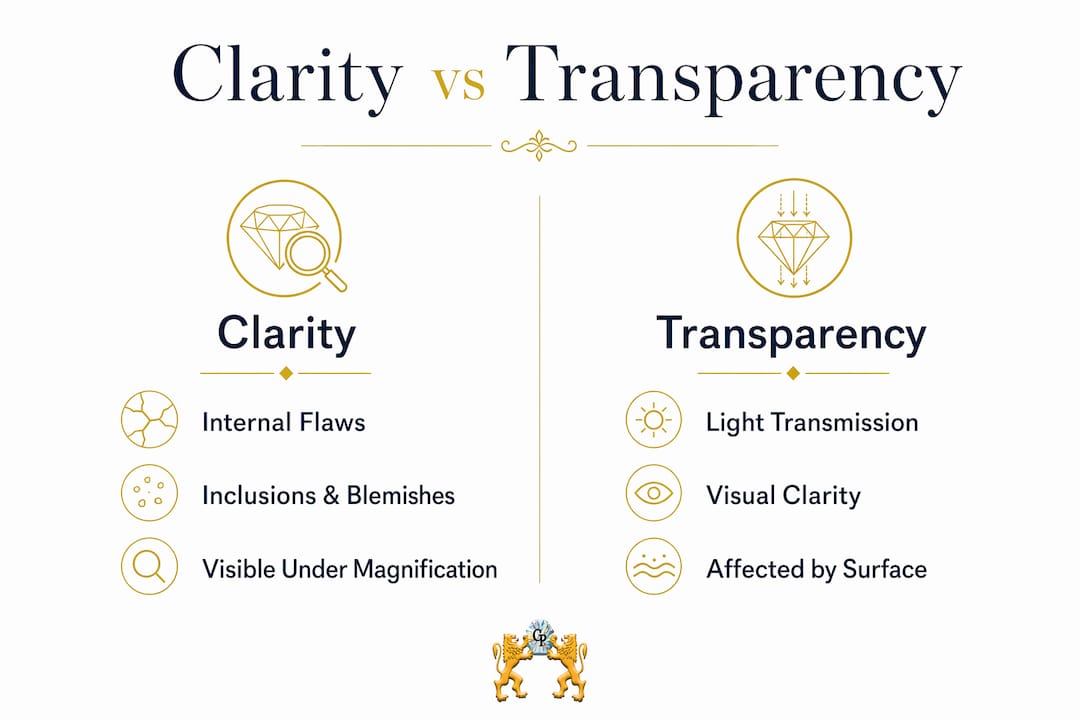
Clarity and transparency are related but measure different things, and confusing them leads to poor purchasing decisions. Clarity refers specifically to the absence of internal flaws: inclusions, fractures, and blemishes within the crystal structure. Transparency refers to how much light passes through the material regardless of internal flaws. A crystal can score well on one measure and poorly on the other.
Diamond clarity grading focuses on assessing inclusions and blemishes under 10x magnification and is not a direct measure of light transmission or transparency. A diamond can carry an excellent clarity grade yet appear hazy or dull because its transparency is compromised by a phenomenon called “milkiness,” which is unrelated to inclusions. This distinction matters when you are evaluating decorative crystals: a piece may be technically inclusion-free yet still fail to deliver the sparkle you expect.
The eye-clean concept defines stones with no inclusions visible to the naked eye, and it offers a practical framework for non-gemologists. For chandelier crystals and decorative prisms, eye-clean is the minimum standard worth paying for. Chasing laboratory-grade clarity in a decorative context adds cost without adding visible benefit.
The table below clarifies the core distinctions:
| Property | What it measures | Practical implication |
|---|---|---|
| Clarity | Internal inclusions and blemishes | Affects sparkle, brilliance, and perceived cleanliness |
| Transparency | Degree of light passage through the material | Determines how much light a crystal transmits |
| Eye-clean standard | Inclusions invisible to the naked eye | Practical threshold for decorative and jewelry use |
| Refractive index | How much light bends when entering the crystal | Influences prismatic effects and perceived brilliance |
Refractive index adds another layer to the picture. Sapphire carries a refractive index of approximately 1.76, while fused quartz sits near 1.46. That difference means sapphire produces higher Fresnel reflection losses and requires anti-reflection coatings in precision optical applications. For decorative use, a higher refractive index generally produces more dramatic prismatic effects, which is why leaded crystal and Swarovski glass have historically outperformed standard glass in chandelier applications.
How crystal clarity affects lighting, optics, and design
Clarity is the single most consequential factor in how a crystal performs inside a lighting fixture. A high-clarity prism placed in a chandelier acts as a light multiplier, bending and dispersing beams into the room. A low-clarity prism absorbs and scatters that same light internally, producing a dull, flat result. The difference is visible from across a room.
Lighting designers and interior decorators who work with crystal fixtures rely on clarity to predict performance. The core principles are:
- Backlighting clear crystals highlights their transparency and allows prismatic dispersion to fill the surrounding space. This is the standard approach for chandelier drops and hanging prisms.
- Front lighting cloudy crystals emphasizes their internal patterns and textures rather than transmission. This works for decorative accent pieces where the inclusion pattern is the visual feature.
- Refractive index determines color dispersion. Higher-index materials split white light into a wider spectrum, producing the rainbow effects associated with premium crystal.
- Birefringence affects perceived clarity under directional light. Sapphire is birefringent, meaning its refractive indices differ by polarization and orientation, while fused quartz is isotropic with no polarization dependence. This optical anisotropy changes how clarity appears under different lighting angles.
The illumination technique you choose should always match the clarity profile of the crystal. Placing a cloudy specimen in a backlit chandelier position wastes the fixture’s potential and highlights the crystal’s limitations rather than its character. Matching light direction to clarity type is one of the most overlooked skills in decorative crystal selection.
For optical applications such as windows, lenses, and precision instruments, clarity requirements are even stricter. Any inclusion that scatters light introduces noise into the optical path. This is why optical-grade quartz and sapphire windows are grown under tightly controlled laboratory conditions rather than sourced from natural deposits.
Pro Tip: When selecting chandelier crystals for lighting, hold each piece against a single-point light source before installing it. A high-clarity crystal will project a clean, defined beam. A low-clarity piece will produce a diffuse glow with no defined projection.
How to assess and select crystals for clarity
Assessing clarity without laboratory equipment is straightforward once you know what to look for. The goal is to evaluate how light moves through the crystal, not just how it looks under ambient room lighting.
- Use a single directional light source. A flashlight or a single LED held directly behind the crystal reveals internal features that ambient light conceals. Clouds, veils, and fractures become immediately visible.
- Rotate the crystal slowly. Some inclusions are only visible from specific angles. A full 360-degree rotation under direct light catches features that a static inspection misses.
- Compare against a known reference. If you are buying multiple pieces for a chandelier, compare each one against a reference crystal you have already approved. Consistency matters as much as individual quality.
- Check for surface scratches separately. Surface blemishes affect appearance but not internal clarity. Distinguish between the two before making a judgment.
- Consider the application before setting a clarity threshold. A suncatcher prism viewed in direct sunlight can tolerate minor inclusions that would be unacceptable in a precision optical window.
Maintenance preserves clarity over time. Dust, fingerprint oils, and mineral deposits from hard water all reduce surface transmission and mimic the appearance of internal cloudiness. Regular cleaning with a purpose-built solution, such as those available through Crystalplace, restores surface transmission without affecting internal clarity. You can read more about preserving crystal clarity with proper cleaning techniques.
The most common misconception in clarity evaluation is treating all cloudy crystals as inferior. Cloudiness is a defect in a chandelier prism. In a collector specimen or a decorative accent piece, the same internal structure can be the primary source of visual interest. Context defines the standard.
Key takeaways
Crystal clarity is the measure of internal cleanliness, and it directly controls how much light a crystal transmits, how brilliantly it performs in a fixture, and how it should be lit for maximum visual effect.
| Point | Details |
|---|---|
| Clarity vs. transparency | Clarity measures internal flaws; transparency measures light passage. Both affect performance. |
| Formation determines clarity | Slow growth in stable, pure conditions produces high-clarity crystals with minimal inclusions. |
| Light transmission gap | Clear crystals transmit 90 to 95% of light; cloudy crystals transmit only 10 to 30%. |
| Match lighting to clarity | Backlight clear crystals for prismatic effects; front-light cloudy ones to show internal texture. |
| Eye-clean is the practical standard | For decorative and chandelier use, inclusions invisible to the naked eye are the threshold that matters. |
Why clarity context matters more than clarity grade
Most people shopping for crystal products focus on the word “clear” and assume it settles the question. After years of working with decorative crystal, I have found that clarity without context is nearly meaningless. A crystal rated flawless under magnification can still disappoint in a chandelier if its refractive index is low or its cut is poor. Conversely, a crystal with minor inclusions, cut precisely and placed in the right lighting position, can outperform a technically superior specimen.
The distinction between clarity and transparency is the one I see misunderstood most often. Buyers assume a clear-looking crystal transmits light well. That is not always true. A piece can appear clean to the eye yet carry a structural quality that limits transmission. This is why Crystalplace sources from Swarovski and other authenticated manufacturers rather than relying on visual inspection alone. The difference between glass and crystal comes down to exactly these material-level properties, not just surface appearance.
My practical advice: define your use case before you define your clarity standard. For a statement chandelier in a dining room, high clarity and a strong refractive index are non-negotiable. For a suncatcher in a window, a crystal with interesting internal features can produce effects that a flawless piece never would. Clarity is a tool, not a trophy.
— BCC
Explore high-clarity crystal prisms at Crystalplace

Crystalplace has sourced authentic, high-clarity crystal products directly from Swarovski and verified manufacturers since 1992. The selection of crystal prisms for chandeliers covers everything from standard chandelier drops to precision-cut hanging prisms designed to maximize light dispersion in residential and commercial spaces. Every piece is selected for the clarity and refractive quality that makes a real difference in how your fixture performs. Free shipping applies to all U.S. orders over $22. Browse the full collection and find the right clarity grade for your specific lighting project.
FAQ
What is the crystal clarity definition?
Crystal clarity is defined as the degree to which a crystal is free from internal inclusions, air bubbles, and mineral impurities that obstruct light transmission. Higher clarity means more light passes through the crystal unobstructed.
How do inclusions affect crystal clarity?
Inclusions scatter and absorb light inside the crystal, reducing transmission from the 90 to 95% range seen in clear specimens down to as little as 10 to 30% in heavily included or cloudy crystals. The type, size, and density of inclusions all influence the severity of this effect.
What is the difference between clarity and transparency in crystals?
Clarity refers to the absence of internal flaws such as inclusions and fractures. Transparency refers to how much light the material passes regardless of flaws. A crystal can have excellent clarity yet poor transparency due to material-level properties unrelated to inclusions.
How do I assess crystal clarity without special equipment?
Hold the crystal against a single directional light source such as a flashlight, then rotate it slowly through a full 360 degrees. Clouds, veils, and fractures become visible as the light angle changes. Compare multiple pieces against a reference specimen for consistent results.
Why does crystal clarity matter for chandeliers?
Chandelier crystals with high clarity transmit and refract light efficiently, producing the prismatic effects and room-filling brilliance that make a fixture visually striking. Low-clarity crystals absorb and scatter light internally, resulting in a dull, flat appearance regardless of fixture quality.
Recommended
- Crystal lighting benefits: 30% brighter, elegant interiors – CrystalPlace
- Crystal lighting: 30% more brilliance for your space – CrystalPlace
- Crystal Prism Basics: Lighting, Decor, and Brilliance – CrystalPlace
- Crystal Bead Types: Enhance Lighting and Style with Informed Choices – CrystalPlace