

Discover how crystal prisms transform home lighting and mood. Learn placement strategies, material tips, and expert advice to create stunning rainbow effects indoors.
TL;DR:
- Crystal prisms disperse sunlight into vibrant rainbows, enhancing room mood and energy.
- Proper placement near south or west windows and matte white surfaces maximize color projection.
- High-quality materials like Swarovski and precise cuts produce more vivid and defined rainbow effects.
Crystal prisms are easy to overlook as simple ornaments, but they do something no paint color or furniture piece can replicate. They pull ordinary sunlight apart and scatter it across your walls as living, moving color. A single well-placed prism can shift the entire mood of a room within minutes of sunrise. This guide covers the real science behind that effect, practical placement strategies, how to choose quality pieces, and how prisms influence your emotional experience of a space. Whether you are decorating a living room or refreshing a home office, what follows will change how you think about light.
Key Takeaways
| Point | Details |
|---|---|
| Transforms light and mood | Crystal prisms turn sunlight or LEDs into vibrant rainbows, uplifting ambiance and emotional energy. |
| Placement influences effect | Strategic placement is crucial for capturing sunlight or maximizing artificial light for vivid results. |
| Quality matters most | High-grade materials and precise cuts produce brighter, sharper rainbow displays than larger but poorly cut prisms. |
| Design goes beyond aesthetics | Crystal prisms impact color, emotion, and holistic room energy as well as visual appeal. |
The science behind crystal prisms and light
To truly understand why crystal prisms matter, let’s look at how light interacts with them. White light, the kind streaming through your windows, is actually a mix of every color in the visible spectrum. When that light enters a crystal prism, it slows down. Different wavelengths slow at different rates, and that difference is what bends each color at a slightly different angle. The result is dispersion, the physical separation of white light into its component colors.
This is the VIBGYOR effect: violet, indigo, blue, green, yellow, orange, and red, each bending just enough to split apart and project onto nearby surfaces. Crystal prisms refract light through dispersion, separating white light into spectral colors due to varying refractive indices for different wavelengths, creating rainbows that enhance room ambiance. That last part matters more than most people realize. A rainbow on a white wall is not just pretty. It signals movement, warmth, and life in a way that static decor simply cannot.
The prism’s shape plays a major role in how dramatic the effect becomes. A triangular prism with a sharp apex angle spreads colors over a wide arc. A rounder, faceted prism like a chandelier drop scatters light in multiple directions at once, creating dozens of small rainbow patches rather than one long band. Both approaches work beautifully depending on your goal.
“The geometry of a prism is not decoration. It is engineering. Every angle is a decision about where the light goes.”
Here is a quick breakdown of how prism shape affects the light output:
| Prism shape | Light output | Best use |
|---|---|---|
| Triangular | Single wide rainbow arc | Feature walls, studios |
| Faceted teardrop | Multiple scattered patches | Living rooms, bedrooms |
| Octagonal | Broad multi-directional spread | Large open spaces |
| Sphere/ball | 360-degree projection | Ceiling and floor effects |
Exploring the types of crystal prisms available helps you match the right geometry to your room’s layout and lighting goals before you buy.
Optimizing prism placement for maximum impact
Knowing the science, let’s move to where and how to place your prisms for the most stunning results. Placement is honestly where most people go wrong. They hang a beautiful prism in a corner that never gets direct light and wonder why nothing happens.
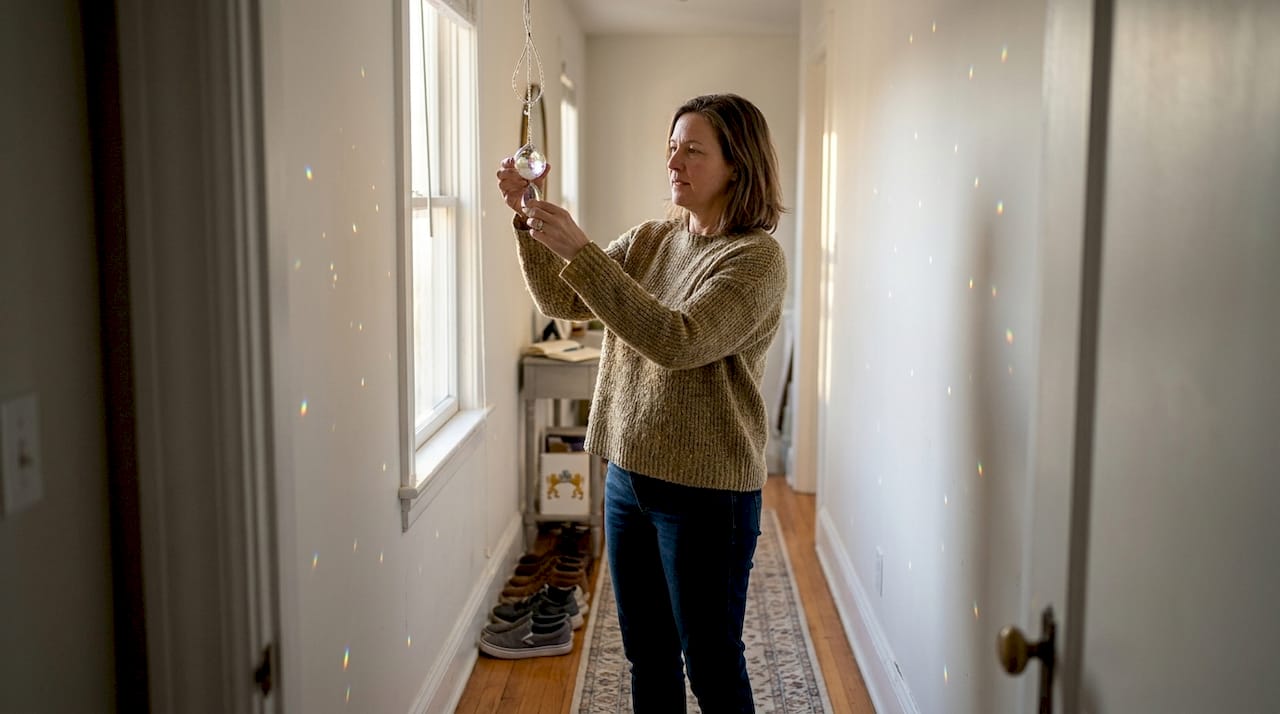
Optimal placement means positioning prisms near south or west-facing windows for direct sun in the morning and afternoon. A 60-degree apex angle maximizes dispersion, and north-facing windows without supplemental light will underperform. South and west windows deliver the strongest, most consistent direct sunlight throughout the day, giving your prisms the raw material they need.
Here are the key placement factors to keep in mind:
- Window direction: South and west exposures provide the most direct sunlight for active rainbow projection
- Height: Hanging prisms at eye level or slightly above creates rainbows on walls and ceilings rather than the floor
- Distance from wall: Prisms 12 to 24 inches from a surface produce sharper, more defined color bands
- Room color: Matte white or light neutral walls show rainbows with the highest contrast and saturation
- Ceiling height: Higher ceilings allow rainbows to travel farther and spread wider
For rooms that lack strong natural light, high-CRI LED bulbs rated at 95 or above can substitute effectively. Standard LEDs often lack the full spectrum needed to trigger vivid dispersion, so CRI rating matters a great deal here.
Statistic: Rooms with CRI 95+ lighting show measurably richer color rendering compared to standard 80 CRI fixtures, which makes a real difference when using prisms with artificial light sources.
Pro Tip: Paint one accent wall in flat white before hanging your prisms. Glossy or textured surfaces scatter the rainbow unevenly, while matte white acts like a projection screen and amplifies every color band.
For creative ideas on how to hang and layer prisms throughout your home, the hanging crystal prism decor ideas resource covers room-by-room strategies. You can also explore decorating with hanging prisms for inspiration on combining multiple prism types in a single space. A good prism selection guide will help you match prism geometry to your specific window orientation.
Choosing quality: Material, cut, and color nuances
Once your placement strategy is set, let’s tackle how to choose prisms that guarantee brilliance and beauty. Not all crystal is created equal, and the difference between a stunning rainbow and a dull smear of color often comes down to material and cut quality.
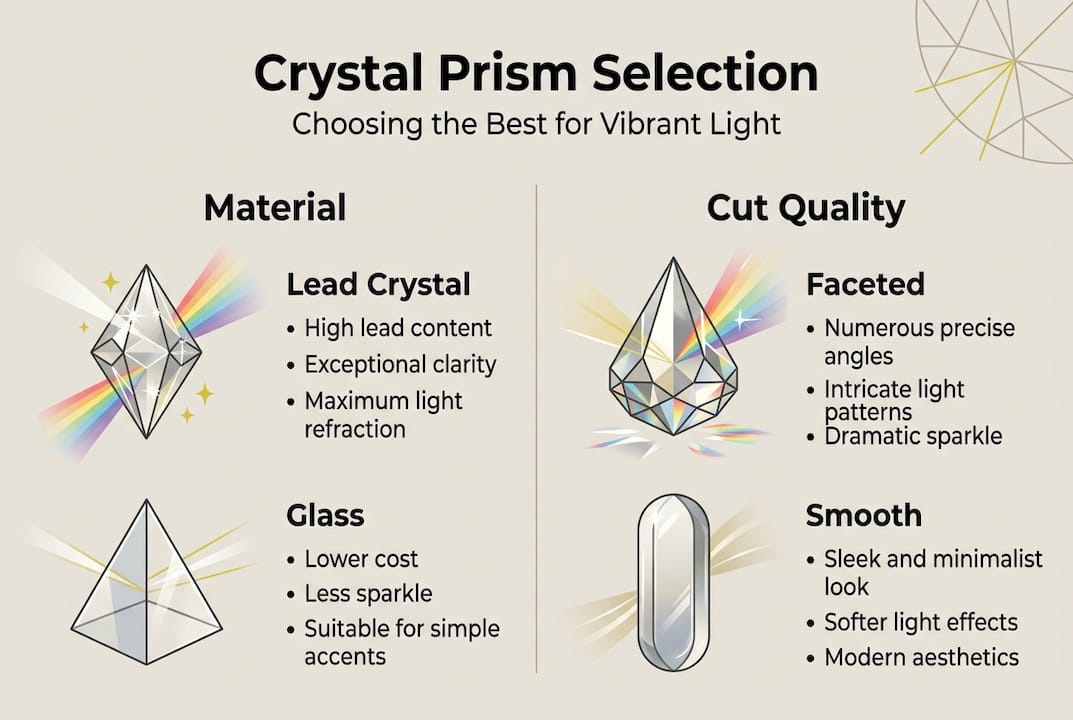
Here is how the main material types compare:
| Material | Refractive index | Rainbow quality | Price range |
|---|---|---|---|
| Swarovski crystal | Very high | Exceptional | Premium |
| Lead crystal | High | Excellent | Mid to high |
| Standard glass | Low | Moderate | Budget |
| Acrylic/plastic | Very low | Weak | Budget |
Facet precision and cut quality matter more than size. Swarovski and lead crystal deliver maximum brilliance, and clean matte-white surfaces amplify the rainbows they produce. A small, precisely cut Swarovski prism will outperform a large, poorly cut glass piece every single time.
Here is a simple process for evaluating prism quality before you buy:
- Check the edges: Sharp, clean facet edges indicate precision cutting. Rounded or uneven edges reduce dispersion quality.
- Look for clarity: High-quality crystal is water-clear with no visible bubbles or cloudiness.
- Test the weight: Real crystal and lead crystal feel noticeably heavier than glass or acrylic of the same size.
- Inspect the finish: Polished facets should reflect light cleanly, not scatter it in a dull, diffuse way.
- Verify the source: Authentic Swarovski pieces carry branding. Buying from reputable suppliers protects you from imitations.
Low light or shade reduces the effect, so using full-spectrum LEDs with CRI 95 or above helps in darker rooms. Larger spaces may need multiple prisms to distribute color effectively. Colored prisms filter mood beautifully: amber creates a cozy, warm atmosphere, while blue produces something more dramatic and cool. The tradeoff is that colored prisms reduce the full spectrum output, so you get mood over variety.
Pro Tip: Choose facets over size every time. A smaller prism with 32 precisely cut facets will throw more vivid, defined rainbows than a large prism with smooth or roughly cut surfaces.
For ready-to-hang options that combine quality and style, sun catcher prisms offer an accessible entry point. If you prefer something more compact, mini crystal prism suncatchers work beautifully in smaller windows and tight spaces.
Beyond aesthetics: Energy, mood, and holistic design
With technical and material details addressed, let’s see how crystal prisms improve more than just decor. They shape atmosphere and well-being in ways that go beyond visual appeal.
Moving light has a measurable effect on how people feel in a space. Rooms filled with dancing color feel more alive and energizing than static rooms, even when the furniture is identical. This is not just perception. Natural light variation throughout the day is linked to improved alertness and mood regulation.
Here is how different prism setups influence the feel of a room:
- Single large prism near a sunny window: Creates a focal point and a dramatic daily light show as the sun moves
- Multiple small prisms clustered together: Produces a layered, immersive effect that fills more of the room with color
- Colored prisms mixed with clear ones: Adds tonal variety, shifting from warm to cool depending on the angle of light
- Prisms at varying heights: Creates depth and dimension, making a room feel larger and more dynamic
“Whether you follow Feng Shui principles or prefer a purely physics-based explanation, the result is the same: rooms with active light feel better to be in.”
Feng Shui sees prisms activating chi and breaking stagnant energy, while physics-focused perspectives emphasize the optical mechanics. Both viewpoints agree on one thing: the mood uplift from light play is real and consistent. You do not need to subscribe to any particular philosophy to benefit from it.
For room-by-room strategies and creative applications, the guide on ways to use crystal prisms covers everything from entryways to home offices with practical, tested ideas.
What most guides miss about crystal prisms
Most articles about crystal prisms focus on one of two things: where to hang them or which product to buy. That is useful, but it misses the most rewarding part of working with prisms, which is the process of experimenting and adjusting over time.
Sun angles shift with the seasons. A prism that throws rainbows across your living room wall in June may project them onto the ceiling by December. That is not a problem. It is an opportunity. Moving a prism just a few inches, or rotating it slightly, can completely change where and how the light lands.
The best prisms for rainbow light are not always the most expensive ones. They are the ones you have placed thoughtfully and adjusted seasonally. Layering different cuts and colors in the same room creates a custom ambiance that no single product can achieve alone.
One insight that almost never appears in mainstream advice: matte-white surfaces are your most powerful tool. More than the prism itself, the surface it projects onto determines how vivid and defined the rainbow appears. Invest in the right wall finish before spending more on a larger prism.
Find your perfect crystal prism
Ready to transform your living space? Here’s how to make it happen.
At Crystal Place, we have been sourcing authentic Swarovski and premium crystal products since 1991, and we know how much the right prism can change a room. Whether you are starting with a single suncatcher or building out a full chandelier display, our selection is curated for quality and brilliance.
Browse our full range of crystal chandeliers and decor to find pieces that match your style and space. For an easy, high-impact starting point, our rainbow maker suncatchers are a customer favorite that deliver stunning results right out of the box. Free shipping on orders over $22 within the USA makes it easy to try something new without any risk.
Frequently asked questions
How do crystal prisms create rainbows indoors?
Crystal prisms separate white light into spectral colors through refraction and dispersion, projecting VIBGYOR rainbow effects onto nearby surfaces. The quality of the crystal and the precision of its cut determine how vivid those colors appear.
Where should I position crystal prisms for the best lighting effects?
Place prisms near south or west-facing windows for direct sunlight exposure, or use high-CRI LEDs rated at 95 or above as a supplement in rooms with limited natural light.
Does prism material or cut affect rainbow quality?
Yes. Facet precision and material quality both matter significantly. Swarovski and lead crystal with precisely cut facets produce brighter, more defined rainbows than standard glass or acrylic alternatives.
Can crystal prisms be used in rooms with little natural light?
Full-spectrum LEDs with CRI 95+ can activate prism effects in low-light rooms, though the results will be less intense than those produced by direct sunlight through a south or west-facing window.
Recommended
- Types of crystal prisms for stunning home lighting in 2026 – CrystalPlace
- Transform Your Space with Premium Crystal Prisms – CrystalPlace
- Crystal prism selection guide: elevate your lighting – CrystalPlace
- Crystal Prisms: Elevate Your Space with Elegance – CrystalPlace
- Top 7 advantages of marble lighting for elegant interiors – Marmorique