

Discover the ultimate guide to crystal shapes and learn how to choose, place, and appreciate these beautiful decor pieces in your home.
TL;DR:
- Crystal shapes originate from both natural mineral growth and human craftsmanship, each carrying unique visual and symbolic qualities. Recognizing their geological formation or processing helps in selecting, placing, and appreciating crystals effectively in decor or collection. Shape choices influence the energetic meaning and aesthetic impact, making understanding these forms essential for intentional use and display.
Crystal shapes are defined as the external geometric forms that crystals take, either through natural mineral growth or through human cutting and polishing for decorative use. This guide to crystal shapes covers both categories: the raw, geologically determined forms that minerals produce on their own, and the finished shapes that artisans create for home design, chandeliers, and personal collections. Understanding the difference between these two origins changes how you select, place, and appreciate every piece you own. Whether you are drawn to a raw amethyst cluster on a bookshelf or a Swarovski prism catching light in a window, the shape you choose carries both visual and symbolic weight.
What are the common natural crystal shapes and how do they form?
Crystal habit is the characteristic external shape a crystal develops during growth, determined by its internal atomic structure, chemical composition, and the physical conditions of its environment. Two crystals of the same mineral can look completely different if one grew slowly in an open cavity and the other was squeezed between layers of rock. This is why understanding habit is the foundation of any crystal structure guide worth reading.
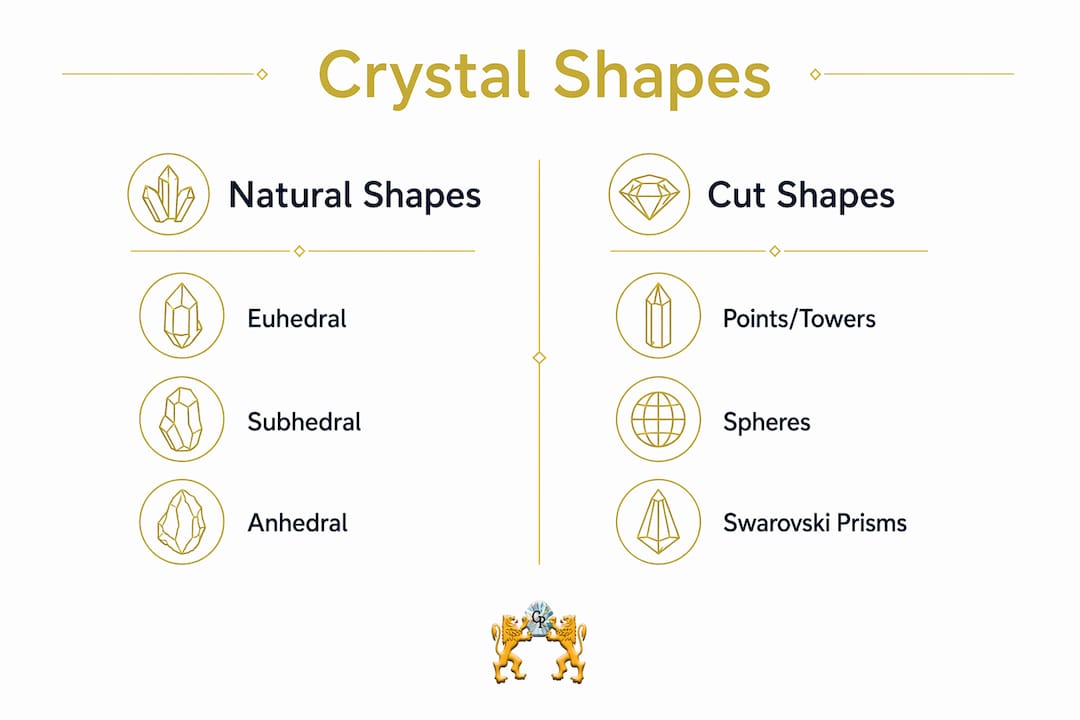
Geologists classify crystal habit quality into three categories. Euhedral crystals have fully developed, clearly defined faces. Subhedral crystals show partial faces where growth was interrupted. Anhedral crystals have no recognizable faces at all, appearing as irregular masses. Most decorative raw specimens fall somewhere between euhedral and subhedral, which is part of what makes each piece unique.
The seven crystal lattice systems govern the possible shapes any mineral can form. These systems are cubic, tetragonal, orthorhombic, hexagonal, trigonal, monoclinic, and triclinic. Each system corresponds to a distinct internal symmetry, which then produces recognizable external forms. Halite (table salt) grows in the cubic system, producing perfect little cubes. Quartz belongs to the trigonal system, which produces the six-sided prismatic columns collectors recognize instantly.
Common natural crystal forms include:
- Prismatic: Long, column-like crystals with parallel faces, typical of quartz and tourmaline
- Cubic: Blocky, equal-sided forms seen in pyrite and fluorite
- Tabular: Flat, plate-like crystals wider than they are tall, common in barite
- Dendritic: Branching, tree-like growths that look almost like frost on glass, seen in manganese minerals
- Acicular: Needle-thin crystals that grow in radiating sprays, found in rutile and natrolite
Pro Tip: When buying a raw crystal, look at the termination (the tip or end of the crystal). A clean, sharp termination usually signals euhedral growth, meaning the crystal had room and time to develop fully. Blunt or irregular ends suggest the crystal was crowded during growth.
Environmental growth constraints explain why natural irregularities are so common. A crystal growing inside a geode has more freedom than one compressed inside sedimentary rock. The result is that no two natural specimens are identical, which is precisely what makes raw crystals so appealing for personal collections.
Which crystal shapes are popular for decoration and how are they made?
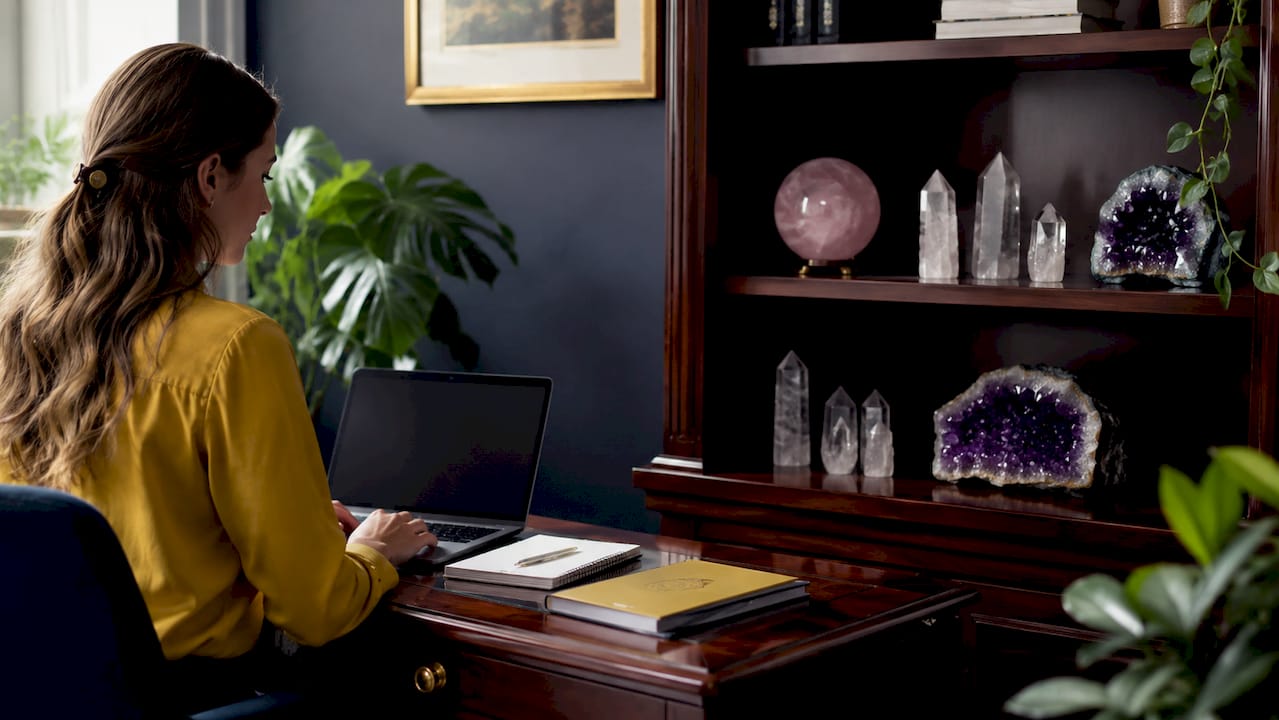
Decorative crystal shapes fall into two broad categories: those that form naturally and are sold as-is, and those that are shaped by human hands through tumbling, cutting, or polishing. Knowing which is which helps you make smarter choices for your home.
| Shape | Origin | Finishing Method | Best Use |
|---|---|---|---|
| Raw/rough crystal | Natural | None | Shelves, grounding displays |
| Tumbled stone | Natural mineral, shaped | Rotary tumbling with abrasive grit | Bowls, portable carry pieces |
| Point/tower | Natural or cut | Natural termination or machine cut | Focal points, windowsills |
| Sphere | Cut and polished | Lathe-turned and hand-polished | Tables, meditation spaces |
| Cluster | Natural | Minimal cleaning only | Centerpieces, ambient display |
| Heart | Cut and polished | Hand-carved and polished | Gifts, decorative accents |
Tumbled stones are smoothed by rotating rough mineral pieces in a drum with progressively finer abrasive grit over days or weeks. The result is a rounded, tactile shape that fits in your palm and works well in decorative bowls or as everyday carry pieces. Raw stones, by contrast, keep their original texture and fracture lines, offering a more intense visual connection to the mineral’s natural state.
Points and towers represent an interesting overlap. Natural single-terminated formations occur when a quartz crystal grows freely and terminates in a natural apex. Cut towers are produced by slicing a rough piece of mineral and grinding it into a uniform column with a polished point at the top. Both look similar on a shelf, but their geological stories are completely different.
Spheres require the most labor of any common decorative shape. A rough piece of mineral is ground down on a lathe, then hand-polished through multiple grades of abrasive until a perfect ball emerges. The process can take hours for a single piece, which explains why quality crystal spheres carry a higher price.
Pro Tip: For chandelier crystal shapes, precision cutting matters more than natural habit. A Swarovski prism is machine-cut to exact angles that maximize light refraction. The shape is entirely engineered, not geological.
What do different crystal shapes mean energetically?
Crystal shape meanings derive from energy-direction traditions rather than scientific measurement, making them powerful tools for personal practice and decor when understood as symbolic guidance rather than fixed fact. That distinction matters. You can fully enjoy the interpretive framework without needing to treat it as physics.
Practitioners organize shapes into five functional energy categories, and each category corresponds to specific forms:
- Directional shapes (points, wands): Believed to focus and project energy in a single direction, like a beam. Points are often placed facing outward to send energy or inward to draw it.
- Radiating shapes (spheres): Said to emit energy evenly in all directions, making spheres popular for rooms where you want balanced, ambient energy rather than a focused flow.
- Amplifying shapes (pyramids, clusters): Thought to intensify and broadcast energy outward. Clusters, with their many terminations pointing in multiple directions, are considered especially active.
- Grounding shapes (cubes, flat bases): Associated with stability and earth energy. Cubic crystals like pyrite or fluorite are often placed on desks or floors to anchor a space.
- Sacred geometry shapes (Merkaba stars, icosahedrons): Carry symbolic meaning tied to ancient geometric traditions and are used more for meditation or intentional display than ambient decor.
For home design specifically, this framework gives you a practical decision tool. A sphere on a dining table suggests warmth and openness. A point on a windowsill facing outward creates a visual and symbolic boundary. A cluster on a coffee table becomes both a conversation piece and a perceived energy hub.
Pro Tip: Pair a grounding cube-shaped crystal like pyrite with a radiating sphere of rose quartz on the same surface. The visual contrast is striking, and within the interpretive tradition, the combination balances active and stable energy in one display.
Hearts and palm stones carry their own meanings. Hearts are universally associated with affection and are among the most popular gift shapes. Palm stones, which are oval and flat, are tumbled to fit the curve of a hand and are used for tactile comfort during stress or meditation.
How to identify crystal shapes accurately
Identifying crystal shapes accurately requires separating two distinct questions: what mineral system produced this crystal, and what processing has it undergone since it left the ground? Conflating the two leads to misidentification and missed appreciation.
-
Start with the termination. A natural point has slight irregularities in its faces and edges. A cut point is perfectly symmetrical with uniform angles. Run your finger along the edges. Natural faces feel slightly uneven; machine-cut faces feel sharp and consistent.
-
Check the base. Natural clusters have an irregular matrix base where the crystals grew attached to host rock. Cut towers have flat, polished bases that were clearly sawn. This is the fastest way to distinguish the two.
-
Look at surface texture. Euhedral crystals show flat, reflective faces called facets that formed during growth. Tumbled stones have a smooth, matte-to-glossy surface with no flat faces. Polished spheres show a continuous, uninterrupted curve.
-
Assess symmetry. Natural crystals are rarely perfectly symmetrical. If a piece looks too perfect, it was almost certainly shaped by a machine. This is not a flaw. It simply tells you the shape was engineered for a specific decorative purpose, like a crystal prism for sparkle in a chandelier or suncatcher.
-
Research the mineral’s crystal system. Knowing that amethyst belongs to the trigonal system tells you it should naturally form six-sided prisms. If your amethyst is a perfect cube, it was cut that way. Collectors who understand the seven crystal systems can immediately recognize when a shape is natural versus manufactured.
A common pitfall is assuming that a more perfect-looking crystal is more valuable or more “natural.” The opposite is often true. A slightly irregular, euhedral quartz point with visible growth lines on its faces is a genuine geological specimen. A flawless tower was shaped by a craftsperson, which has its own value but a different kind of story.
Practical tips for choosing crystal shapes for your home
Matching crystal shapes to your actual space and decorating style is more useful than following any single rule about energy or geology. Here is how to think through your choices:
- For focal points: Choose a tower, large point, or sphere. These shapes have strong visual presence and hold attention. A 4-inch amethyst tower on a mantle reads as intentional and curated.
- For ambient texture: Clusters and raw specimens add organic complexity to a shelf or side table without demanding attention. They work well alongside books, plants, and other natural materials.
- For portability: Tumbled stones and palm stones are the right choice. They travel well, fit in pockets, and work in small spaces like a desk drawer or a bedside dish.
- For lighting enhancement: Faceted prisms, hanging crystal decor, and suncatcher shapes are specifically designed to interact with light. These are not geological specimens but engineered pieces that transform sunlight or chandelier glow into color and sparkle.
- For beginners: Start with two or three tumbled stones in minerals you find visually appealing, plus one statement piece like a small cluster or sphere. This gives you variety without overwhelming a space.
Care varies significantly by shape. Tumbled stones tolerate mild washing with water and gentle soap. Delicate clusters and water-soluble minerals like selenite require dry cleaning only. Polished spheres benefit from occasional buffing with a soft cloth to maintain their surface. Faceted crystal prisms can be cleaned with a crystal-specific cleaning solution to preserve their optical clarity.
Combining shapes intentionally creates more visual interest than using only one type. A cluster paired with a sphere and a small tower gives you three different silhouettes, three different textures, and three different light interactions in one grouping.
Key takeaways
Crystal shape selection becomes most effective when you understand both the geological origin and the decorative purpose of each form you choose.
| Point | Details |
|---|---|
| Natural vs. cut shapes | Natural habit forms during mineral growth; cut shapes are engineered for decorative or optical effect. |
| Seven crystal systems | The cubic, hexagonal, trigonal, and other systems determine what natural shapes a mineral can produce. |
| Energy direction framework | Points direct, spheres radiate, clusters amplify, cubes ground. Use this as a placement guide, not a rule. |
| Identification method | Check termination regularity, base texture, and symmetry to distinguish natural from processed shapes. |
| Care by shape type | Tumbled stones tolerate water; clusters and selenite require dry cleaning to preserve their structure. |
Why shape is the most underrated part of crystal collecting
Most people who start collecting crystals focus almost entirely on mineral type. They want amethyst, rose quartz, or obsidian. Shape becomes an afterthought. After years of working with decorative crystals and watching how people interact with their collections, I am convinced that shape matters more than mineral type for most decorative purposes.
A rose quartz sphere and a rose quartz raw chunk are the same mineral. They carry the same color and the same geological history. But they create completely different experiences in a room. The sphere reads as polished, intentional, and modern. The raw chunk reads as earthy, organic, and collected. Neither is better. They are just different design choices, and treating them as such gives you far more creative control.
I have also found that the energy interpretation framework, while not scientific, is genuinely useful as a design language. Saying “I want something that radiates energy in all directions” is a surprisingly clear brief for choosing a sphere over a point. The metaphor does real work even if the physics does not.
The one thing I would push back on is the tendency to treat cut shapes as somehow less authentic than natural ones. A Swarovski crystal prism is a masterpiece of optical engineering. A hand-carved crystal heart took skill and time to produce. These pieces have their own integrity. Understanding crystal shapes means appreciating both the geological and the human-made, without ranking one above the other.
— BCC
Explore premium crystal shapes at Crystalplace
Crystalplace has been sourcing authentic crystal products since 1992, with a catalog that spans everything from Swarovski prisms to hand-finished ornaments designed for chandeliers, suncatchers, and decorative displays. If this guide has clarified what shapes work best for your space, the next step is finding pieces cut to the precision that makes a real visual difference. Browse the full selection of premium crystal prisms to find shapes that match your decor goals, whether you are restoring a chandelier, building a windowsill display, or adding a focal point to a living room. Free shipping applies to orders over $22 within the USA.
FAQ
What is a crystal habit?
Crystal habit is the natural external shape a crystal develops during growth, determined by its internal atomic structure and environmental conditions. It can be euhedral (well-formed faces), subhedral (partial faces), or anhedral (no recognizable faces).
How do I tell a natural crystal point from a cut one?
Natural points have slight surface irregularities, uneven edges, and visible growth lines on their faces. Cut points are perfectly symmetrical with sharp, uniform angles and a flat sawn base.
What crystal shape is best for home decor?
Spheres work well for ambient display because they radiate energy evenly and have a clean, modern silhouette. Clusters add organic texture, while towers create strong focal points on shelves or mantles.
Are cut crystal shapes less valuable than natural ones?
Not necessarily. Cut shapes like Swarovski prisms are engineered for optical precision and carry their own craftsmanship value. Natural specimens are valued for geological authenticity. The two serve different decorative and collecting purposes.
How should I care for different crystal shapes?
Tumbled stones tolerate mild washing, while clusters and water-soluble minerals like selenite need dry cleaning only. Polished spheres and faceted prisms benefit from a soft cloth or a crystal-specific cleaning solution to maintain clarity and surface quality.
Recommended
- Crystal Ornament Types: A Home Décor Buyer’s Guide – CrystalPlace
- Crystal Decor Styling Tips for a Polished Home – CrystalPlace
- Crystal Clarity Explained: Properties, Light, and Design – CrystalPlace
- Crystal Octagon vs Almond Prisms – CrystalPlace