

Discover the different crystal types explained in this complete guide. Shop and decorate with confidence using our expert insights!
TL;DR:
- Natural crystals are minerals with ordered atomic structures classified into seven crystal systems, each producing distinct shapes. Manufactured crystal glass contains metallic oxides that increase brilliance and weight, differing from natural crystals in composition and internal features. Recognizing the differences helps in proper care, valuation, and choosing the right crystal for decorative or healing purposes.
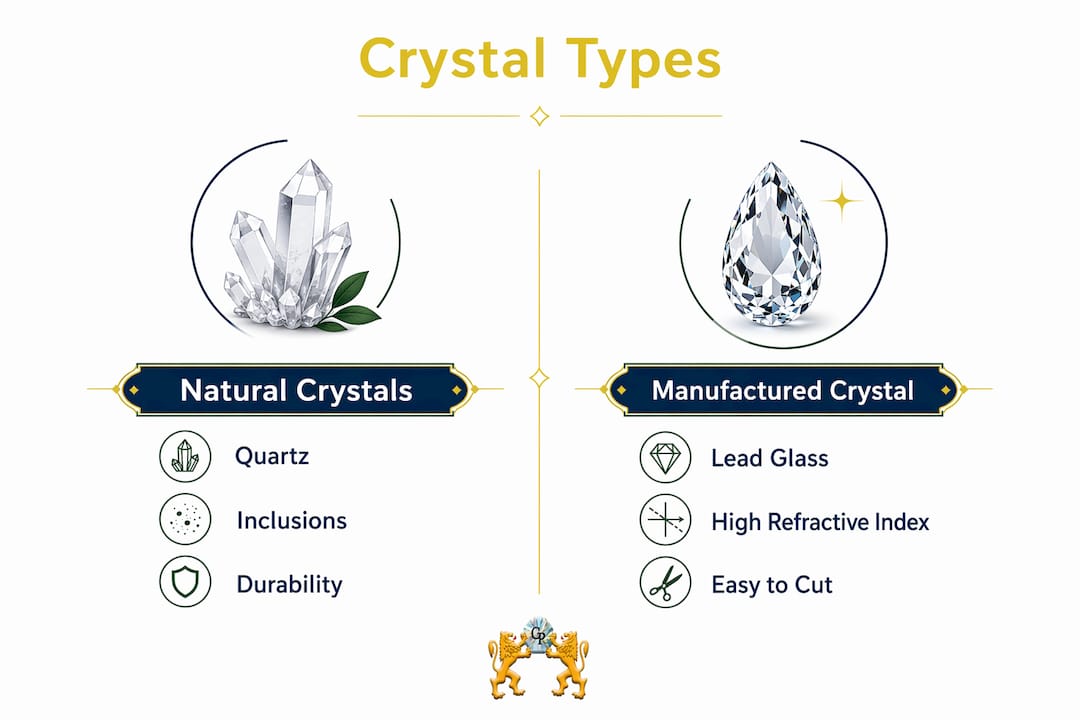
Crystal is defined as a solid material whose atoms are arranged in a repeating, ordered lattice structure. That definition covers both natural minerals like quartz and the manufactured glass products sold under the “crystal” label in decorative trades. The confusion between these two categories is widespread. In decorative markets, “crystal” more commonly refers to high-quality manufactured glass than to natural mineral crystals. This guide covers crystal types explained from both angles, so you can shop, collect, and decorate with confidence.
What are the main natural crystal types?
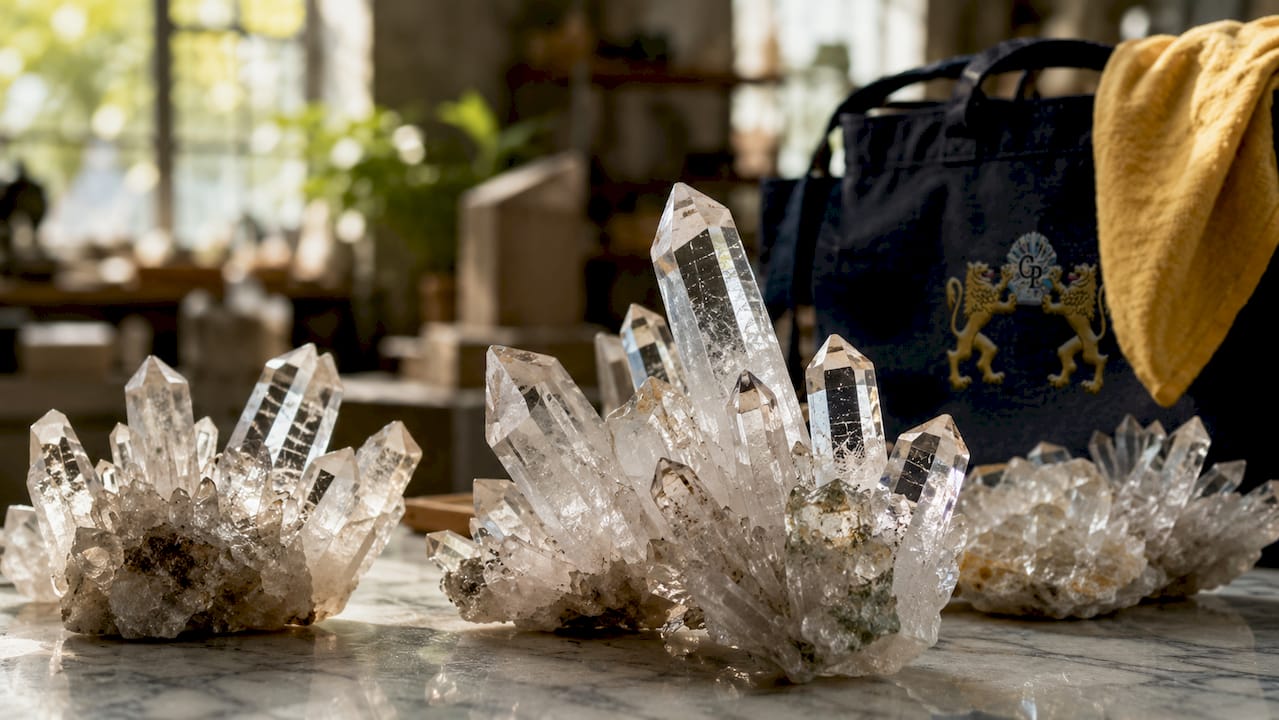
Natural crystals are minerals that form when atoms bond into repeating geometric patterns under heat, pressure, or slow cooling. The result is a solid with measurable symmetry, predictable cleavage planes, and consistent physical properties. Geologists classify all natural crystals into seven crystal systems: triclinic, monoclinic, orthorhombic, tetragonal, trigonal, hexagonal, and cubic. Each system describes a distinct set of symmetry rules and lattice angles.
The seven crystal systems and what they produce
Understanding these systems helps you recognize why different crystals look and behave so differently from one another.
- Cubic: Produces crystals with equal axes at 90-degree angles. Fluorite and garnet fall here. These crystals often appear as cubes or octahedrons.
- Hexagonal: Generates six-sided prisms. Emerald and aquamarine belong to this system. The cross-section looks like a stop sign.
- Trigonal: A subdivision of hexagonal, producing three-fold symmetry. Quartz, amethyst, and citrine all crystallize in the trigonal system. This is the most common system for popular decorative and healing stones.
- Tetragonal: Four-fold symmetry with two equal horizontal axes and one vertical axis of different length. Zircon and apophyllite form here.
- Orthorhombic: Three unequal axes all at right angles. Topaz and peridot are classic examples.
- Monoclinic: Two axes at right angles, one tilted. Moonstone and gypsum belong here.
- Triclinic: No right angles at all. Labradorite and kyanite form in this system, producing some of the most visually complex stones.
Key natural crystal varieties for enthusiasts
Rock crystal, the transparent variety of quartz, is pure silicon dioxide (SiO2) with a crystalline lattice. Natural rock crystal shows internal inclusions, veils, and growth lines that manufactured glass never replicates. Amethyst is purple quartz colored by iron impurities. Citrine is yellow to orange quartz, colored by heat or iron in a different oxidation state. Agate is a banded variety of microcrystalline quartz, prized for its layered color patterns.
Pro Tip: Hold a natural crystal up to light and look for internal “veils” or needle-like inclusions. These imperfections are proof of natural formation. Perfectly clear, bubble-free material with no inclusions is almost always manufactured glass.
How is manufactured crystal glass different from natural crystals?
Manufactured crystal glass starts with silica (SiO2) as its base, just like natural quartz. The critical difference is that glassmakers add metallic oxides during production to change the optical and physical properties of the final product. Lead crystal contains 24%–35% lead oxide by weight. Lead-free crystal substitutes barium oxide, zinc oxide, or potassium oxide to achieve similar effects without the toxicity concerns.
These additives increase the refractive index of the glass, which means light bends more sharply as it passes through. That bending produces the brilliant rainbow dispersion that makes crystal chandeliers and prisms so visually striking. The additives also increase density, giving crystal glass a noticeably heavier feel than ordinary soda-lime glass of the same size.
Comparing natural crystal, lead crystal, and ordinary glass
| Property | Natural quartz | Lead crystal glass | Ordinary glass |
|---|---|---|---|
| Composition | Pure SiO2 lattice | Silica + 24%–35% lead oxide | Silica + soda + lime |
| Structure | Crystalline (ordered lattice) | Amorphous (no lattice) | Amorphous (no lattice) |
| Refractive index | ~1.54 | ~1.56–1.70 | ~1.52 |
| Weight | Moderate | Heavy | Light |
| Scratch resistance | High (Mohs 7) | Lower (Mohs ~5–6) | Lower than quartz |
| Sound when tapped | Dull | Clear, sustained ring | Dull thud |
| Internal features | Inclusions, veils | Uniform, may show bubbles | Uniform |
| Primary use | Healing, decor, jewelry | Chandeliers, stemware, prisms | Everyday glassware |
Lead crystal rings with a clear, sustained tone when tapped. Ordinary glass produces a dull thud. That acoustic difference comes from the denser molecular structure of lead crystal compared to soda-lime glass. You can perform this test at home without any tools.
Pro Tip: Run a wet finger around the rim of a crystal glass. Lead crystal produces a singing tone; ordinary glass stays silent. This is the same principle as the ring test and works reliably for stemware and decorative bowls.
Lead crystal is easier to cut and polish than natural quartz because it is softer. That softness allows craftspeople to cut deeper, sharper facets, which produce brighter light dispersion. The trade-off is that those facets wear and scratch more easily over time than natural quartz surfaces.
What are the best uses for different crystal varieties?
The right crystal type depends entirely on what you want it to do. Natural and manufactured crystals each have clear strengths in both decorative and healing contexts.
Natural rock crystal creates a softer, organic luxury feel in interiors. Its warm light diffusion suits modern and minimalist spaces. Lead crystal glass produces sharp, lively brilliance that suits traditional glamour and formal rooms. Choosing between them is a question of the mood you want to create, not which material is objectively better.
Popular crystals and their applications
- Clear quartz (rock crystal): Used in suncatchers, healing grids, and minimalist decor. Culturally associated with clarity and amplification of intention.
- Amethyst: A popular healing stone linked to calm and focus. Works well as a decorative cluster on a desk or shelf.
- Citrine: Often called the “merchant’s stone” in crystal healing traditions. Its warm yellow color suits living rooms and kitchens.
- Agate: Sliced agate geodes make striking wall art and bookends. The banding patterns are unique to each piece.
- Lead crystal prisms: The standard material for chandelier crystals and hanging decor. They scatter rainbow light across walls and ceilings when sunlight or artificial light passes through them.
- Lead-free crystal: Used in contemporary lighting and stemware where lead content is a concern. Optical performance is close to lead crystal.
Crystalplace has supplied crystal prisms and decorative crystal components since 1992, sourcing directly from authentic crystal brands including Swarovski. The chandelier crystal options available cover everything from traditional lead crystal to modern lead-free alternatives, so you can match both your aesthetic and your practical requirements.
The healing use of crystals is a cultural and personal practice rather than a medically validated one. That said, the tactile and visual qualities of natural crystals, their weight, color, and texture, do contribute to the sensory experience that many enthusiasts value. Choosing a crystal for healing purposes is as much about personal resonance as it is about mineral classification.
How to identify and care for crystals at home
Identifying your crystal correctly before you clean or display it prevents damage. The methods below require no specialist equipment.
- Check the weight. Natural quartz and lead crystal both feel heavier than ordinary glass of the same size. If a piece feels surprisingly light, it is likely soda-lime glass.
- Look for inclusions. Hold the piece up to a bright light. Natural crystals show internal veils, needles, or growth patterns. Manufactured glass is uniform, though it may show small bubbles.
- Tap and listen. Tap the piece gently with a fingernail. Lead crystal rings clearly. Natural quartz and ordinary glass both produce a duller sound, though quartz has a slightly crisper response than soda-lime glass.
- Test scratch resistance. Natural quartz (Mohs hardness 7) scratches glass easily. If you can scratch a glass surface with the crystal’s edge, it is likely quartz or harder. Lead crystal glass scratches more easily than quartz.
- Look for rainbow dispersion. Hold the piece in direct sunlight. Lead crystal and high-quality lead-free crystal scatter vivid rainbow patterns. Natural quartz scatters light too, but the pattern is softer and less intense.
Caring for natural crystals versus manufactured crystal glass
Care practices differ significantly between natural stones and glass crystal. Natural crystals need gentle cleaning with a soft, damp cloth. Avoid harsh chemicals, which can damage surface finishes or react with mineral inclusions. Some natural stones, like selenite, dissolve in water and should never be submerged.
Manufactured crystal glass needs careful handling to protect its polished facets. Mild dish soap and warm water work well for most pieces. Avoid abrasive cloths, which scratch the softer glass surface. For chandelier crystals, Crystalplace recommends a no-rinse crystal cleaning spray that removes dust and oils without requiring disassembly. You can find detailed guidance in the crystal care guide for homeowners.
Pro Tip: Store natural crystals away from prolonged direct sunlight. Many colored stones, including amethyst and citrine, fade with extended UV exposure. Manufactured crystal glass is not affected by UV in the same way, but direct sun does highlight dust and water spots more visibly.
For jewelry with crystal components, proper care extends the life of both the setting and the stone. Resources like the jewelry care guide at Jewels By Ares offer practical advice that applies equally well to crystal-set pieces in your collection.
Key Takeaways
Knowing whether your crystal is a natural mineral or manufactured glass determines how you clean it, display it, and evaluate its value.
| Point | Details |
|---|---|
| Two distinct categories | “Crystal” covers both natural mineral crystals and manufactured glass with metallic oxide additives. |
| Seven natural crystal systems | All natural crystals fit one of seven systems; trigonal is the most common for popular decorative stones. |
| Lead crystal identification | Tap the piece: a clear, sustained ring indicates lead crystal; a dull thud indicates ordinary glass. |
| Care differs by type | Natural stones need gentle, chemical-free cleaning; manufactured crystal glass needs soft cloths and mild soap. |
| Inclusions confirm natural origin | Internal veils and growth lines prove natural formation; uniform, inclusion-free material is manufactured glass. |
Why getting crystal types right actually matters
The crystal industry uses the word “crystal” as a marketing term as often as it uses it as a scientific one. That gap between trade language and mineralogy is where most consumer mistakes happen. I have seen enthusiasts pay natural-stone prices for high-quality glass, and I have seen others dismiss beautiful lead crystal as “fake” because it is not a mineral. Both reactions come from the same source: not knowing what they are actually looking at.
The practical stakes are real. Natural quartz and lead crystal glass require different cleaning methods, tolerate different levels of handling, and age differently. A natural amethyst cluster left in direct sunlight for a year will fade noticeably. A lead crystal prism in the same window will stay brilliant but collect fingerprints faster. Knowing the difference lets you make choices that protect your investment.
What I find most interesting is how the two categories complement each other rather than compete. Natural crystals bring organic texture and geological history into a space. Manufactured crystal glass brings engineered brilliance and optical precision. The best-decorated rooms I have seen use both deliberately. A raw quartz cluster on a shelf next to a crystal prism catching afternoon light creates a contrast that neither material achieves alone.
The chandelier crystal grades guide from Crystalplace is one of the clearest resources I have found for understanding how manufactured crystal quality is graded and what that means for light output in a real room.
— BCC
Quality crystal prisms and decor at Crystalplace
Crystalplace has sourced and supplied authentic crystal products since 1992, working directly with brands like Swarovski to deliver verified quality to homeowners, decorators, and lighting professionals across the USA.
Whether you are replacing a missing prism on a vintage chandelier or building a new display from scratch, the crystal prisms for chandeliers at Crystalplace cover the full range of sizes, cuts, and materials. Orders over $22 ship free within the USA. The product selection includes both lead crystal and lead-free options, so you can choose based on your specific aesthetic and practical needs. Use what you have learned here to shop with clarity.
FAQ
What is the difference between natural crystal and crystal glass?
Natural crystal is a mineral with an ordered atomic lattice, such as quartz (SiO2). Crystal glass is an amorphous silica glass with metallic oxide additives that increase brilliance and weight.
How do I identify lead crystal at home?
Tap the piece gently with a fingernail. Lead crystal produces a clear, sustained ringing tone. Ordinary glass produces a dull thud. Weight is also a reliable indicator: lead crystal feels noticeably heavier than glass of the same size.
What crystal types are used in chandeliers?
Chandeliers most commonly use lead crystal or lead-free crystal glass, not natural mineral crystals. These manufactured glasses produce the sharp rainbow dispersion and brilliant sparkle associated with high-end lighting.
Can natural crystals fade or get damaged?
Yes. Many colored natural crystals, including amethyst and citrine, fade with prolonged UV exposure. Natural stones also vary in water sensitivity: selenite dissolves in water, while quartz tolerates gentle washing.
What does “crystal system” mean for natural stones?
A crystal system describes the geometric symmetry of a mineral’s atomic lattice. All natural crystals belong to one of seven systems, and the system determines the stone’s shape, cleavage, and optical behavior.
Recommended
- Crystal Shapes Explained: A Collector’s Decor Guide – CrystalPlace
- Key Crystal Terminology: A Guide for Design Professionals – CrystalPlace
- Crystal Ornament Types: A Home Décor Buyer’s Guide – CrystalPlace
- How to Identify Real Crystal: A Buyer’s Guide – CrystalPlace