

Discover the role of crystals in interior design with our 2026 guide. Enhance your space's beauty and energy with expert insights!
TL;DR:
- Crystals in interior design serve as decorative focal points and energy-influencing architectural elements that shape a room’s ambiance. Selecting durable, lightfast crystals like quartz family minerals enhances longevity, especially in moisture-prone or sun-exposed areas. Proper placement, grouping, and maintenance ensure that crystals add aesthetic appeal and subtle energy qualities effectively.
Crystals in interior design are defined as natural mineral specimens used both as decorative focal points and as energy-influencing elements that shape a room’s ambiance, texture, and light quality. Quartz, amethyst, rose quartz, and citrine are the most widely used specimens, each bringing distinct color, form, and light-refracting properties to a space. The role of crystals in interior design goes well beyond placing a pretty rock on a shelf. Architect Julio Arco frames it precisely: weight, texture, and light are what define a crystal’s architectural function, not its metaphysical reputation. When you treat crystals as design materials first, the results are consistently more refined and longer lasting.
What physical and durability considerations matter when choosing crystals for your home?
Selecting crystals without understanding their physical properties is the fastest way to ruin an expensive piece. The Mohs hardness scale, which rates minerals from 1 to 10, is the most practical tool for matching a crystal to its environment. Quartz family minerals score a 7, making them durable and moisture-resistant and well suited for kitchens, bathrooms, and any high-traffic surface. That durability rating means quartz, amethyst, and citrine can handle humidity and accidental contact without scratching or degrading.
Not every crystal shares that resilience. Selenite and malachite are water-soluble or water-sensitive, meaning prolonged exposure to humidity causes surface erosion, color loss, or structural breakdown. Selenite, which scores only a 2 on the Mohs scale, will literally dissolve with repeated moisture contact. Malachite, beyond its water sensitivity, is also mildly toxic, which matters in homes with pets or young children.
Light sensitivity is the second major durability factor most homeowners overlook. Amethyst fades under UV exposure within weeks to months of direct sunlight, because its purple color comes from iron impurities and radiation-induced color centers that break down under sustained UV. Rose quartz faces the same risk. The practical fix is straightforward: reserve UV-sensitive stones for interior shelves away from south- or west-facing windows.
Here is a room-by-room durability guide to simplify your selections:
- Kitchen and bathroom: Quartz, agate, and jasper. All score 6.5 to 7 on the Mohs scale and resist moisture.
- Living room shelves: Amethyst clusters, citrine points, and selenite lamps work well away from direct window light.
- Windowsills: Agate slices on windowsills are ideal because their stable mineral inclusions withstand UV while displaying beautiful translucency.
- Entryways: Black tourmaline and obsidian are hard, dense, and nearly impervious to daily wear.
- Humid zones: Avoid selenite, halite, and malachite entirely.
Pro Tip: Choose quartz family members, including clear quartz, amethyst, and citrine, for any room where moisture or frequent handling is likely. They are the most forgiving crystals in a domestic setting.
How do crystals function as architectural and lighting elements?
Crystals interact with light in ways no other decorative material replicates. When natural or artificial light passes through a faceted crystal or geode cavity, it refracts and disperses into spectral color plays across walls and ceilings. This effect is not accidental. It is a direct function of a crystal’s internal structure, and designing around it produces rooms that feel alive at different times of day.
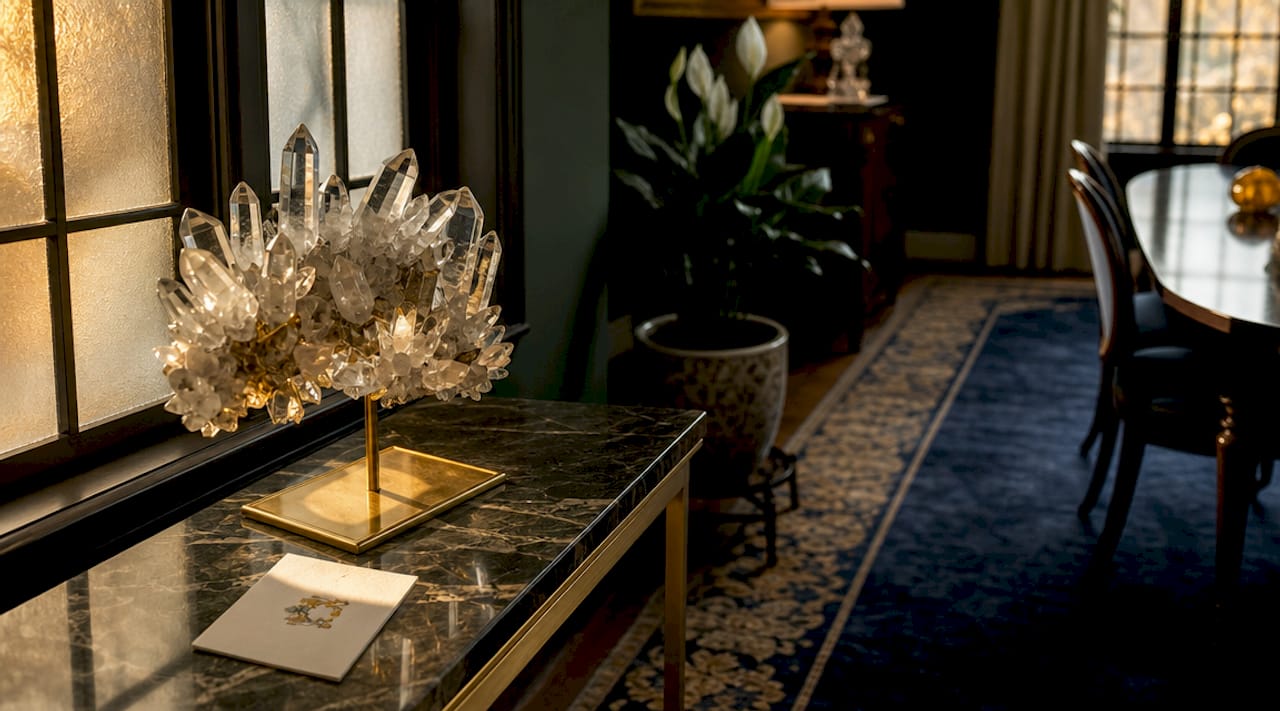
Lighting temperature is a factor most homeowners never consider. Warm bulbs at 2700K can dull cool-toned stones like celestite or aquamarine, making them appear muddy or gray rather than their natural blue-green. This means the lighting you choose is as important as the crystal itself. Cooler lighting in the 4000K to 5000K range preserves blues, greens, and purples, while warm lighting flatters amber, citrine, and golden calcite.
Beyond light interaction, crystals carry what designers call visual weight. A large amethyst geode commands a room the way a sculpture does. A cluster of small quartz points reads as texture rather than focal point. Understanding this distinction lets you build displays with genuine architectural intention.
Here is a four-step framework for placing crystals as design elements:
- Identify your focal point. Every display needs one anchor piece, typically the largest or most visually complex specimen, positioned at eye level.
- Add a bridge piece. A medium-sized crystal of contrasting color or form connects the anchor to the surrounding space without competing with it.
- Introduce texture fillers. Small tumbled stones, crystal points, or raw clusters fill negative space and add tactile interest.
- Apply material contrast. Pair crystals with warm wood bases, linen textiles, or brass risers to offset their cold, hard surfaces and create visual balance.
“Crystals offer an enchanting way to blend elegance with purpose, far more than decorative elements.” — Bark and Chase
Pro Tip: Use acrylic or brass risers to create layered height within a display. Varying the elevation of three to five pieces creates a dynamic, gallery-quality arrangement without requiring more floor or shelf space.
For more on crystal interior lighting and how to select the right fixtures and specimens for each room, Crystalplace has a dedicated guide worth reading before you finalize your layout.
Which crystal decor ideas work best for specific rooms?
Room-specific crystal selection is where using crystals in home design moves from general interest to genuine interior strategy. Each room has a different function, light condition, and traffic level, and the crystal you choose should match all three.
| Room | Recommended Crystal | Why It Works |
|---|---|---|
| Bedroom | Rose quartz | Soft pink tones promote calm; low hardness acceptable in low-traffic zones |
| Entryway | Black tourmaline | Dense, hard, and visually grounding at a home’s threshold |
| Living room | Amethyst geode | High visual impact; keep away from direct sunlight to prevent fading |
| Home office | Clear quartz or citrine | Bright, energizing tones; quartz family durability suits desk surfaces |
| Kitchen | Agate or jasper | Moisture-resistant and available in warm earth tones that complement natural materials |
Grouping strategy matters as much as individual selection. Triangulation connects three crystal points visually, creating a sense of flow rather than a random pile. The rule is simple: place your anchor, then position two smaller pieces at angles that draw the eye in a triangle rather than a straight line. This is the same principle architects use when arranging furniture or art.
Negative space is the most underused tool in crystal styling. Allow 4 inches of breathing room for every 6 inches of crystal to prevent visual fatigue. Crystals have fractal, complex surfaces that demand space to read clearly. Crowding them together turns a curated collection into visual noise.
Safety deserves specific attention in homes with pets. Malachite is toxic and must stay out of reach of animals that might chew or knock it over. Beyond toxicity, heavy geodes require reinforced surfaces because standard floating shelves are often not rated for their weight. A large amethyst cathedral geode can weigh 20 to 50 pounds, which exceeds the load capacity of most decorative shelving.
- Pair crystals with potted plants for a natural, organic composition that softens the hard mineral surfaces.
- Use shallow trays or wooden boards to group smaller pieces and define their display zone without a formal stand.
- Layer textiles like linen runners or velvet pads beneath crystals to protect furniture surfaces and add warmth.
Pro Tip: Before placing any crystal cluster or geode on a shelf, check the shelf’s weight rating. If the manufacturer’s spec is not labeled, assume a standard decorative shelf holds no more than 20 to 25 pounds and plan accordingly.
What are the most common mistakes in crystal decor maintenance?
The most common mistake homeowners make with crystal decor is treating every specimen the same way. Maintenance requirements vary significantly by mineral type, and one wrong cleaning method can permanently damage a piece.
Direct sunlight is the most frequent cause of crystal color loss. Amethyst, rose quartz, and fluorite all fade under prolonged UV exposure. Moving these stones back from windows or using UV-filtering window film protects their color without sacrificing natural light in the room. Petrified wood, by contrast, is nearly indestructible under domestic conditions and can sit in full sun without any degradation, making it one of the most practical display choices for bright rooms.
Dusting is another area where technique matters. Compressed air removes dust from delicate crystal clusters and geode cavities without the abrasion risk of a cloth. For smooth-surfaced stones, a soft microfiber cloth works well. Never use chemical cleaners on raw or porous minerals, as they can strip surface coatings or accelerate water damage on sensitive specimens.
Stability is a safety issue, not just an aesthetic one. Museum putty, the same product used in galleries to secure sculptures and artifacts, holds crystals in place on shelves and prevents tipping from vibration or accidental contact. This is especially relevant in homes with pets or children.
- Keep water-soluble minerals like selenite and halite away from bathrooms, kitchens, and any humid zone.
- Rotate your collection periodically to prevent uneven UV exposure on stones near windows.
- Edit your display twice a year. Removing pieces that no longer serve the composition keeps the collection looking curated rather than accumulated.
Pro Tip: Apply a small amount of museum putty to the base of any crystal placed on a shelf above eye level. It is invisible, removable, and prevents costly accidents without damaging the stone or the surface beneath it.
For detailed guidance on cleaning crystal decor, Crystalplace has a homeowner-focused resource that covers safe methods for every major mineral type.
Key takeaways
Crystals function best in interior design when selected for their physical properties first and their aesthetic qualities second.
| Point | Details |
|---|---|
| Match hardness to room conditions | Use quartz family crystals in kitchens and bathrooms; avoid selenite in any humid zone. |
| Control light exposure | Keep amethyst and rose quartz away from direct sunlight to prevent irreversible color fading. |
| Apply triangulation for displays | Place three crystals at visual triangle points to create flow and avoid a cluttered arrangement. |
| Respect negative space | Allow 4 inches of open space for every 6 inches of crystal to achieve a gallery-quality look. |
| Prioritize safety and stability | Check shelf weight ratings and use museum putty to secure heavy or valuable specimens. |
What I have learned from years of working with crystals in interiors
Most people approach crystal decor from one of two extremes. They either treat crystals as purely spiritual objects with no design logic, or they dismiss the energy dimension entirely and end up with expensive rocks that feel disconnected from the room. Neither approach produces the best results.
What I have observed consistently is that the most successful crystal interiors treat specimens the way a good architect treats materials: with respect for their physical properties and an honest understanding of what they contribute visually. A large amethyst geode placed in a corner with no light source is wasted. The same piece positioned near a 4000K spotlight becomes a room-defining feature.
The energy dimension is real in a practical sense, even if you set aside metaphysical beliefs entirely. A room with a grounding black tourmaline at the entry and a warm citrine cluster near the seating area simply feels different from a room without them. Whether that is psychology, color theory, or something else is less important than the fact that it works.
My honest advice: start with one anchor piece you genuinely love, learn its care requirements, and build from there. The homeowners who end up with the most beautiful crystal interiors are the ones who edited ruthlessly and placed intentionally, not the ones who bought the most pieces.
— BCC
Discover quality crystal decor at Crystalplace
Crystalplace has been sourcing authentic crystal products since 1992, with a catalog that includes Swarovski crystal prisms, hanging crystals, suncatchers, and chandelier components designed specifically for residential interiors. Whether you are building a statement display or enhancing an existing lighting fixture, the selection at Crystalplace covers everything from individual prisms to complete chandelier assemblies. The brand also publishes expert guides on crystal decor styling to help homeowners make confident, design-forward choices. Free shipping applies to all US orders over $22, making it practical to start small and build your collection over time.
FAQ
What is the role of crystals in interior design?
Crystals serve as both decorative focal points and light-refracting architectural elements in interior design. Their color, form, and mineral structure contribute visual weight, texture, and dynamic light effects to any room.
Which crystals are best for beginners in home decor?
Clear quartz, amethyst, and citrine are the most practical starting points because they belong to the quartz family, score a 7 on the Mohs hardness scale, and tolerate most domestic conditions without special care.
How do you prevent crystals from fading in a home setting?
Keep UV-sensitive stones like amethyst and rose quartz away from direct sunlight, since their color fades within weeks to months of sustained UV exposure. Interior placement away from south- or west-facing windows is the simplest prevention.
How should crystals be grouped for a polished display?
Use the triangulation method: place one anchor piece, one bridge piece, and one or two texture fillers at three visual points. Allow 4 inches of negative space for every 6 inches of crystal to prevent visual fatigue.
Are any crystals unsafe for homes with pets?
Malachite is toxic to pets and must be kept out of reach. Heavy geodes also pose a tipping risk on standard shelves, so always verify weight ratings and use museum putty to secure any specimen above floor level.
Recommended
- The Role of Crystal Decor in Events: 2026 Guide – CrystalPlace
- How Crystal Accents Transform Interiors: Design Impact – CrystalPlace
- The Role of Crystal Beads in Design for Decorators – CrystalPlace
- The Real Role of Crystals in Decor for Your Home – CrystalPlace