

Discover the art of understanding crystal craftsmanship. Learn techniques, materials, and tips to enhance your skills in this beautiful craft.
TL;DR:
- Crystal craftsmanship involves shaping and polishing crystal to create optical brilliance through specialized materials and precise techniques. The industry standard for quality is 24% lead oxide crystal, which maximizes sparkle and workability, while traditional methods like Edo Kiriko demand decades of skill. Hobbyists can begin with simple wire wrapping and resin embedding techniques that preserve the crystal’s integrity and brilliance.
Crystal craftsmanship is the art and science of shaping, cutting, and polishing crystal into pieces that display optical brilliance and distinct artistry. Understanding crystal craftsmanship means recognizing it as far more than decorative work. It requires specialized materials, precise technique, and deep patience. From the 24% lead oxide (PbO) standard that defines premium glass crystal to the stepwise hand-cutting traditions of Edo Kiriko, the craft blends material science with artistic skill. Whether you are a hobbyist exploring wire wrapping or an artisan pursuing traditional hand-cut methods, the principles behind quality remain the same.
What are the primary materials used in crystal craftsmanship?
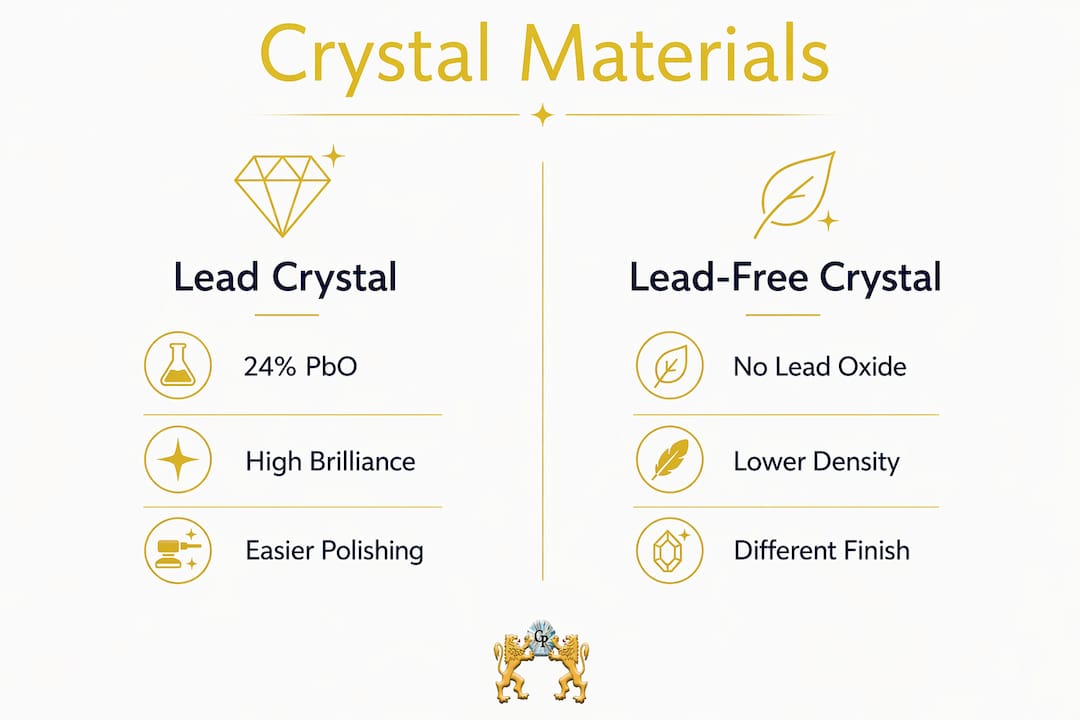
24% lead oxide crystal is the industry standard for brilliance, density, and workability in fine crystal crafting. That specific lead content creates the optical density that makes light bend and scatter inside the piece, producing the sparkle collectors and decorators prize. Lead-free alternatives exist and have improved considerably, but they trade some cutting performance and acoustic resonance for safer handling.
Material choice shapes every step that follows. High lead content softens the glass enough for deep hand engraving while still holding a sharp facet edge. Lead-free crystal tends to be harder, which shortens tool life and limits the depth of decorative cuts. For hobbyists working with natural stones rather than glass crystal, the relevant materials shift entirely.
Natural crystals used in jewelry and craft projects each bring distinct properties:
- Quartz is the most workable natural crystal for wire wrapping and resin embedding. Its hardness (7 on the Mohs scale) resists scratching during handling.
- Amethyst offers deep purple color and similar hardness to quartz, making it a reliable choice for pendants and decorative pieces.
- Agate provides banded color patterns and a smooth surface that polishes well.
- Jade is dense and tough, prized for carving and engraving rather than faceting.
Material composition also determines polishing behavior. Softer lead crystal accepts a high-gloss polish more readily than harder natural stones. Facet precision depends on how cleanly the material responds to grinding wheels at each stage of finishing.
| Material | Lead/Composition | Best Use | Key Trade-off |
|---|---|---|---|
| 24% PbO lead crystal | 24% lead oxide | Hand engraving, faceting | Requires careful handling |
| Lead-free crystal | Barium or zinc oxide | Machine cutting, everyday use | Less acoustic resonance |
| Quartz | Silicon dioxide | Wire wrapping, resin casting | Limited engraving depth |
| Amethyst | Iron-tinted quartz | Pendants, decorative pieces | Color varies by source |
| Jade | Jadeite or nephrite | Carving, sculpture | Difficult to facet |
Which traditional techniques define high-quality crystal craftsmanship?
Edo Kiriko, the Japanese tradition of hand-cut glass crystal, defines the gold standard for traditional crystal crafting techniques. The process follows a strict sequence that cannot be rushed without destroying the optical quality of the finished piece.
The five core stages are:
- Sumitsuke (marking): The artisan draws the cutting pattern directly onto the crystal surface using a brush and ink. Accuracy at this stage determines every cut that follows.
- Arazuri (rough cutting): A coarse grinding wheel removes material along the marked lines. This stage sets the basic facet geometry.
- Sanban-gake (medium grinding): A finer wheel refines the facets, removing the rough texture left by the first pass.
- Ishikake (fine grinding): A stone wheel smooths the facets to near-optical clarity.
- Migaki (polishing): The final stage brings the crystal to full brilliance using a polishing wheel and compound.
Complex hand-cut patterns require over 10 hours of labor per piece. That time investment is not inefficiency. It is the cost of optical precision that machine pressing cannot replicate.
Edo Kiriko mastery takes 10–20 years to develop, and fewer than 100 craftsmen hold official recognition in the tradition. That scarcity explains why authentic hand-cut pieces command prices far above machine-made equivalents.
Cutting is optical engineering. Facet angles control internal reflection, and a single degree of error scatters light in the wrong direction. Cutting speed works against quality. A wheel moving too fast generates heat and chips edges, producing dull facets that absorb rather than reflect light.
Slight irregularities in hand-cut patterns are markers of authentic craftsmanship, not defects. Machine-pressed glass achieves geometric perfection but lacks the depth and variation that make hand-cut crystal visually alive.
Pro Tip: When examining a piece for authenticity, hold it under a single light source and rotate it slowly. Hand-cut facets produce shifting light patterns with subtle variation. Machine-pressed pieces reflect light in uniform, predictable bands.
How do wire wrapping and resin embedding work for hobbyists?
Wire wrapping and resin embedding are the two most accessible entry points into crystal crafting for hobbyists. Both methods work with raw, undrilled stones and require no specialized grinding equipment.
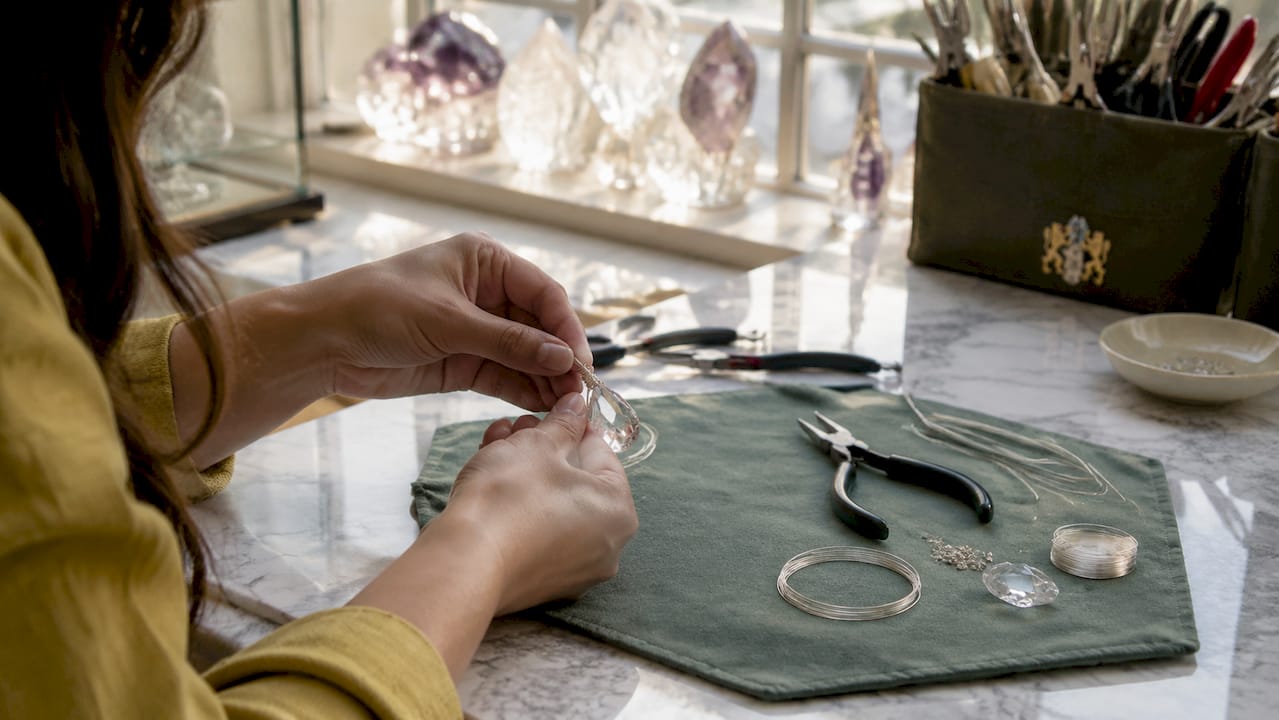
Wire wrapping works by building a tension-based frame around the crystal. 20-gauge dead-soft wire forms the structural frame, and 26-gauge wire handles the decorative weaving. Dead-soft wire bends without springback, which matters when you are working around irregular stone shapes. Harder wire tempers fight back against your hands and produce uneven wraps that loosen over time.
Key wire wrapping steps for beginners:
- Cut a base frame from 20-gauge wire, leaving enough length to form anchor loops at the top and bottom of the stone.
- Secure the frame by wrapping the 26-gauge wire tightly around the base wires at the top, bottom, and midpoint.
- Tension-based frameworks hold the stone without drilling or adhesive, preserving the crystal’s surface integrity.
- Finish by forming a bail loop at the top for pendant use.
Resin embedding follows a different logic. The goal is to suspend the crystal inside a clear resin cast without it sinking to the bottom before the resin sets.
The two-pour resin technique solves the sinking problem. Pour a thin initial layer of resin into the mold, then wait 60–90 minutes until it reaches a tacky, gel-like consistency. Place the crystal on the tacky surface and pour the second layer over it. The partial cure holds the crystal in position while the second pour encases it completely.
Pro Tip: Use a toothpick to pop surface bubbles in resin within the first 10 minutes of each pour. A brief pass with a heat gun or lighter held 6 inches above the surface also clears bubbles without disturbing the crystal’s position.
Common pitfalls to avoid: using half-hard or full-hard wire temper for wrapping (it cracks and unravels), skipping the partial cure step in resin work (the crystal sinks), and choosing porous stones like selenite for resin casting (moisture trapped in the stone creates cloudiness).
What determines the brilliance and lasting quality of a crystal piece?
Brilliance in crystal is not accidental. It results from three factors working together: material composition, cut precision, and surface maintenance.
Cutting speed inversely affects quality. A slower, more deliberate cut produces sharper facet edges that direct light cleanly through the crystal. Rushed cuts leave micro-fractures along facet edges that scatter light and dull the finished piece. This principle applies equally to industrial glass crystal and natural stone.
Foiling quality and cut precision both affect how much light a finished crystal reflects. In flatback crystals used for jewelry and decoration, the foil backing acts as a mirror. Poor foiling reduces reflectivity even when the cut is excellent. For artisans sourcing flatback crystals, foiling quality is as important as facet geometry.
Surface maintenance is the factor most hobbyists underestimate. Skin oils interrupt light paths inside the crystal, causing a visible loss of sparkle. A crystal that looks dull after handling is not damaged. It needs cleaning. Regular cleaning with a soft cloth and mild solution restores brilliance. For chandelier crystals and hanging decorations, periodic maintenance preserves lasting sparkle that would otherwise fade from dust and oil accumulation.
Durability follows material composition. Lead crystal is softer than natural quartz, which makes it easier to engrave but more vulnerable to chips and scratches. Natural stones like quartz and agate resist surface damage better but require more effort to polish to the same optical standard. Understanding the factors behind crystal brilliance helps you choose the right material for each project and maintain it correctly over time.
Key Takeaways
Crystal craftsmanship produces lasting brilliance only when material choice, cut precision, and surface care work together at every stage.
| Point | Details |
|---|---|
| Material sets the foundation | 24% PbO lead crystal delivers the best balance of optical brilliance and workability for hand cutting. |
| Cut precision controls light | Facet geometry determines internal reflection; rushing any grinding stage produces dull, uneven results. |
| Hand-cut marks authenticity | Slight irregularities in hand-cut pieces indicate genuine artisan work, not manufacturing defects. |
| Hobbyist techniques are accessible | Wire wrapping with dead-soft wire and the two-pour resin method let beginners work with raw crystals safely. |
| Surface care preserves brilliance | Skin oils dull crystal quickly; regular cleaning restores sparkle and extends the life of any piece. |
What I have learned from years of watching crystal craftsmanship evolve
The most common mistake I see among new artisans is treating crystal work as purely decorative. They focus on the finished look and skip the material science. That shortcut shows up immediately in the quality of the light.
The 24 PbO standard exists for a reason. When you hold a piece of 24% lead crystal next to a lead-free equivalent and rotate both under the same light, the difference is not subtle. The lead crystal throws light across the room. The lead-free piece glows quietly. Neither is wrong for every application, but knowing which you are working with changes every decision you make about cutting speed, polishing compound, and handling.
Traditional methods like Edo Kiriko are not museum pieces. They are the clearest proof that patience produces better optics than technology. A craftsman who has spent 15 years at a grinding wheel understands facet geometry in a way that no machine setting can replicate. The fewer than 100 recognized Edo Kiriko craftsmen in existence are not a sign of a dying art. They are a reminder of how high the standard actually is.
What excites me about the current moment is that resin embedding and wire wrapping have genuinely expanded who gets to work with crystals. A hobbyist with $30 in wire and a raw amethyst point can produce a pendant that shows real understanding of how light moves through stone. That is not a lesser form of the craft. It is a different entry point into the same principles.
The imperfections in hand-cut crystal are not something to apologize for. They are the signature of a human hand working at the edge of its precision. Machine-pressed glass is perfect and forgettable. Hand-cut crystal is imperfect and unforgettable.
— BCC
Premium crystal materials for your next crafting project
Crystalplace has supplied artisans, decorators, and hobbyists with authentic crystal materials since 1992. The selection covers everything from individual crystal prisms to full chandelier components, all sourced directly from trusted crystal brands.
Whether you are building a wire-wrapped pendant, assembling a chandelier, or sourcing flatback crystals for resin work, the quality of your starting material determines your finished result. Crystalplace stocks crystal prisms and hanging decor that meet the brilliance and clarity standards this article describes. Free shipping applies to orders over $22 within the USA. If you are serious about the craft, start with materials that are serious about quality.
FAQ
What is the industry standard for crystal craftsmanship materials?
24% lead oxide (24 PbO) crystal is the recognized industry standard. It provides the best balance of optical brilliance, tactile density, and workability for hand cutting and engraving.
How long does traditional hand-cut crystal take to make?
Complex hand-cut pieces require over 10 hours of labor. Standard pieces like whiskey tumblers typically take 4–8 hours depending on pattern complexity.
What wire gauge should beginners use for wire wrapping crystals?
Use 20-gauge dead-soft wire for the structural frame and 26-gauge wire for decorative wrapping. Dead-soft temper bends without springback, which makes it far easier to work around irregular stone shapes.
How do I prevent crystals from sinking in resin?
Use the two-pour technique. Pour a thin base layer, wait 60–90 minutes until it reaches a tacky consistency, then place the crystal and add the second pour. The partial cure holds the crystal in position.
Why does my crystal look dull after handling?
Skin oils coat the surface and interrupt the internal light path. Clean the crystal with a soft cloth and mild solution to restore brilliance. This applies to both glass crystal and natural stones.
Recommended
- What Is Crystal Craftsmanship: A Crafter’s Guide – CrystalPlace
- Key Crystal Terminology: A Guide for Design Professionals – CrystalPlace
- The Role of Crystal Beads in Design for Decorators – CrystalPlace
- The Crystal Place: Where Chandelier Parts Get Easy – CrystalPlace