

Discover what a finial is and its crucial role in chandelier restoration. Learn how this small part enhances style and structure for your fixture.
TL;DR:
- A finial is both a decorative end cap and a structural fastener at the bottom of a chandelier. Its material, shape, and thread fit influence the fixture’s appearance, safety, and light behavior. Proper measurement, authentic sourcing, and careful installation are essential for restoration and safety.
A finial is the ornamental end cap at the very bottom of a chandelier’s central assembly. It does two things at once: it finishes the fixture visually, acting as a decorative “full stop,” and it functions as the final threaded retention component that locks the central column and bottom bowl in place. For anyone sourcing replacement chandelier parts, that dual role matters more than most buyers realize. Suppliers like Crystalplace stock authentic Swarovski crystal finials and proprietary Magnificent Crystal Brand options precisely because getting this small part right affects both how a fixture looks and how safely it holds together.
At a glance, a finial:
- Serves as the decorative and structural cap at the base of the chandelier assembly
- Acts as the final threaded fastener securing the central column and bottom bowl
- Signals the fixture’s style through shape, material, and finish
- Affects light behavior depending on material (crystal vs. pressed glass vs. metal)
- Determines balance and perceived quality when replaced incorrectly
What does a finial do for your chandelier?
Most homeowners glance at a finial and see decoration. Lighting specialists see something closer to a keystone. The finial is typically the final threaded component screwed onto the bottom of the chandelier assembly, and on multi-tier or heavy fixtures, it stabilizes the entire column. A missing or mismatched finial does not just look wrong; it can allow the central column to shift, which puts stress on the arms and crystal drops above it.
The aesthetic cost is just as real. A finial that clashes in scale or style breaks the visual logic of the fixture, making an otherwise well-restored chandelier read as unfinished.
Which materials and finishes actually change the light?
Material and finish determine two things: how the finial handles light and how much load it adds to the assembly. Get these wrong and you either lose brilliance or overload a delicate fixture.
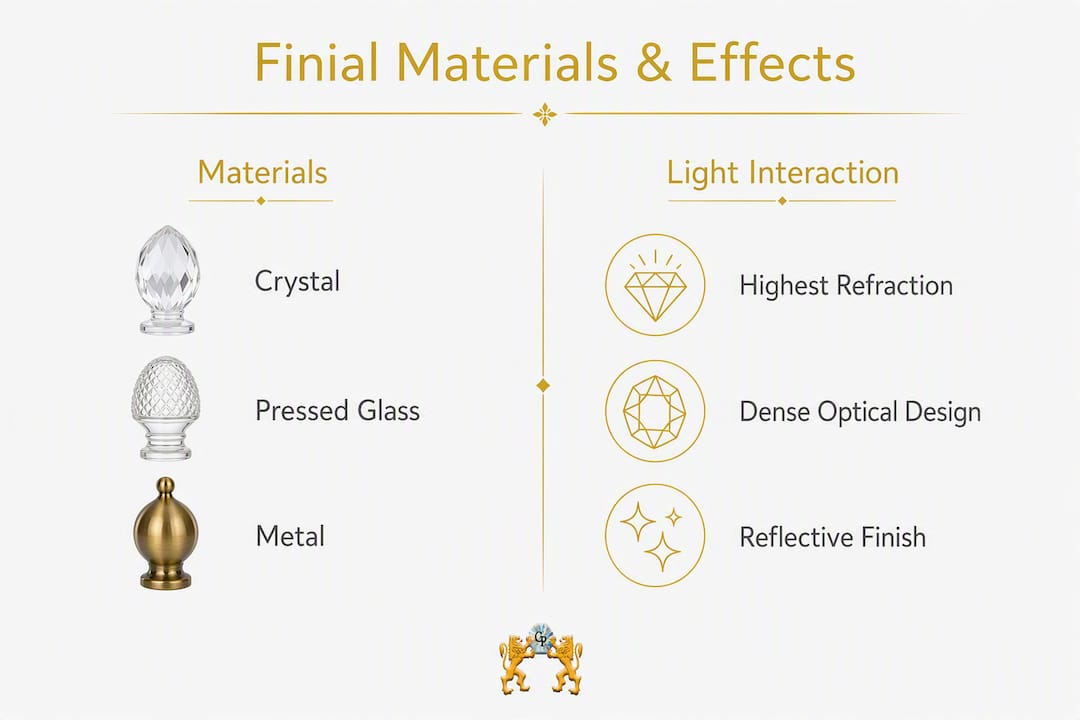
Crystal produces the highest refraction. Premium crystal is polished using cerium-oxide slurries on multi-axis buffer wheels, which removes mold seams and micro-irregularities that would otherwise scatter light unevenly. This is what separates restoration-grade crystal from mass-market alternatives. Authentic Swarovski crystal, available through Crystalplace, is the benchmark for this level of finish.
Pressed glass yields precise, angular, heavier designs with dense optical properties. It suits smaller fixtures where weight is manageable and geometric detail reads clearly.
Blown glass is hollow and significantly lighter, making it the practical choice for large multi-tier chandeliers where cumulative load across all components matters.
Metal finials (brass, bronze, chrome) serve as durable accent pieces or threaded ferrule housings. They add almost no optical effect but provide structural reliability on commercial or high-traffic fixtures.
- Polished clear: maximizes refraction and brilliance
- Frosted or acid-etched: diffuses glare, softens the light pool
- Textured: decorative diffusion, suits transitional or rustic styles
Pro Tip: On large multi-tier chandeliers, use hollow blown glass or lightweight crystal forms to manage cumulative load. Reserve pressed glass or solid crystal for smaller fixtures where the added weight is structurally acceptable.
What shape finial suits your chandelier’s style?
Shape is the fastest visual signal a finial sends. Choose one that harmonizes with the chandelier’s period and ornamentation, not one that simply looks attractive on its own.

Ball: The most versatile shape. Works in minimal modern fixtures and in classic European-style chandeliers where a clean terminus is preferred. It reads as neutral without being invisible.
Urn and acorn: Traditional shapes that belong on formal or period-appropriate fixtures. An acorn finial on a Rococo-style chandelier feels intentional; the same shape on a mid-century modern fixture looks like a mistake.
Flame: Suited to Gothic revival, Victorian, or ecclesiastical fixtures. The upward taper echoes candle forms and reinforces the fixture’s historical reference.
Faceted and prism shapes: The natural choice for crystal chandeliers. Faceted finials catch and redirect light the same way a pendant prism does, so the bottom of the fixture stays optically active rather than becoming a dead zone.
Pro Tip: Before ordering, photograph the bottom of your fixture and include a close-up of the thread and surrounding components. Scale matters as much as shape. A finial that looks proportional in a product photo can read as undersized or oversized once it is on the fixture. You can find styling guidance for crystal finials at Crystalplace to help match shape to fixture type.
How do you measure a finial for the right fit?
Fit is threaded and dimensional. Measure three things before you order: thread diameter, thread pitch, and overall finial length.
| Thread Label | Nominal Diameter | Threads per Inch | Common Use |
|---|---|---|---|
| 1/4-27 | — | 27 | Standard U.S. chandelier finials |
| 1/8 IP | — | 27 | Larger lamp and chandelier columns |
For large commercial or multi-tier fixtures, thread pitch and ferrule strength are critical. A thread mismatch on a heavy fixture does not just cause wobble; it can cause thread galling and assembly failure over time.
Measurement checklist:
- Measure exposed thread diameter with calipers
- Count threads per inch or note the listed spec (1/4-27 and 1/8 IP are the two most common U.S. standards)
- Measure finial length and widest diameter to confirm visual proportion against the bottom bowl
- Note the ferrule material (brass is preferred for durability)
Pro Tip: If you are unsure of the thread spec, photograph the thread against a ruler and send it to your vendor. A good supplier will confirm the embedded ferrule material and thread pitch before you commit to a purchase. Crystalplace’s finial replacement guidance covers this process in detail.
How to safely remove and install a chandelier finial
Replacing a finial is usually a straightforward screw-off, screw-on operation. Fragile crystal and threaded inserts change the risk profile, so a few precautions prevent expensive damage.
Tools you need: padded gloves, microfiber cloths, soft-jaw pliers, calipers, a flashlight, and a stable step ladder with a platform.
- Power off the fixture at the breaker, not just the wall switch.
- Support the fixture from below before touching any component.
- Remove the bottom bowl or lower tier if it blocks access to the finial.
- Support the central column with one hand while you work.
- Use soft-jaw pliers wrapped in microfiber to grip the finial body without scratching.
- Unscrew counterclockwise. If it resists, stop and check for thread damage before applying more force.
- Inspect the exposed thread and ferrule for wear, corrosion, or cross-threading.
- Test-fit the replacement by hand before final tightening. It should thread smoothly with no resistance.
- Tighten gently. Finger-tight plus a quarter turn is usually sufficient. Over-torquing cracks crystal and galls metal threads.
Safety note: For multi-tier or heavy fixtures, use a second person or hire a licensed lighting installer. Crystal and blown glass finials are fragile; a dropped finial from height can shatter and cause injury.
Troubleshooting: If the replacement cross-threads, back it out completely and realign before trying again. A stripped ferrule should never be forced. Source a replacement ferrule or the entire finial assembly rather than risk destabilizing the fixture.
Cleaning and caring for crystal and glass finials
Gentle, non-abrasive cleaning preserves refraction and prevents micro-scratching that dulls a crystal surface over time. Avoid ammonia-based cleaners and harsh acids on leaded crystal; both degrade the surface coating and reduce brilliance.
For routine cleaning, use warm water with a small amount of mild dish soap, a soft microfiber cloth, and dry the finial immediately after rinsing. For vintage or coated finishes, a specialized chandelier cleaner like Brilliante crystal chandelier cleaner is a safer choice than general household products.
Pro Tip: Store spare finials wrapped in acid-free tissue, boxed upright to prevent chipping, and label each one with its thread spec. You will thank yourself the next time a replacement is needed.
Professional cerium-oxide polishing is worth considering for restoration-grade finials that have developed surface haze. It removes micro-seams and restores the refraction quality that distinguishes a premium part from a worn one.
Where to find authentic replacement finials in the U.S.
Buy from suppliers who publish material proofs, crystal provenance, thread specifications, and a clear return or exchange policy. That combination is the baseline for any restoration purchase.
Verification checklist before you buy:
- Ask for material certificates or product photos taken under direct light
- Confirm thread pitch and embedded ferrule material in writing
- Request close-up photos of mold seams and polish quality
- Verify whether the crystal is authentic Swarovski or a proprietary brand with documented optical specs
- Confirm the return or exchange policy covers fit issues, not just defects
Specialty retailers that list Swarovski inventory and offer fit support are the most reliable source for premium restoration. Antique dealers can supply period-correct shapes, but thread specs on vintage parts vary widely and often require adapter ferrules. General online marketplaces carry finials at lower price points, but material provenance and thread accuracy are rarely verified.
For entryway chandeliers and statement fixtures where the finial is visible at eye level, the quality difference between a polished authentic crystal and a mass-market replica is immediately apparent. Entryway chandelier staging tips can help you assess how visible the bottom of your fixture will be before you decide on finish quality.
Key Takeaways
A finial is both the decorative finish and the structural anchor of a chandelier assembly. Fit, material, and provenance all matter when sourcing a replacement.
| Point | Details |
|---|---|
| Dual role | A finial decorates and mechanically secures the central column and bottom bowl. |
| Material drives light | Crystal maximizes refraction; pressed glass adds weight and precision; blown glass reduces load on large fixtures. |
| Measure before ordering | Confirm thread diameter (1/4-27 or 1/8 IP), pitch, and finial length with calipers before purchasing. |
| Verify authenticity | Request material certificates, ferrule specs, and close-up photos from any supplier before committing. |
| Crystalplace | Stocks authentic Swarovski crystal finials and Magnificent Crystal Brand options with fit support for restoration buyers. |
The part most restorers get wrong
The conventional wisdom on chandelier restoration focuses on crystals: the prisms, the pendalogues, the garlands. The finial gets treated as a footnote. That is a mistake, and one that shows up immediately once the fixture is rehung.
A finial at the wrong scale makes a restored chandelier look unfinished, regardless of how perfect the crystal work above it is. A finial in the wrong material adds load that a delicate assembly was not designed to carry. And a finial with a mismatched thread spec is a structural liability, not a cosmetic one.
The deeper issue is that most buyers shop for finials by appearance alone. Shape and finish are visible in a product photo. Thread pitch, ferrule material, and polish quality are not. Those are the specifications that determine whether a replacement actually works, and they require a supplier willing to provide documentation, not just a product listing.
Crystalplace has operated from California since 1992, and the restoration focus shows in how the catalog is structured: thread specs are listed, Swarovski provenance is documented, and fit assistance is available before purchase. That is the standard worth holding any finial supplier to.
Crystalplace carries the finials your restoration needs
Crystalplace stocks a curated range of crystal chandelier finials, including authentic Swarovski crystal options and the proprietary Magnificent Crystal Brand line, alongside the full complement of chandelier parts: bobeches, columns, arms, connectors, and garlands. Free U.S. shipping applies on orders over $22, and tiered volume pricing is available for larger restoration projects.
If you are unsure about thread fit, send photos of your existing finial and thread to the Crystalplace team before ordering. Fit assistance is part of the service. Browse the finial catalog at Crystalplace and confirm your thread spec before your next restoration order.
Useful sources
- Finial – Wikipedia: Broad definition covering architectural and decorative uses; useful for understanding the term’s scope beyond chandeliers.
- Finial: Chandelier explained – Residence Supply: Covers the dual decorative and structural role; supports the BLUF definition and installation sections.
- Different types of finials used in chandeliers – Siga Glass: Detailed breakdown of pressed vs. blown glass manufacturing; primary reference for the materials section.
- Exploring glass finials: types and unique uses – Siga Glass: Covers cerium-oxide polishing, thread standards (1/4-27, 1/8 IP), and load thresholds; supports the sizing, materials, and care sections.
- Understanding the finial of a chandelier – ALA Lighting Specialist: Specialist perspective on structural importance and perceived fixture quality; supports the explainer and perspective sections.
Recommended
- Chandelier Finials Explained: Crystal Elegance for Home Lighting – CrystalPlace
- Chandelier Finial Replacement That Fits Right – CrystalPlace
- Chandelier finials: meaning, style, and design impact – CrystalPlace
- What Is a Crystal Finial? Types, Uses, and Styling Tips – CrystalPlace