

Learn what lead crystal is, how labeling varies, how it differs from modern lead-free crystal, and what official guidance says about handling and food contact.
Lead crystal is a type of glass made with lead oxide. It has traditionally been valued for its weight, workability, polished appearance, and interaction with light.
The term is frequently used without enough context. Legal definitions vary by market, modern manufacturers use several lead-free formulas, and appearance alone cannot confirm a crystal’s composition.
Safety also depends on how the item is used. Food-contact crystalware, an installed chandelier prism, and damaged glass that may create dust are different situations and should not be described as having the same exposure risk.
What Does “Lead Crystal” Mean?
In everyday use, lead crystal refers to glass formulated with lead oxide.
Some jurisdictions define particular crystal-glass descriptions by composition and physical properties. The European Union’s Crystal Glass Directive, for example, sets requirements for terms including “full lead crystal” and “lead crystal.”
Under that European framework, certain “lead crystal” categories require at least 24 percent lead oxide. That is a labeling definition for a specific market—not a universal rule governing every product described as crystal worldwide.
A product listing should identify the manufacturer, material, age, and available documentation rather than relying on one generic description.
Why Was Lead Added to Glass?
Traditional glassmakers used lead oxide because it changed how the molten glass could be worked and how the finished object looked and felt.
Lead-containing glass may have:
- Greater weight than some similarly sized glass pieces
- A surface that can accept deep decorative cutting
- Strong light reflection and color dispersion when well cut
- A distinctive appearance after polishing
- Different acoustic properties depending on the item’s shape and thickness
These are general characteristics, not guaranteed quality measurements. Poorly cut lead crystal may look less impressive than a precisely manufactured lead-free crystal.
The final appearance depends on the complete formula, clarity, cutting, polishing, shape, condition, and lighting.
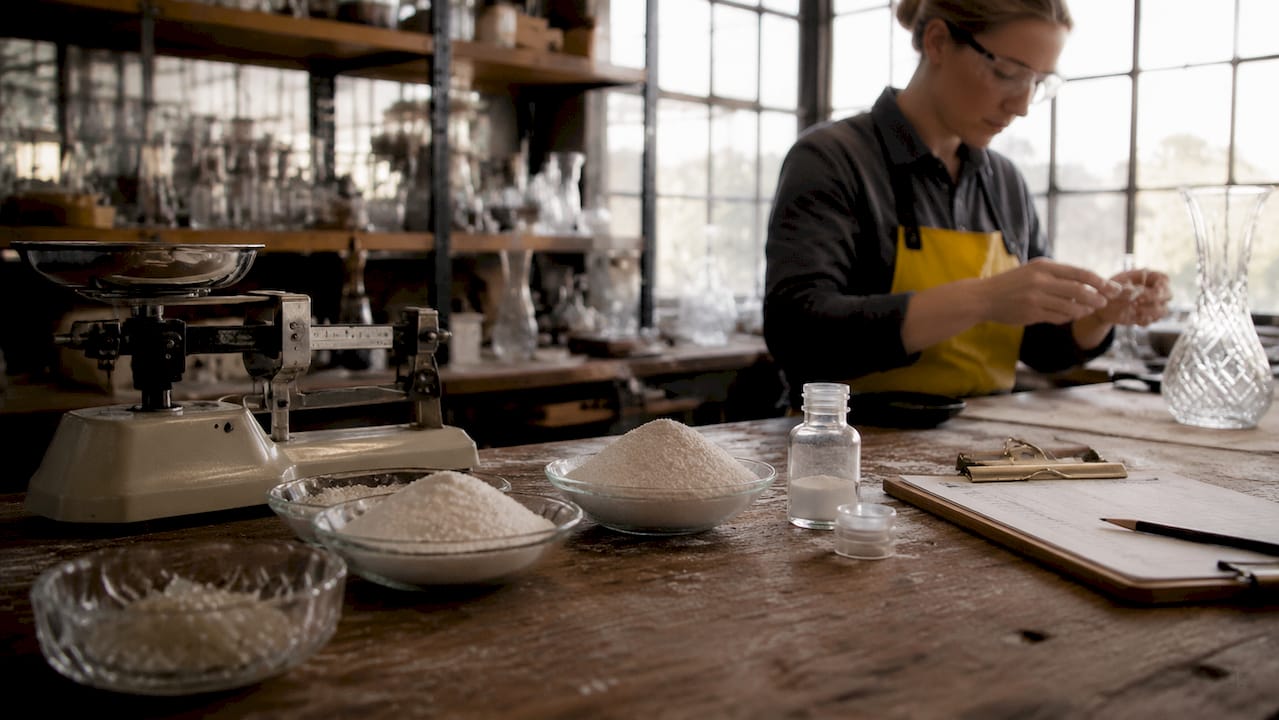
Not All Crystal Contains Lead
Many modern crystal products use lead-free glass formulas.
Manufacturers may use different mineral combinations and manufacturing methods to produce clarity, weight, and light play without intentionally adding lead.
Swarovski’s current professional information states that its Advanced Crystal formula has no intentionally added lead and contains lead at 40 parts per million or lower.
That does not establish the composition of every vintage Swarovski component. Older products may come from different manufacturing periods and formulas.
When composition matters, identify the specific component instead of applying a current specification to every historical piece.
Lead Crystal, Lead-Free Crystal, and Glass
These terms are often used inconsistently in retail listings.
Lead crystal
Glass manufactured with lead oxide. The precise composition and permitted label depend on the product and market.
Lead-free crystal
A broad description for crystal glass made without intentionally added lead. Different manufacturers may use different formulas.
K9 crystal
A term commonly used in the lighting trade for a type of optical glass. It is not a universal quality grade and does not by itself confirm a manufacturer, origin, cut, or finished quality.
Ordinary glass
A broad category that includes many formulas and levels of quality. A well-made glass prism may still be suitable when its appearance and measurements match the chandelier.
The safest buying approach is to review the actual product information instead of assuming one material is automatically superior in every application.
How Can Lead Crystal Be Identified?
Appearance, weight, and sound can provide clues, but they do not prove composition.
Product documentation
Begin with:
- Manufacturer information
- Original packaging
- Stock or pattern number
- Invoice
- Product description
- Country of origin
- Age or production period
- Available compliance information
Documentation is more useful than a generic “premium crystal” label.
Visual comparison
Inspect the piece for:
- Clarity
- Facet pattern
- Surface polish
- Color
- Bubbles or internal marks
- Edge condition
- Hole quality
- Signs of wear
These details help determine quality and condition but cannot confirm lead content.
Weight
Lead-containing glass may feel heavier than some lead-free alternatives of the same dimensions. Thickness, shape, and cutting also affect weight, so this is not proof.
Sound
The familiar “ring test” is unreliable. Sound changes with shape, thickness, size, damage, and the way the item is held.
Tapping can also chip a delicate rim or crystal edge. It should not be used as an authenticity test.
Professional material testing
Specialized testing such as X-ray fluorescence may identify elemental composition. This should be performed by someone trained to use the equipment and interpret the result.
Do not grind, sand, scrape, or break a crystal to test it. Those actions can damage the piece and may create dust.
Lead Crystalware and Food Contact
Lead-containing drinkware and decanters require particular care because lead can transfer into food or beverages.
Health Canada’s lead-crystalware guidance explains that the amount transferred depends partly on:
- The type of food or drink
- Its acidity
- How long it remains in contact with the crystalware
Health Canada recommends using lead-free containers for food and drink storage. It advises that lead crystalware, when used, should be limited to occasional serving rather than storage—especially for infants, children, and pregnant people.
The U.S. Food and Drug Administration states that no known safe level of lead exposure has been identified and seeks to limit lead exposure from food and foodware.
Do not describe drinking from lead crystal as completely safe or assign it a universal “minimal risk.” Individual exposure depends on the product, use, contact time, and person.
What About Lead Crystal on a Chandelier?
A hanging chandelier prism is not used to hold food or beverages. Therefore, the food-contact leaching pathway described for glasses and decanters does not apply in the same way.
That does not justify calling lead-containing décor completely risk-free.
Lead exposure generally occurs through ingestion or inhalation. The CDC explains that children are particularly vulnerable and that no safe blood lead level in children has been identified.
Use sensible precautions:
- Keep loose and broken components away from children.
- Do not allow crystals to be placed in the mouth.
- Avoid sanding, drilling, grinding, or crushing lead-containing glass.
- Wash your hands after handling dusty, broken, or unidentified vintage components and before eating.
- Clean broken fragments carefully without creating dust.
- Follow applicable local guidance for disposing of lead-containing material.
- Contact a qualified professional if a fixture requires cutting or alteration.
An intact decorative component installed out of reach presents a different situation from food-contact crystalware or a process that creates lead-containing dust.
Handling Broken or Chipped Lead Crystal
Wear appropriate protective gloves when collecting broken glass. Keep children and pets away from the area.
For larger fragments:
- Pick them up carefully rather than sweeping aggressively.
- Place them in a rigid, puncture-resistant container.
- Check the surrounding area for small pieces.
- Wash your hands after cleanup.
- Do not reuse a badly chipped piece where it carries hanging weight.
- Follow local disposal requirements.
Do not dry-grind or sand the damaged area. A damaged crystal should normally be replaced rather than reshaped at home.
If you believe someone may have been exposed to lead, contact a healthcare professional. A blood test—not symptoms or a home crystal test—is used to assess lead exposure.
Using Lead Crystal for Chandelier Restoration
When restoring an older chandelier, composition may be only one part of the matching process.
Also compare:
- Shape
- Height and width
- Thickness
- Facet arrangement
- Hole position
- Connector style
- Color
- Surface wear
- Weight
- Placement on the fixture
A modern lead-free replacement may look more consistent than an inaccurately sized lead-crystal prism. Test a sample on the chandelier before replacing an entire section.
See our chandelier crystal quality guide for a complete buying checklist.
Caring for Decorative Crystal
Follow the crystal and fixture manufacturer’s instructions.
For light dust:
- Use a soft, lint-free cloth or brush.
- Support the crystal while cleaning it.
- Avoid striking it against metal or neighboring pieces.
- Keep moisture away from electrical components.
- Do not use abrasive materials.
Swarovski’s official care guidance advises avoiding harsh materials and glass cleaners. For suitable washable crystal décor, it recommends lukewarm water, mild pH-neutral dish detergent, minimal water contact, and thorough drying.
A vintage or unidentified crystal may require different handling. When uncertain, begin with the least aggressive cleaning method.
Frequently Asked Questions
Is all crystal made with lead?
No. Many current crystal products use lead-free formulas. Review the manufacturer and specific product information.
Does “lead crystal” always mean at least 24 percent lead oxide?
Not worldwide. The 24-percent threshold appears in specific legal labeling categories, including the European Union’s Crystal Glass Directive. Definitions and permitted descriptions vary by market.
Is modern Swarovski crystal leaded?
Swarovski states that its current Advanced Crystal formula has no intentionally added lead and contains lead at 40 parts per million or lower. Older components may come from different product generations.
Can I identify lead crystal by tapping it?
No. Sound is not reliable proof of composition and tapping can damage the piece.
Is lead crystal safe for drinking?
Official guidance recommends reducing lead exposure. Do not store food or beverages in lead crystalware. Health Canada recommends using lead-free tableware, particularly for infants, children, and pregnant people, and limiting lead crystalware to occasional serving if it is used.
Is an installed lead-crystal chandelier the same risk as a decanter?
No. A chandelier prism does not hold food or drink, so the food-contact leaching pathway is different. Still, avoid mouthing, grinding, sanding, or careless handling of broken lead-containing glass.
Should broken lead crystal be repaired?
A chipped or broken hanging crystal should generally be replaced. Grinding or reshaping it at home may create dust and can weaken the component.
Final Advice
Lead crystal has an important history in glassmaking and decorative lighting, but it should be described accurately.
Do not assume that every crystal contains lead, that every product called lead crystal follows the same international definition, or that decorative lead crystal has “no health risk.”
Use manufacturer information when available, follow government guidance for food-contact crystalware, avoid activities that create dust, and match chandelier replacements by their complete physical characteristics—not composition alone.
CrystalPlace has supplied chandelier crystals and replacement components since 1992. Clear photographs, accurate measurements, and any available product markings help our team identify an appropriate replacement.
Sources
- European Union: Crystal Glass Directive
- U.S. Food and Drug Administration: Lead in Food and Foodwares
- Health Canada: Lead Crystalware and Your Health
- CDC: Childhood Lead Poisoning Prevention
- Swarovski for Professionals: Advanced Crystal and Compliance
- Swarovski: How to Care for Crystal Decorations