

Discover what makes Swarovski crystal the top choice for elegant interior lighting. Learn about grades, STRASS vs Advanced Crystal, and how to choose the right prism for your home.
TL;DR:
- Swarovski crystals are high-quality lead or lead-free crystal glass with precise faceting for exceptional brilliance.
- Manufacturing involves melted raw materials, patented machining, and optional coatings like Aurora Borealis.
- For interior lighting, use Swarovski STRASS for focal points and consider K9 or other grades for budget efficiency.
Not every crystal chandelier fills a room with rainbows. If you’ve ever stood beneath a fixture that looked expensive but delivered a flat, lifeless glow, you’ve felt the difference that crystal quality makes. Swarovski has earned a global reputation because its crystals do something ordinary glass simply cannot: they split light into precise, vivid prismatic color. Whether you’re renovating a dining room, specifying fixtures for a client, or repairing a beloved chandelier, understanding what Swarovski crystal actually is, how it’s made, and how it compares to alternatives gives you the knowledge to make smart, lasting choices.
Key Takeaways
| Point | Details |
|---|---|
| Crystal clarity matters | Swarovski crystals use precise facets and premium materials, resulting in unmatched sparkle and radiance. |
| Lighting grades retain lead | Swarovski STRASS crystals for lighting are still leaded to maximize brilliance, unlike most jewelry or decor crystals. |
| Mix and match for value | Combine Swarovski and K9 crystals in installations to balance cost and visual impact without sacrificing elegance. |
| Proper care ensures brilliance | Maintain your crystals by using gentle cleaners and avoiding harsh methods to keep them sparkling for years. |
What is Swarovski crystal? A clear definition
Swarovski is not just a brand name on a price tag. It’s a proprietary crystal glass product produced by a family-owned Austrian company founded by Daniel Swarovski in 1895. From the very beginning, the goal was simple: create glass crystal with a brilliance and precision that no other manufacturer could match. That mission still drives every piece produced today.
At its core, Swarovski crystal is a type of lead crystal glass that uses a specific blend of raw materials and a tightly controlled manufacturing process. What separates it from generic glass or lower-grade crystal is the consistency of its optical clarity and the sharpness of its facet cuts. When light enters a Swarovski crystal, it bends, bounces, and exits as precise beams of color rather than a dull, diffused shimmer.
Composition has evolved over the decades. Older versions of the crystal contained up to 32% lead oxide for a high refractive index of approximately 1.70, approaching diamond’s 2.42. Since around 2012, Swarovski reduced lead content dramatically in consumer products, now offering what it calls Advanced Crystal with trace levels of 0.009% and then down to 0.004%, making most lines essentially lead-free without sacrificing sparkle.
Here’s a quick look at where Swarovski crystal shows up:
- Chandelier prisms and drops for residential and commercial lighting
- Jewelry and accessories using faceted beads and rhinestones
- Home décor ornaments, figurines, and suncatchers
- Custom architectural installations for hotels and event spaces
“Swarovski’s commitment to precision cutting is what separates it from any other decorative crystal on the market. The facets are not approximate. They are exact.”
When you explore the full range of types of Swarovski crystals, you’ll see just how broad and thoughtfully tiered the product line actually is.
How Swarovski crystal is made: From raw materials to brilliance
The magic behind Swarovski’s sparkle begins at the furnace, not the showroom. Raw materials including silica sand, soda, potash, and in certain lighting-grade formulas, lead are melted together at extreme temperatures to form molten crystal glass. The exact chemical ratios are proprietary, and that formula has been refined for well over a century.
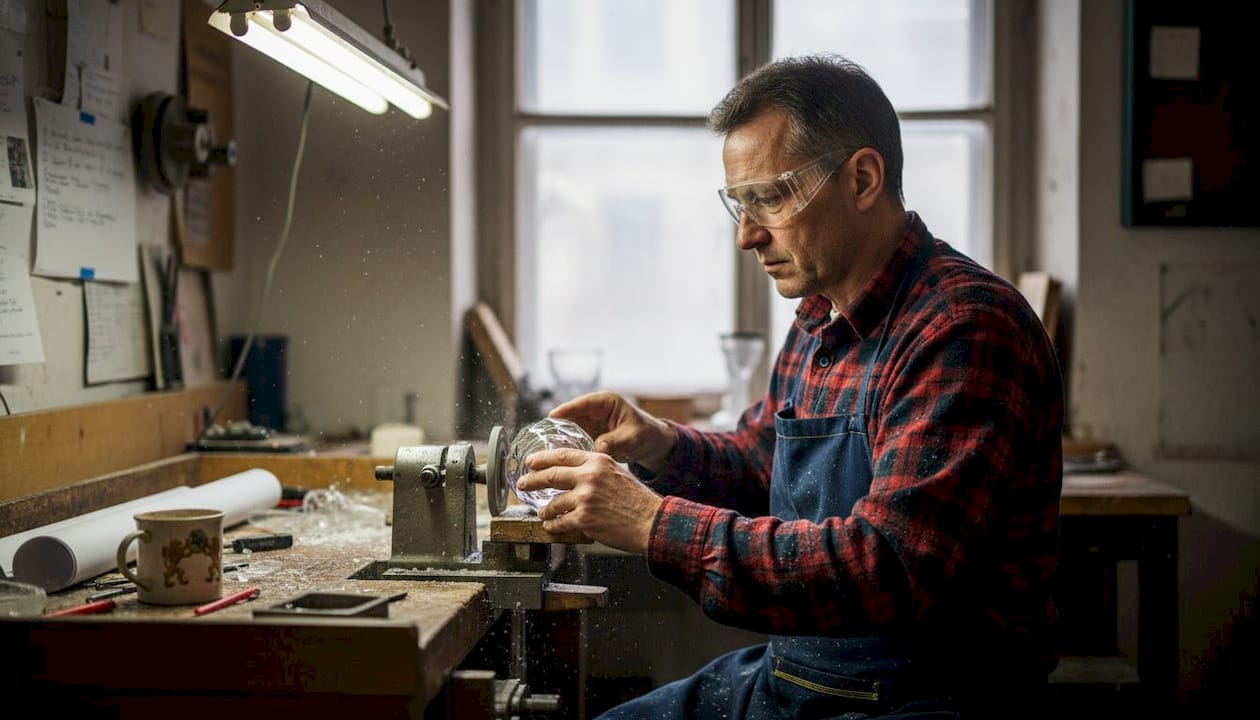
Once the glass cools into usable blanks, the real precision work begins. Swarovski uses patented cutting machinery to grind and shape each crystal into its final form. Manufacturing creates up to 100 facets per crystal, each one calculated to maximize how light enters, travels through, and exits the piece. This is not hand-cutting. It is machine-driven precision at a scale that ensures every crystal in a chandelier drop performs identically to every other one.
After cutting, crystals go through a polishing stage that removes microscopic surface imperfections. Some pieces then receive optional coatings. The most famous of these is the Aurora Borealis (AB) coating, a thin metallic film that adds iridescent rainbow color to the surface. It’s subtle but stunning when light catches it from different angles.
Here’s the production sequence in order:
- Raw material melting at high temperature in controlled batches
- Molding or pressing into rough crystal shapes
- Precision facet cutting with patented Swarovski machinery
- Polishing to achieve optical-grade surface clarity
- Optional coatings such as Aurora Borealis for added iridescence
- Quality inspection before packaging or shipping
Pro Tip: When shopping for brilliant chandelier crystals, look for sharp, crisp facet edges. Run a fingernail across the surface. A genuine Swarovski piece will feel almost razor-precise, not rounded or soft.
Those hundreds of precision facets are what generate the vivid light shows you see from quality chandeliers. Understanding the process helps you recognize why these crystal types for lighting outperform cheaper alternatives so consistently.
Grades and types: STRASS, Advanced Crystal, and beyond
Not all Swarovski crystals are created equal within the brand’s own lineup. Swarovski produces distinct product lines for different applications, and knowing the difference saves you from paying a premium for a product that doesn’t fit your specific project.
Swarovski STRASS is the flagship lighting and decorative grade. For chandeliers and architectural lighting, STRASS retains approximately 30% lead for optimal weight, brilliance, and refraction. That lead content is not a flaw. It’s an engineering feature. The higher density gives each prism the heft to hang correctly on a chandelier and the refractive index to throw vivid, defined rainbows across walls and ceilings.
Swarovski Advanced Crystal is the consumer-facing line used in jewelry, home décor, and fashion accessories. It is essentially lead-free, making it safe for everyday contact and compliant with modern safety regulations worldwide.
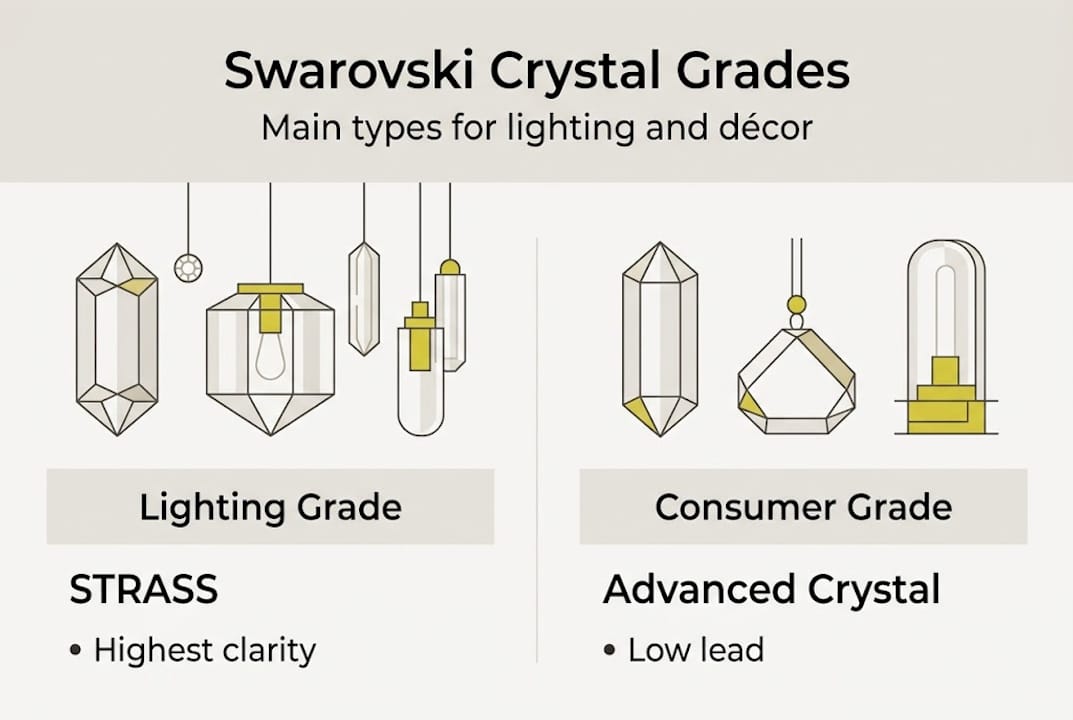
Here’s a comparison of the main crystal grades:
| Feature | STRASS (Lighting) | Advanced Crystal (Consumer) |
|---|---|---|
| Lead content | ~30% | Trace only (0.004%) |
| Refractive index | ~1.70 | ~1.55 to 1.60 |
| Primary use | Chandeliers, prisms | Jewelry, décor, fashion |
| Price point | Premium | Mid to high |
| Light dispersion | Vivid rainbows | Bright, clear sparkle |
Pro Tip: If you’re designing a statement chandelier and want to keep costs manageable, use genuine STRASS elements for the most visible drops at eye level and around light sources, then consider mixing in other grades for interior or upper tiers where the visual impact is lower. You can learn more about this strategy by reviewing how to enhance your home with Swarovski for different budget scenarios.
Beyond STRASS and Advanced Crystal, Swarovski also produces specialty beads, custom-cut shapes, and limited decorative formats for fashion and event design. For interior lighting, STRASS is almost always the correct specification, while understanding Swarovski vs K9 crystals is the next key comparison to understand.
Swarovski vs K9 and alternatives: Clarity, brilliance, and value
When homeowners and designers compare crystal options, the most common alternative to Swarovski is K9 crystal, a Chinese-made optical glass that has become widely used in mid-range chandeliers and decorative lighting. Both materials sparkle. But they do not sparkle equally.
Swarovski outperforms K9 in clarity and durability across every measurable factor. Swarovski’s refractive index of 1.6 or higher versus K9’s approximately 1.5 means Swarovski bends light more aggressively, producing crisper, more defined sparkle rather than a softer, diffused glow. Swarovski’s facets are also cut to tighter tolerances, which eliminates the slightly hazy look that lower-grade crystal can develop over time.
Here’s a side-by-side comparison:
| Factor | Swarovski | K9 Crystal | Lead-free glass |
|---|---|---|---|
| Refractive index | 1.6 to 1.70 | ~1.5 | ~1.45 to 1.50 |
| Facet precision | Patented, very high | Moderate | Variable |
| Light output | Vivid rainbows | Soft glow | Minimal sparkle |
| Durability | High | Moderate | Lower |
| Cost | Premium | Budget-friendly | Lowest |
Key points to consider when choosing:
- Swarovski works best as the centerpiece material in visible, well-lit areas
- K9 offers a good budget-conscious option for secondary or background positions
- Lead-free glass suits decorative props or children’s spaces where safety is the first concern
- Mixing grades thoughtfully can stretch your budget without sacrificing the overall visual impact
For more on how Swarovski contributes to room ambiance, explore the lighting benefits of Swarovski for interior spaces.
Swarovski crystal in interior lighting and décor: Practical tips
Knowing which crystal to choose is only half the job. Knowing where to put it and how to care for it determines whether your investment pays off for years or fades within months.
The precision facets in STRASS are computer-optimized to maximize light return, and the higher lead content provides extra heft and resistance to everyday dust and humidity. But those same facets collect grime quickly in kitchens or humid bathrooms. Placement and maintenance are not afterthoughts. They are part of the design decision.
Follow this sequence for best results:
- Position fixtures where light sources are direct so crystals catch and refract maximum light
- Reserve STRASS elements for focal-point locations such as dining rooms, entryways, and main living areas
- Clean with a crystal-specific spray such as Brilliante cleaner applied with a soft cloth, avoiding ultrasonics which can loosen stringing wire
- Dust regularly with a dry microfiber cloth to prevent buildup that dulls refraction
- Avoid harsh chemicals including ammonia-based glass cleaners that etch crystal surfaces
Pro Tip: A common mistake is hanging crystals in spaces with indirect or very warm-temperature bulbs. Swarovski prisms perform best under cooler, whiter light sources that allow full-spectrum refraction. When choosing chandelier prisms, match your crystal grade to your bulb temperature for the most dramatic effect.
For ongoing maintenance, following a dedicated cleaning and care for crystals routine twice a year keeps your Swarovski elements performing at their best over the long term.
Our take: What sets Swarovski crystal apart for interiors
After years of seeing how crystals perform across different installations, here is our honest perspective: most homeowners and designers overthink quantity and underthink placement. A chandelier loaded with budget glass will never match a fixture dressed with well-placed STRASS. The physics are simply different.
The real secret is knowing where quality pays off. Swarovski STRASS belongs at eye level and directly around your light source where every facet is visible. Mixing in K9 or Advanced Crystal elements further up the fixture, where shadows limit visibility, is a smart economy that most guests will never detect.
For anyone serious about interior lighting, prioritizing STRASS for chandeliers and statement fixtures maximizes light dispersion and room presence in a way no budget alternative replicates. We’ve seen it transform ordinary rooms into spaces that guests talk about long after they leave.
The conventional wisdom says buy the most expensive crystal you can afford everywhere. Our experience says: buy the best crystal where it matters most, and invest those savings back into more fixtures or better light sources. The result is almost always superior. If you want guidance on sourcing the right elements, start with choosing quality prisms to build your shortlist.
Where to buy genuine Swarovski crystals for lighting
Finding authentic Swarovski for interior projects is easier when you work with a supplier that sources directly from the brand rather than through gray-market resellers. Crystal Place has been sourcing genuine crystals since 1992, and our catalog covers everything from individual STRASS prisms to full chandelier repair kits and custom installations.
Whether you need a handful of replacement drops or a full specification for a new build, you can explore our complete Swarovski prism collections with confidence that every piece is authentic. We offer free shipping on orders over $22 within the USA, so even small repair orders ship without added cost. If you’re unsure which grade fits your project, our team is ready to help you choose the right crystal for every position in your fixture.
Frequently asked questions
Are all Swarovski crystals lead-free in 2026?
Most Swarovski consumer crystals are now lead-free under the Advanced Crystal line, but STRASS lighting elements retain approximately 30% lead to deliver maximum light dispersion and sparkle in chandeliers and prisms.
How can you tell if a crystal is genuine Swarovski?
Genuine Swarovski crystals feature razor-sharp facets, consistent optical clarity, and may carry specific brand etching. The up to 100 facets produced by patented machinery create a crisp light return that generic glass cannot replicate.
What is the difference between Swarovski and K9 crystal?
Swarovski delivers a refractive index of 1.6 or higher with precisely cut facets, while K9 sits at approximately 1.5, producing a softer glow. Swarovski outperforms K9 in clarity and durability across all lighting applications.
Where are Swarovski crystals most effective in interior design?
Swarovski STRASS performs best in chandeliers, entry pendants, and any fixture where direct light hits each prism. STRASS for chandeliers delivers the vivid rainbows and defined sparkle that make statement lighting truly memorable.
Recommended
- Crystal Chandeliers at Your Home with Brilliance – CrystalPlace
- Chandelier crystal types explained: Brilliance & style – CrystalPlace
- Examples of chandelier crystals to enhance brilliance – CrystalPlace
- How to Spot Real Swarovski Crystals Fast – CrystalPlace
- Luxury jewelry terminology explained: master fine gems – Eternal Carat