

Discover what makes crystals brilliant with insights on light, cut, and clarity. Enhance your shopping experience and see the sparkle!
TL;DR:
- Crystal brilliance results from total internal reflection, precise facet geometry, and material purity. It manifests as internal light return, not surface shine, and depends on optical properties that can be tested through movement and standard measurements. Buyers should focus on cut precision, material standards, and dynamic light tests to select crystals with optimal brilliance.
Crystal brilliance is defined as the efficient return of light through a crystal’s interior, creating the glow and sparkle that makes a well-cut piece look lit from within. This effect depends on three core factors: total internal reflection, material purity, and precise facet geometry. These are not decorative qualities. They are measurable optical properties that separate a luminous crystal from a dull one. Whether you are choosing a chandelier prism, a suncatcher, or a wellness stone, understanding what makes crystals brilliant changes how you shop and what you see.
What physical phenomena cause crystal brilliance?
Brilliance is the result of total internal reflection, the process by which light entering a crystal is redirected back upward through the crown rather than escaping through the sides or bottom. When this works correctly, the crystal appears to generate its own light. When it fails, the crystal looks flat and lifeless regardless of how clean or polished it is.
Three distinct optical effects combine to create what most people call “sparkle”:
- Brilliance: White light returned directly to the eye through internal reflection
- Fire: The splitting of white light into spectral colors, measured by a dispersion constant of 0.044 in diamonds, producing rainbow flashes
- Scintillation: The dynamic sparkle that appears when the crystal or the light source moves
These three effects are related but separate. A crystal can have strong fire but weak brilliance if the facet angles are off. It can have high scintillation but appear cold if the material lacks sufficient refractive index.
“A truly brilliant crystal acts as a light engine, gathering light and conducting it internally without loss, creating glow rather than just reflection.”
The refractive index of a material determines how sharply it bends incoming light. Higher refractive indices bend light more aggressively, making total internal reflection easier to achieve. For optimal brilliance in round-cut crystals, pavilion angles of 40.6°–41.8°, a crown angle of 34°–35°, and a table size of 53%–58% are the proven proportions. Any deviation from these ranges causes light to leak out the bottom, producing a dull, washed-out appearance even in a high-clarity stone.
How do cut quality and material purity impact crystal brilliance?
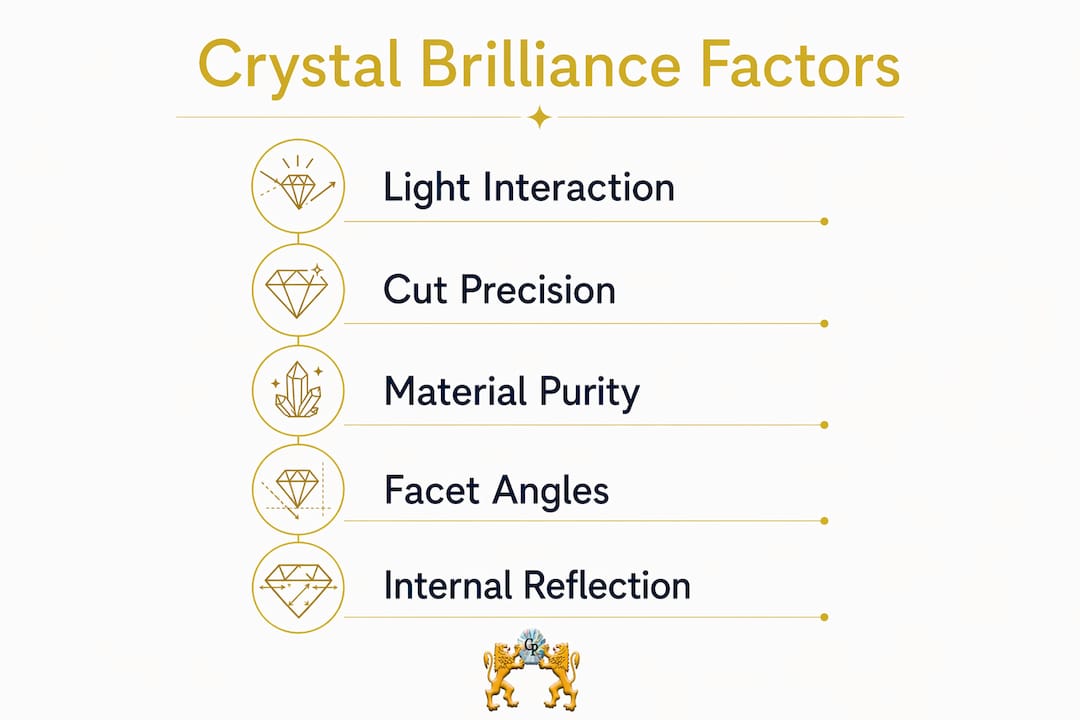
Cut quality and material purity are the two variables that determine whether a crystal reaches its optical potential. Facet count is the most commonly cited quality marker, but it is also the most misleading one.
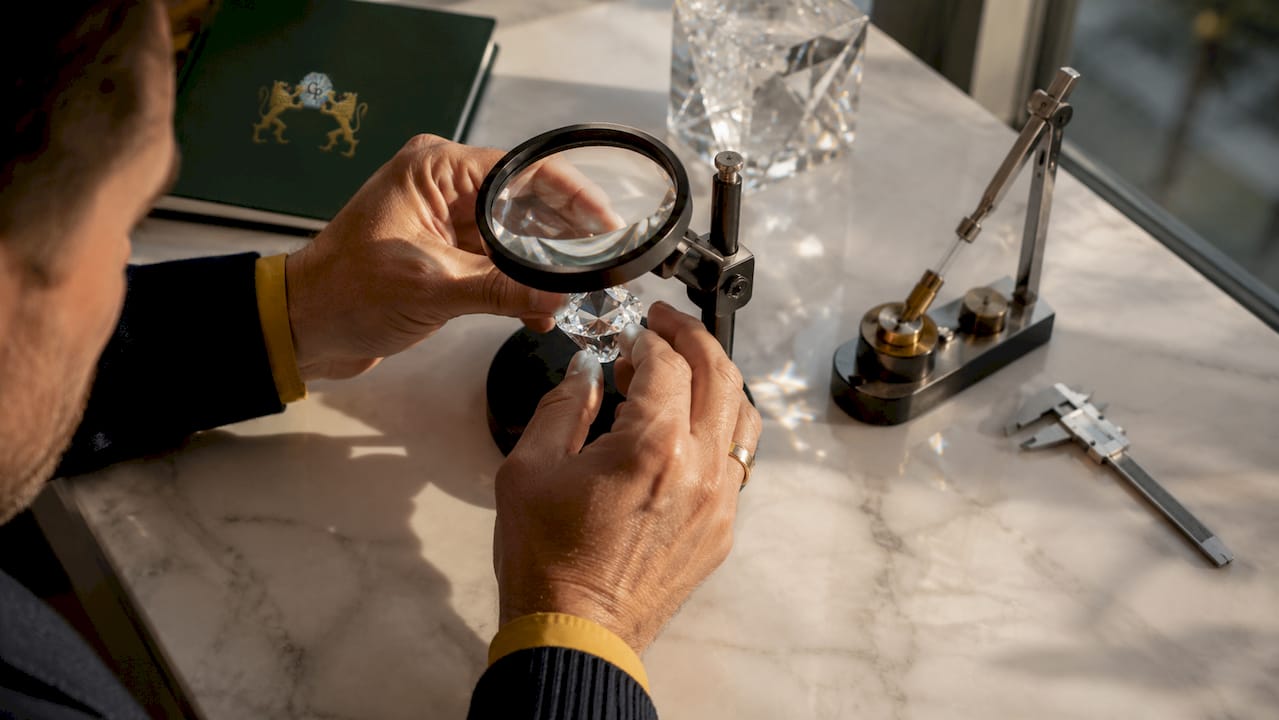
The real measure of cut quality is angular precision. Industry standards require a tolerance of ±0.8° for each facet angle, certified under ISO 10110-5. A deviation beyond this threshold causes chromatic dispersion loss, meaning the crystal scatters light instead of returning it. More facets cut at the wrong angle produce less brilliance than fewer facets cut correctly.
Material purity follows the same logic. A crystal’s refractive index must remain consistent throughout the piece. The accepted standard is nD = 1.542 ± 0.003. Variation beyond this range, caused by impurities or inconsistent raw materials, creates zones inside the crystal where light bends unpredictably. The result is internal cloudiness that no amount of polishing can fix.
Manufacturing process matters just as much as raw material quality. Improper annealing, the controlled cooling process after forming, introduces residual internal stress that distorts the crystal’s optical path. The industry standard requires a thermal gradient of no more than 3°C per centimeter during cooling. Crystals cooled too quickly develop internal strain that degrades brilliance permanently, and no subsequent treatment reverses it.
- Check angular precision first. Ask whether the crystal meets ISO 10110-5 certification for facet geometry.
- Verify refractive index consistency. Premium suppliers document material purity standards for their crystal lines.
- Ask about the annealing process. Reputable manufacturers control cooling rates to prevent internal stress.
- Treat facet count as secondary. A crystal with 32 precisely cut facets outperforms one with 64 poorly angled ones.
- Source from established brands. Swarovski and comparable certified manufacturers maintain documented optical standards.
Pro Tip: Hold a crystal up to a single light source and tilt it slowly. A brilliant crystal will show a clear, bright flash that moves with the tilt. A poorly cut or impure crystal will show a dim, diffuse glow that does not shift cleanly. This movement test reveals internal light return better than any static inspection.
What distinguishes brilliance from luster and sparkle?
Gemstone luster is surface reflection, the light that bounces off the outer polish of a crystal without entering it. Brilliance is internal light return, the light that travels through the crystal and comes back out the top. These are fundamentally different optical events, and confusing them leads to poor purchasing decisions.
A crystal can have a high-gloss surface finish and still look dead under light. That is strong luster with weak brilliance. The surface looks shiny, but the interior does not engage with light. Conversely, a crystal with a slightly matte surface can still produce exceptional brilliance if its internal geometry is correct.
| Property | Source | Visual Effect | Depends On |
|---|---|---|---|
| Brilliance | Internal light return | Glow, depth, lit-from-within | Cut angles, refractive index |
| Luster | Surface reflection | Gloss, shine | Polish quality |
| Fire | Light dispersion | Rainbow color flashes | Dispersion constant, facet design |
| Scintillation | Movement-based sparkle | Dynamic flash pattern | Facet layout, viewing angle |
Sparkle, or scintillation, is the most dynamic of these effects. It only appears when something moves, either the crystal, the viewer, or the light source. A crystal sitting still under flat lighting shows almost no scintillation. The same crystal under a moving light source or in a draft produces a completely different visual experience. This is why brilliance reveals itself with movement and why static display cases in stores often hide a crystal’s true optical performance.
How does crystal formation affect optical brilliance?
Not all crystals achieve brilliance through the same physical mechanism. Clear-cut crystals like quartz, leaded glass, and diamond produce brilliance through refraction and total internal reflection. Their atomic structure is uniform, which allows light to travel predictably through the material and return efficiently to the eye.
Opals work entirely differently. They achieve their characteristic play of color through structural coloration, a photonic crystal effect produced by nanometer-scale silica spheres packed in a regular grid. This structure causes Bragg diffraction, splitting light into spectral colors that shift with viewing angle. The effect is not refraction-based at all. It is a product of physical nanostructure.
This distinction matters for anyone choosing crystals for decor or wellness:
- Quartz and leaded crystal: Produce classic white-light brilliance and fire through refraction. Best for chandeliers, prisms, and suncatchers where maximum light return is the goal.
- Diamond: Achieves the highest brilliance-to-fire ratio of any natural material due to its extreme refractive index and dispersion constant.
- Opal: Produces shifting color play rather than traditional brilliance. The effect changes with angle and lighting, making it more atmospheric than directional.
- Swarovski crystal: Uses precision-engineered lead-free glass with controlled refractive index to replicate diamond-level brilliance in decorative applications.
Understanding these differences helps you match the right crystal type to the right application. A chandelier benefits from quartz or Swarovski crystal because the goal is maximum light return across a room. A wellness display benefits from opal or amethyst because the goal is color and visual depth rather than directional sparkle.
How can you evaluate and use crystal brilliance in decor and wellness?
Evaluating crystal brilliance before you buy requires active observation, not passive looking. A crystal’s true optical performance only shows under the right conditions. Knowing what to look for saves you from buying pieces that disappoint once they are installed.
When assessing a crystal for home decor use, place it near a natural or point light source and rotate it slowly. Count how many distinct bright flashes appear across a full rotation. A high-brilliance crystal produces multiple clean, sharp flashes. A low-quality crystal produces one diffuse glow that does not shift.
For chandelier applications, the quality of the crystal prism determines how far light travels across a room. A well-cut prism redirects light at precise angles, casting defined patterns on walls and ceilings. A poorly cut one scatters light randomly, reducing the visual impact of the entire fixture.
Key factors to prioritize when selecting crystals for decor or wellness:
- Cut precision over facet count. Angular accuracy determines light return. More facets do not mean more brilliance.
- Material certification. Look for documented refractive index standards from the manufacturer.
- Light source compatibility. Crystals perform differently under incandescent, LED, and natural light. Test under the light you will actually use.
- Size relative to space. Larger crystals in small rooms create overwhelming scatter. Smaller, precisely cut pieces in well-lit spaces often outperform larger, cheaper alternatives.
Pro Tip: Clean crystal surfaces regularly with a solution designed for optical glass. Dust and residue on the surface reduce light entry, which directly lowers brilliance. Crystalplace offers crystal cleaning solutions formulated specifically for decorative crystal pieces.
Key Takeaways
Crystal brilliance depends on total internal reflection, precise facet geometry, and consistent material purity working together, not on surface polish or facet count alone.
| Point | Details |
|---|---|
| Total internal reflection drives brilliance | Light must return through the crown, not escape through the sides or bottom. |
| Angular precision is the real quality measure | Facet angles must meet ±0.8° tolerance to prevent light leakage and dispersion loss. |
| Material purity is non-negotiable | Refractive index must stay within nD = 1.542 ± 0.003 for consistent internal light behavior. |
| Luster and brilliance are not the same | Surface gloss does not indicate internal light return. Test with movement, not static viewing. |
| Crystal type determines brilliance mechanism | Quartz and leaded crystal use refraction; opals use nanostructure diffraction for color play. |
The part of crystal brilliance most buyers never think about
Most buyers walk into a crystal purchase focused on the wrong things. They count facets. They check surface gloss. They hold the piece still under a store light and decide based on a single static impression. Every one of those habits leads to disappointment.
What I have found, after years of working with decorative and optical crystals, is that brilliance is a performance property, not a visual one. It only shows under the right conditions. A crystal that looks mediocre in a box can transform a room when hung near a window. A crystal that dazzles in a display case can look flat and cold once installed under the wrong light source.
The buyers who get this right are the ones who test with movement. They tilt, rotate, and hold the crystal at multiple angles before committing. They ask about material standards and manufacturing process, not just price and appearance. They understand that a crystal with fewer, better-cut facets will always outperform one with more poorly angled ones.
Brilliance also matters in wellness contexts beyond aesthetics. A crystal that returns light efficiently creates a living, shifting visual environment. That dynamic quality, the way light moves through a room as the sun changes angle, is what makes crystal decor feel alive rather than static. That effect is not magic. It is physics. And once you understand the physics, you can choose crystals that actually deliver it.
— BCC
Premium crystal prisms and decor at Crystalplace
Crystalplace has sourced and supplied authentic crystal products since 1992, with a focus on the optical standards that actually determine brilliance. Every piece in the collection meets documented material and cut quality benchmarks, from Swarovski prisms to precision-cut hanging crystals for chandeliers and suncatchers.
If you are ready to see the difference that cut precision and material purity make in a real space, browse the full selection of crystal prisms and hanging decor at Crystalplace. Free shipping applies to orders over $22 within the USA. Whether you are restoring a chandelier or adding light to a room, the right crystal makes the result immediately visible.
FAQ
What makes crystals brilliant vs. just shiny?
Brilliance is internal light return through total internal reflection. Shininess, or luster, is surface reflection only. A crystal can be shiny without being brilliant.
What is the most important factor in crystal brilliance?
Facet angle precision is the primary factor. Pavilion angles of 40.6°–41.8° and a table size of 53%–58% produce maximum light return. Material purity and refractive index consistency follow closely.
Why do some crystals look dull even when clean?
Dull crystals typically have incorrect facet angles, inconsistent refractive index, or internal stress from improper annealing. Cleaning the surface does not fix internal optical problems.
How do opals produce their color effect?
Opals use structural coloration from nanometer-scale silica spheres that cause Bragg diffraction. This produces shifting color play that changes with viewing angle, not traditional refraction-based brilliance.
How can I test crystal brilliance before buying?
Hold the crystal near a point light source and rotate it slowly. A brilliant crystal produces multiple sharp, shifting flashes. A poor-quality crystal shows a single diffuse glow that does not move cleanly with the tilt.
Recommended
- Crystal Clarity Explained: Properties, Light, and Design – CrystalPlace
- Crystal lighting: 30% more brilliance for your space – CrystalPlace
- Achieving Crystal Clarity with Brilliante Crystal Cleaner – CrystalPlace
- Crystal lighting benefits: 30% brighter, elegant interiors – CrystalPlace