

Discover the importance of crystal craftsmanship for artisans. Learn how skill and dedication create exceptional pieces that stand out.
TL;DR:
- Hand-cut crystal is valued for its superior optical, tactile, and acoustic qualities, which machine production cannot replicate. Authentic pieces require extensive skill, often needing hours of artisan labor, and are distinguished by sharp facets, micro-variations, and warmth in touch. Preserving this craft maintains cultural heritage and adds value through rarity and genuine craftsmanship recognition.
Crystal craftsmanship is defined as the skilled practice of shaping, cutting, and finishing crystal through meticulous handwork and deep material knowledge to produce pieces of exceptional optical, tactile, and acoustic quality. The importance of crystal craftsmanship goes far beyond aesthetics. A single hand-cut piece can require 4 to 10+ hours of artisan labor, compared to minutes for machine production. The industry gold standard calls for 24% lead oxide composition to achieve optimal brilliance, structural stability, and resonance. As of 2026, fewer than 100 recognized Edo Kiriko craftsmen exist worldwide, each requiring 10 to 20 years of practice to master the art.
What techniques and materials define high-quality crystal craftsmanship?
The foundation of genuine crystal craftsmanship is material composition. Lead crystal containing 24% lead oxide is softer than ordinary glass. That softness enables deeper cutting and more refined optical textures, which is why traditional artisans have favored it for centuries. The lead content also produces the sustained chime and warm hand-feel that collectors recognize immediately.
Hand-cutting vs. machine production
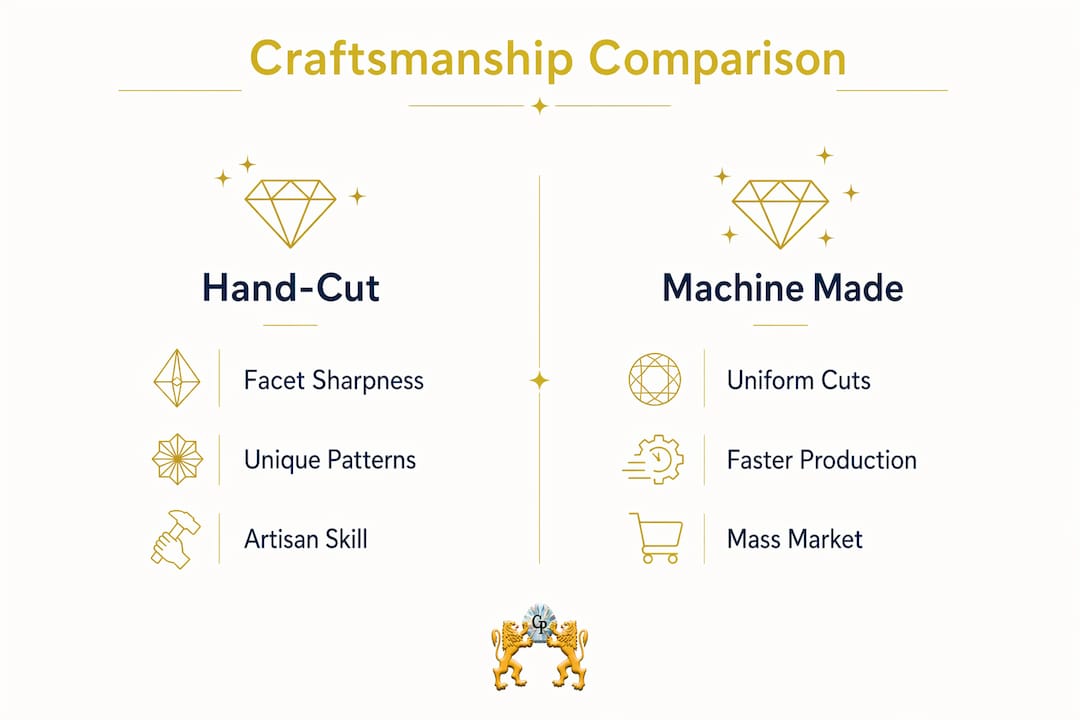
Hand-cutting and machine production are not interchangeable processes. They produce fundamentally different results at every level of quality. Hand-cutting involves a trained artisan pressing the crystal against a rotating wheel, adjusting pressure and angle by feel and sight. Machine or laser cutting applies uniform, programmed force with no sensitivity to the material’s natural grain.
The differences show up clearly in the finished piece:
- Facet sharpness. Crisp facet edges are required to maximize sparkle. Rounded edges reduce contrast and degrade optical performance. Hand-cutting maintains sharpness through constant artisan adjustment.
- Angular variation. Authentic artisans produce subtle, unprogrammed angular variations that create diffuse, starry reflections impossible to replicate with machines.
- Polishing depth. Manual polishing after cutting enhances optical clarity by removing micro-scratches that scatter light unevenly.
- Natural grain respect. Artisans read the crystal’s inclusions and follow its natural structure, producing balanced results rather than forcing a shape onto the material.
Traditional Japanese Edo Kiriko cutting is one of the clearest examples of this difference. The technique uses layered geometric patterns cut by hand, with each piece taking between 4 and 8 hours for a standard tumbler and over 10 hours for complex designs.
Pro Tip: When evaluating a hand-cut piece, look at the facet intersections under direct light. A machine-cut piece shows perfectly uniform meeting points. A hand-cut piece shows micro-variations at those intersections. Those variations are not flaws. They are the signature of a human hand.
Why does crystal craftsmanship matter for aesthetic and functional design?
Crystal craftsmanship matters because it turns a decorative object into a functional design tool. Hand-cut facets control light refraction in ways that flat or uniformly cut surfaces cannot. Each facet acts as a small prism, splitting white light into its spectrum and projecting color across walls and ceilings. The result is a room that feels alive and warm rather than static.
The functional benefits of skilled crystal artistry extend across several design applications:
- Light manipulation. Crystal prisms and chandeliers scatter and amplify natural light, reducing the need for artificial lighting during daylight hours. Crystalplace’s crystal lighting benefits are well documented in interior design practice.
- Atmosphere control. The angle and depth of cuts determine whether a piece produces soft ambient glow or sharp, dramatic sparkle. Artisans choose cutting patterns deliberately to match the intended room mood.
- Acoustic quality. Lead crystal produces a clear, sustained chime when struck. That resonance is not decorative. It is a direct result of the material’s density and the precision of the cut.
- Tactile experience. Hand-cut crystal absorbs body heat quickly, creating a warm sensation in the hand. Machine-made glass stays cold. That difference is immediately noticeable and communicates quality without a word.
“Crystal art glass functions as a design tool by manipulating natural light to shape room atmosphere and mood, beyond mere decoration.” — Love Happens Magazine, 2026
The significance of crystal art in interior design is not a trend. It is a centuries-old application of physics and material science, executed by hand. A well-placed crystal ornament does what no paint color or fabric can: it changes the quality of light itself.
What is the cultural and historical significance of preserving traditional crystal craftsmanship?
Crystal craftsmanship is a form of cultural memory. Each technique carries the accumulated knowledge of generations of artisans who refined their methods over decades. When a traditional atelier closes or a master craftsman retires without passing on their skills, that knowledge disappears permanently.
The cultural value of handcrafted crystal rests on four interconnected factors:
- Scarcity of masters. Fewer than 100 Edo Kiriko craftsmen are recognized globally as of 2026. The learning curve spans 10 to 20 years of dedicated practice. That scarcity makes every authentic piece a rare object, not just a product.
- Cultural storytelling. Traditional ateliers produce limited batches with exclusive patterns, each tied to a regional or historical tradition. Bohemian crystal, Venetian glass, and Edo Kiriko each carry distinct visual languages developed over centuries.
- Investment value. Handcrafted pieces hold or increase in value over time because they cannot be replicated at scale. Collectors and enthusiasts recognize that the labor, skill, and material quality embedded in each piece are finite resources.
- Emotional and spiritual resonance. Hand-carved crystals preserve the stone’s natural grain, producing pieces that feel energetically balanced and personally meaningful. Many collectors and healers seek hand-carved pieces specifically for this quality. The care and intention behind each piece communicate themselves through the object itself.
The psychology of crystals research published in 2026 confirms that geometric crystal forms act as cognitive templates for symbolic and metaphysical ideas. That human response to crystal geometry is not accidental. It reflects a deep, cross-cultural recognition of the skill and intention embedded in the form.
Preserving traditional craftsmanship is not nostalgia. It is the active maintenance of a knowledge base that mass production cannot replace. Supporting artisan communities, purchasing authentic pieces, and learning to recognize genuine craftsmanship all contribute to keeping these skills alive.
How can artisans and enthusiasts identify authentic crystal craftsmanship?
Identifying genuine hand-crafted crystal requires using all your senses, not just your eyes. Most people focus on visual clarity, but the most reliable indicators are tactile and acoustic.
Visual indicators:
- Look for depth in the cuts. Hand-cut facets have a three-dimensional quality. Machine cuts look flat and uniform under close inspection.
- Check facet intersections. Sharp, clean meeting points indicate careful hand work. Blurred or rounded intersections suggest machine production.
- Examine clarity. High-lead crystal has a natural warmth and depth. Ordinary glass looks flat and slightly blue-white.
Tactile and acoustic tests:
- Hold the piece for 10 seconds. Genuine high-lead crystal warms quickly in your hand. Machine-made glass stays cold.
- Tap the rim gently with a fingernail. Lead crystal produces a clear, sustained ring that fades slowly. Ordinary glass produces a dull, short tap.
| Quality indicator | Authentic hand-cut crystal | Machine-made glass |
|---|---|---|
| Facet sharpness | Crisp, with micro-variations | Uniform, rounded edges |
| Tactile warmth | Warms quickly in hand | Stays cold |
| Acoustic resonance | Clear, sustained ring | Short, dull tap |
| Cut depth | Deep, three-dimensional | Shallow, flat appearance |
| Light refraction | Dynamic, layered sparkle | Flat, uniform reflection |
Pro Tip: The detail most people overlook is the back of the piece. Machine production applies equal effort to all surfaces. Hand-cut artisans often leave subtle tool marks or slight asymmetries on interior surfaces. Those marks confirm human involvement and are a sign of authenticity, not poor quality.
Key takeaways
The importance of crystal craftsmanship lies in its irreplaceable combination of material science, artisan skill, and cultural legacy that mass production cannot duplicate.
| Point | Details |
|---|---|
| Material composition matters | 24% lead oxide is the gold standard for brilliance, deep cutting, and acoustic resonance. |
| Labor time signals quality | Authentic hand-cut pieces require 4 to 10+ hours per piece, versus minutes for machine production. |
| Craftsmanship serves function | Hand-cut facets control light refraction, shape room atmosphere, and deliver tactile warmth. |
| Cultural scarcity adds value | Fewer than 100 Edo Kiriko masters exist globally, making authentic pieces rare and investment-worthy. |
| Sensory tests confirm authenticity | Tactile warmth, acoustic ring, and facet sharpness are the most reliable indicators of genuine crystal. |
Why I believe handcrafted crystal deserves more respect than it gets
The craft world talks a lot about authenticity, but crystal craftsmanship is one of the few areas where authenticity is physically measurable. You can feel it, hear it, and see it in the light. That is rare.
What strikes me most is the patience required. A single Edo Kiriko tumbler takes up to 8 hours of focused, physical work. That is not a romantic notion. It is a real constraint that forces the artisan to be fully present with the material. There is no shortcut that preserves the result.
The market undervalues this. Artisans and enthusiasts who understand the craft behind crystal making know the difference between a hand-cut piece and a machine-pressed imitation. But casual buyers often do not, and that gap in understanding drives down the perceived value of genuine work.
Supporting traditional crystal craftsmanship is not about sentimentality. It is about preserving a form of material intelligence that took centuries to develop and cannot be downloaded or automated. Every authentic piece you choose over a mass-produced substitute keeps that knowledge alive.
— BCC
Crystalplace and the craft of authentic crystal
Crystalplace has sourced and sold authentic crystal products since 1992, building one of the most curated selections of genuine crystal prisms, chandelier parts, and decorative pieces available online.
For artisans and enthusiasts who understand the value of handmade crystals, Crystalplace offers direct access to Swarovski and other authenticated crystal lines. Every piece reflects the material standards and optical precision that define real craftsmanship. Whether you are restoring a chandelier, building a decorative installation, or sourcing prisms for a design project, the crystal prism collection at Crystalplace gives you the quality that hand-cut work demands. Free shipping applies to orders over $22 within the USA.
FAQ
What is crystal craftsmanship?
Crystal craftsmanship is the skilled practice of shaping, cutting, and finishing crystal by hand to produce pieces with superior optical, tactile, and acoustic qualities. It combines material science with artisan technique to achieve results that machine production cannot replicate.
Why does lead oxide matter in crystal quality?
A 24% lead oxide composition is the industry gold standard because it makes crystal softer, enabling deeper cuts, and produces the brilliance and sustained chime that define high-quality pieces.
How long does it take to hand-cut a crystal piece?
A standard hand-cut crystal tumbler takes 4 to 8 hours of artisan labor. Complex patterns can exceed 10 hours. Machine production completes the same form in minutes.
How do I test if crystal is authentic?
Hold the piece for 10 seconds. Genuine lead crystal warms quickly in your hand. Tap the rim gently. Authentic crystal produces a clear, sustained ring. Machine-made glass stays cold and produces a short, dull tap.
Why is traditional crystal craftsmanship culturally significant?
Traditional crystal craftsmanship carries centuries of regional knowledge and technique. With fewer than 100 recognized Edo Kiriko masters remaining globally, each authentic piece represents a rare, non-reproducible form of cultural and material heritage.
Recommended
- What Is Crystal Craftsmanship: A Crafter’s Guide – CrystalPlace
- The Role of Crystal Beads in Design for Decorators – CrystalPlace
- Why Use Crystal Beads for Your Craft Projects – CrystalPlace
- Crystal repair services: restoring your fixture’s brilliance – CrystalPlace