

Discover chandelier mounting types explained to find the perfect fit for your style and ceiling height. Transform your space today!
TL;DR:
- The choice of chandelier mounting type depends on ceiling height, fixture weight, and electrical box rating. Proper hardware installation, finish matching, and code compliance are essential for a safe and visually appealing fixture. Crystalplace offers hardware parts and crystal care supplies to support high-quality chandelier installation and restoration.
The six main chandelier mounting types are chain suspension, rod/pipe suspension, flush mount, semi-flush mount, pendant/cable suspension, and ceiling hook/J-box suspension. Each solves a different structural and aesthetic problem. The Crystal Place, with 30+ years of supplying premium crystal parts, sees the same mismatches repeatedly — and most of them trace back to choosing the mount before checking the ceiling.
Quick-reference guide:
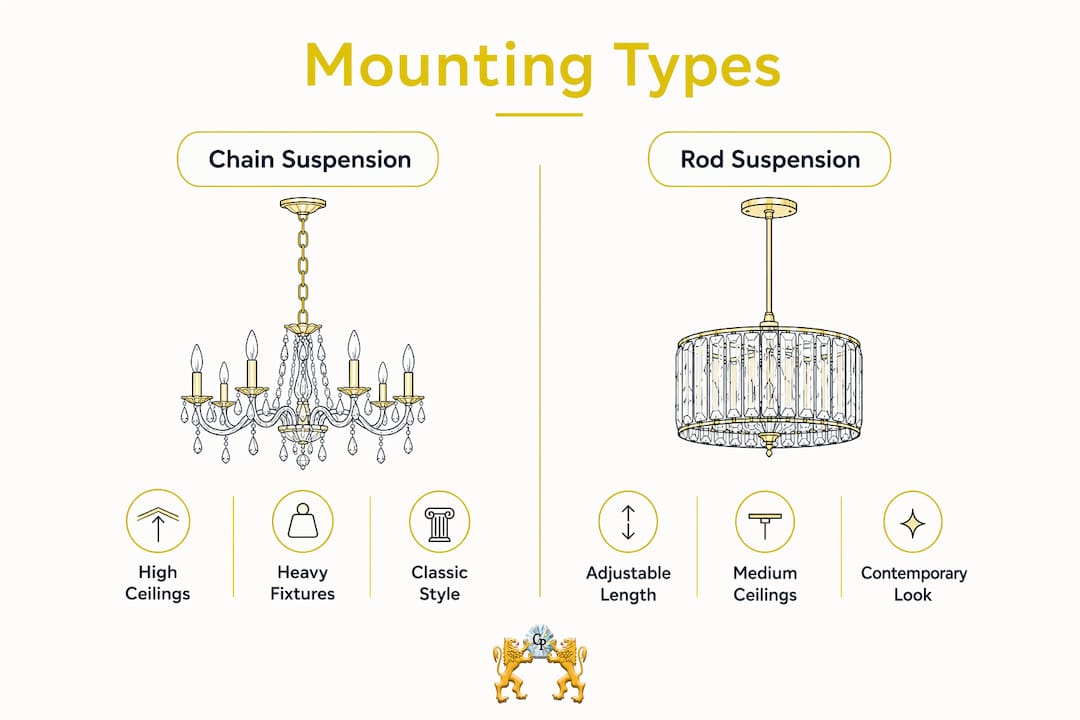
- Chain suspension — adjustable height, best for standard 9–12 ft ceilings and traditional or crystal fixtures
- Rod/pipe suspension — rigid, fixed-length drop; ideal for modern or contemporary designs where sway is unwanted
- Flush mount — sits tight to the ceiling; the right call for rooms with 8 ft or less of clearance
- Semi-flush mount — drops 4–10 inches; a practical middle ground for 8–9 ft ceilings that need some visual presence
- Pendant/cable suspension — adjustable, contemporary; works well over islands, dining nooks, or in grouped arrangements
- Ceiling hook/J-box suspension — a hook screwed into a rated junction box; common for lighter decorative fixtures and swag-style hangs
TL;DR: If your fixture exceeds 50 lbs or your ceiling is nonstandard (sloped, vaulted, two-story), consult a licensed electrician before ordering any hardware. NEC 410.36 requires all wiring and splices to be fully contained in a rated junction box — no exceptions.
What are the main chandelier mounting types?
Chain and rod suspension dominate the premium crystal fixture market because they allow the fixture to hang at the correct visual height. Chain suspension allows adjustable height by adding or removing links to set the drop without new hardware. Rod/pipe suspension offers a rigid, clean look, eliminating sway, important for heavy multi-tier crystal chandeliers where movement can stress components.
| Mounting Type | Best Ceiling Height | Typical Weight Range | Style Fit |
|---|---|---|---|
| Chain suspension | high ceilings | Up to 50 lbs (standard box) | Traditional, crystal, ornate |
| Rod/pipe suspension | suitable for high ceilings | Up to 50 lbs (standard box) | Modern, transitional |
| Flush mount | suitable for lower ceilings | Under 25 lbs | Contemporary, minimal |
| Semi-flush mount | suitable for moderately low ceilings | Under 50 lbs | Transitional, casual |
| Pendant/cable | suitable for higher ceilings | Under 25 lbs | Modern, industrial |
| Ceiling hook/J-box | suitable for higher ceilings | Under 50 lbs | Swag, casual, decorative |
Finish matching across the canopy, chain, and fixture body is one of the most overlooked details in a premium installation. Lighting designers consistently flag mismatched finishes as the single fastest way to make an expensive crystal chandelier look amateurish. If the fixture body is antique brass, the chain and canopy need to match — not “close enough.”
Pro Tip: When ordering replacement chain or a new canopy, photograph the existing hardware under natural light and compare it against the supplier’s finish swatches. Polished brass and satin brass read very differently in person.
What does each piece of mounting hardware actually do?
Every chandelier mounting system is a stack of components, and each one has a specific job. Knowing which parts are structural and which are decorative tells you what to inspect on arrival.
- Canopy — the decorative plate that covers the junction box opening. It carries no structural load; the crossbar and box do. If the canopy sits skewed or shows gaps, the bracket underneath is not plumb.
- Crossbar/strap — the metal bar that spans the junction box opening and anchors the fixture. This is a structural part; verify its weight rating matches or exceeds your fixture.
- Threaded nipple — the short threaded pipe that connects the crossbar to the canopy or chain loop. Thread size (typically ⅜-inch IPS) must match across all components.
- Screw-collar loop — the loop at the top of the chain that threads onto the nipple; it must be rated for the fixture’s weight.
- Chain links — decorative and functional; each link must be rated for the total hanging load, including the fixture and any added crystal weight.
- Rod/pipe couplers — join sections of rigid rod; check that couplers are the same diameter and finish as the rod itself.
- Swivel canopy/angled adapter — allows the canopy to pivot on a sloped ceiling while keeping the fixture plumb. Required for any ceiling pitch beyond a few degrees.
- Ceiling hook assembly — a hook-and-ball assembly screwed into the crossbar; used for swag-style or hook-hung fixtures.
Pro Tip: On arrival, thread the nipple into the crossbar by hand before installation. If it binds or cross-threads, the parts are mismatched — return them before the electrician shows up.
How do sloped or vaulted ceilings change your mounting options?
A standard canopy is flat. On a sloped ceiling, a flat canopy creates a gap on one side and puts uneven stress on the mount. Swivel canopies keep a fixture vertical on sloped or vaulted ceilings and prevent that uneven stress — they are not optional on any ceiling with meaningful pitch.
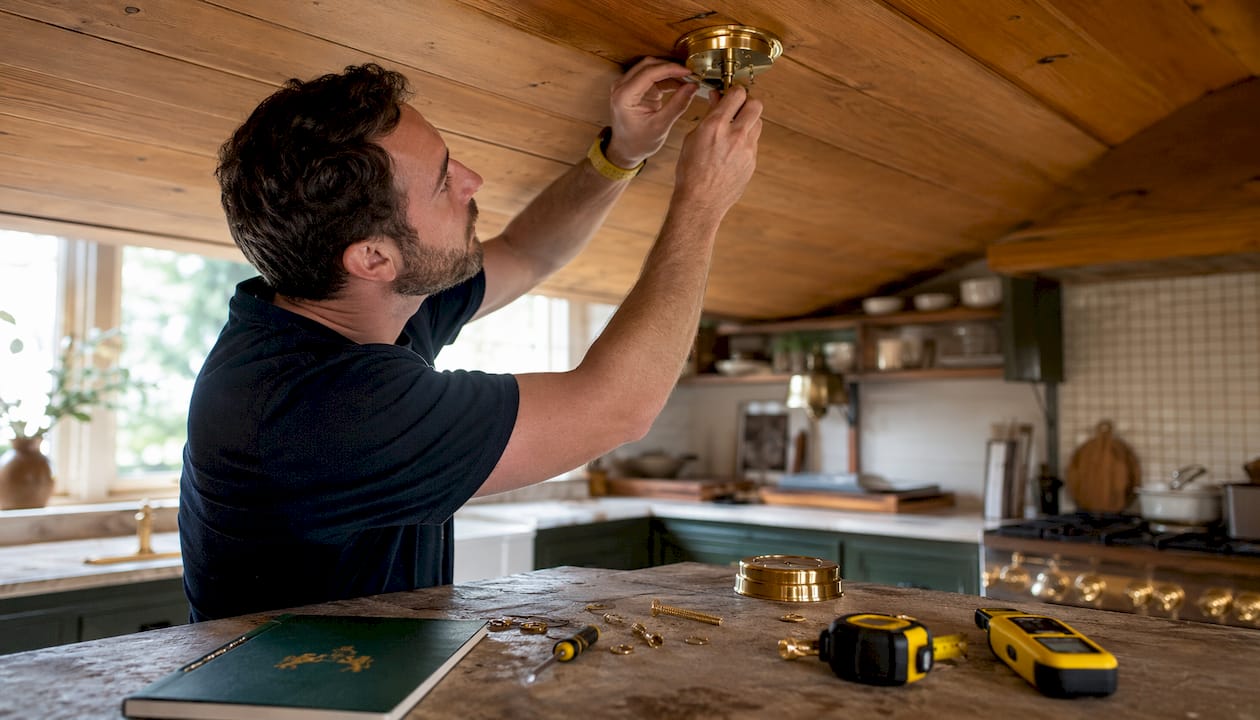
For vaulted or cathedral ceilings, the junction box must be anchored to a structural member, not just drywall. High-ceiling installations typically require reinforced boxes, longer chain or rod runs, and often a two-person crew or a lift for safe positioning. The Crystorama Fulton six-light ceiling mount is one example of hardware designed to perform on vaulted ceilings.
Hardware checklist for sloped or vaulted installations:
- Swivel canopy rated to the fixture’s weight
- Fan-rated brace box anchored to framing (not drywall)
- Longer threaded nipple to accommodate the canopy pivot
- Safety cable as a secondary retention point for fixtures over 25 lbs
- Extended chain or rod length calculated from the highest ceiling point
Pro Tip: Measure the ceiling pitch in degrees before ordering a swivel canopy. Most swivel canopies accommodate pitches up to 45–60 degrees, but verify the spec — a steep cathedral ceiling may need a custom angled adapter.
Does your ceiling structure actually support the fixture weight?
Weight-to-mount mismatch is the leading cause of mounting failure — and it tends to show up gradually as “fixture creep” before it becomes a catastrophic drop. Standard 4-inch round or octagonal junction boxes are rated to 50 lbs. Fan-rated brace boxes extend capacity to roughly 75 lbs. Anything heavier requires direct joist anchoring or dedicated lumber blocking.
The 1.5× safety factor rule: Hardware should be rated for at least 1.5 times the fixture’s actual weight to account for dynamic loading. A 40-lb chandelier needs hardware rated for at least 60 lbs minimum.
| Fixture Weight | Recommended Support |
|---|---|
| Under 25 lbs | Standard ceiling box |
| 25–50 lbs | Standard box (verify rating stamp) |
| 50–75 lbs | Fan-rated brace box |
| 75–100 lbs | Heavy-duty brace + joist anchor |
| Over 100 lbs | Engineering review required |
Professionals commonly add 2×10 or 2×12 lumber blocking between ceiling joists for heavy fixtures rather than trusting any pre-existing box. For fixtures over 100 lbs, a structural review is the responsible call.
Inspection checklist: Locate the nearest joist with a stud finder. Check the box for a weight-rating stamp. If no stamp is visible, treat it as unrated and replace it.
What electrical code requires for chandelier junction boxes
Every hardwired chandelier must have a properly rated junction box. NEC 410.36 requires all wiring and splices to be fully contained within that box. The canopy is decorative — it covers the box opening but carries no wiring responsibility and no structural load.
“Professional installations ensure wiring is contained within the junction box; the canopy is decorative and should not hold wires or splices.” — Uboze Lighting, citing NEC 410.36 compliance requirements.
Red flags that mean stop and call an electrician:
- No junction box present (wires emerging directly from drywall)
- Box not attached to framing — it moves when pushed
- Exposed wire splices inside the canopy
- Box with no visible weight-rating stamp for a fixture over 25 lbs
Questions to ask your electrician: Is the existing box rated for this fixture’s weight? Does the box attach to a joist or a brace? Are all splices inside the box, not the canopy?
How to choose the right mounting for your project
Work through this checklist in order before buying any hardware.
- Measure ceiling height and room scale. Under 8 ft: flush or semi-flush only. 9 ft and above: chain, rod, or pendant suspension are all viable.
- Weigh or find the fixture’s listed weight. Include crystals, arms, and any added decorative elements.
- Verify junction box rating. Match or exceed the fixture weight, then apply the 1.5× safety factor.
- Choose suspension method. Chain for adjustable height and traditional style; rod for rigid, modern drop; flush/semi-flush for low ceilings.
- Match finish across canopy, chain/rod, and fixture body. Order samples if you are unsure.
Hire a pro when: the fixture exceeds 75 lbs, the ceiling is two stories up, the existing box is unrated or unattached to framing, or the wiring situation is unclear. A step-by-step chandelier assembly guide can help you prepare for the installation conversation.
What does chandelier installation actually cost?
| Item | Typical U.S. Cost Range |
|---|---|
| Basic hardware (canopy, strap, nipple) | $20–$50 |
| Fan-rated brace box | $20–$50 |
| Electrician labor, standard install | $100–$150 |
| Electrician labor, reinforced/vaulted | $250–$400 |
| Joist blocking and structural work | $150–$400 additional |
Timeline notes:
- Standard install (existing box, under 50 lbs): 1–3 hours, same day
- Reinforced install (new brace box, 50–100 lbs): half to full day
- Structural reinforcement or very high ceilings: one to two days, may require scaffold or lift rental
Regional labor rates vary significantly. Urban markets on the coasts run toward the top of these ranges; rural markets often come in lower. Custom hardware, specialty finishes, or fixtures requiring scaffold access push costs higher regardless of location.
Keeping your chandelier looking its best after installation
Finish coordination does not stop at the canopy. The canopy, chain or rod, and fixture body should share the same metal finish — polished nickel, antique brass, oil-rubbed bronze, or matte black are the most common choices for premium crystal fixtures. For vintage chandelier parts matching, photographing existing hardware in natural light before ordering is the most reliable approach.
Maintenance checklist:
- Clean crystals with Brilliante crystal chandelier cleaner — spray-on formulas protect wiring by eliminating the need to submerge or scrub
- Check threaded fittings (nipple, screw-collar loop) for loosening every 12 months; vibration from nearby doors or HVAC causes gradual backing-out
- Inspect chain links annually for stress deformation, especially on fixtures over 30 lbs
- When installing chandelier crystals, work from the top tier down to avoid dislodging already-hung pieces
Pro Tip: On multi-arm chandeliers, hang crystals symmetrically from opposite sides rather than completing one arm at a time. This keeps the fixture balanced on the mount throughout the process and prevents the chain from twisting under uneven load.
Crystalplace resources for parts, education, and restoration
Crystalplace has supplied premium crystal chandelier parts since 1992, and the catalog covers everything a mounting or restoration project needs: canopies, chains, bobeches, crystal connectors, finials, and Brilliante cleaner. The blog library includes practical guides on chandelier repair workflows and replacing chandelier parts that walk through hardware inspection and swap procedures step by step.
- Mounting hardware: canopies, crossbars, threaded nipples, screw-collar loops, and chain in matched finishes
- Crystal prisms: authentic Swarovski and Magnificent Crystal Brand, clear and colored, for restoration or upgrade
- Maintenance supplies: Brilliante crystal chandelier cleaner for safe, no-disassembly cleaning
- Educational resources: assembly guides, repair workflows, and parts-matching tutorials for DIYers and professionals
With over 30 years in the specialty crystal parts market, Crystalplace is the resource lighting professionals and homeowners return to when standard hardware stores fall short on finish options or part specificity.
Key Takeaways
Choosing the correct chandelier mounting type comes down to three variables: ceiling height, fixture weight, and junction box rating — get all three right before ordering any hardware.
| Point | Details |
|---|---|
| Match mount to ceiling height | Flush/semi-flush for under 8 ft; chain or rod suspension for 9 ft and above. |
| Apply the 1.5× safety factor | Hardware must be rated for at least 1.5 times the fixture’s actual weight for dynamic load safety. |
| Use swivel canopies on slopes | Any meaningful ceiling pitch requires a swivel canopy or angled adapter to keep the fixture plumb. |
| Hire a pro above 75 lbs | Fixtures over 75 lbs, vaulted ceilings, or unrated boxes require a licensed electrician. |
| Crystalplace for parts and finish matching | Crystalplace stocks canopies, chains, crystal prisms, and Brilliante cleaner for complete mounting and restoration projects. |
The detail most guides skip
The conversation around chandelier mounting types tends to focus on weight limits and box ratings — which matters — but the detail that separates a truly finished installation from a merely functional one is bracket leveling and wire routing inside the junction box. If the mounting bracket is even slightly off-plumb, the canopy will sit crooked or show a gap on one side. No amount of crystal quality fixes that. And stuffing wires into the canopy rather than coiling them neatly inside the box is not just a code violation under NEC 410.36 — it physically prevents the canopy from sitting flat.
After 30+ years of supplying premium parts, the pattern is consistent: buyers invest in exceptional crystals and then lose the visual payoff because the hardware underneath was treated as an afterthought. Inspect every threaded component on arrival, verify the finish under natural light, and confirm the bracket is plumb before the canopy goes on. Those three steps cost nothing extra and protect everything you spent on the fixture itself.
Where to find premium mounting parts and crystal-care supplies
Crystalplace stocks the full range of mounting hardware and crystal-care supplies that premium chandelier installations demand — from finish-matched canopies and chains to authentic Swarovski prisms and Brilliante cleaner.
Whether you are replacing a single canopy to match an existing fixture or sourcing parts for a full restoration, the Crystalplace catalog covers it:
- Canopies and crossbars in polished nickel, antique brass, oil-rubbed bronze, and matte black
- Chains, rods, and swivel adapters for standard and sloped ceilings
- Crystal prisms (Swarovski and Magnificent Crystal Brand) in clear and color
- Brilliante crystal chandelier cleaner for maintenance without disassembly
Browse the full catalog and order with free U.S. shipping on orders over $22 at crystalplace.com.
Useful sources
These references back the technical claims in this guide. Bring them to your electrician or contractor when discussing load ratings, code compliance, or reinforcement options.
- Modern Chandelier — Installation and Electrical Safety Guide: weight-to-mount ratios, the 1.5× safety factor, and common installer errors
- Uboze Lighting — Code Requirements for Crystal Chandelier Electrical Boxes: NEC 410.36 wiring containment requirements
- Amped Electrical Inc. — Do You Really Need an Electrician?: vaulted ceiling risks, joist blocking, and when to hire a pro
- Research.Lighting — Chandelier FAQs: swivel canopy requirements for sloped ceilings and wire routing best practices
- Golden Lighting — How to Hang Chandeliers: fixture weight thresholds and fan-rated box requirements
Recommended
- Chandelier parts guide: 8 key components explained – CrystalPlace
- Chandelier Crystal Connector Types Explained – CrystalPlace
- Chandelier Parts for Sale: What to Buy – CrystalPlace
- Chandelier Crystals & Parts Guide - Replacement Tips – CrystalPlace