

Learn how to replace damaged chandelier crystals safely, match replacement prisms and hardware, clean delicate pieces, and know when to call an electrician.
A missing or damaged chandelier crystal can often be replaced without dismantling the entire fixture. The important part is knowing where a straightforward decorative repair ends and electrical or structural work begins.
This guide explains how to replace hanging crystals, connectors, pins, and similar decorative components. If the chandelier has damaged wiring, loose sockets, cracked arms, an unstable ceiling connection, or signs of overheating, stop and contact a qualified electrician or chandelier-restoration professional.
What You Can Safely Repair Yourself
Many homeowners can handle simple decorative repairs such as:
- Replacing a missing crystal
- Removing a chipped or cracked prism
- Replacing an open or damaged connector
- Reattaching a loose crystal chain
- Cleaning detached crystals
- Matching replacement prisms by size and shape
Professional help is the safer choice when the repair involves:
- Wiring or electrical connections
- Lamp sockets
- The ceiling canopy or mounting bracket
- A loose, leaning, or unusually heavy chandelier
- Cracked glass arms or load-bearing components
- Scorch marks, damaged insulation, flickering, or unusual heat
- Work that cannot be reached comfortably from a suitable ladder
Before You Begin
Gather everything before climbing:
- A stable stepladder suitable for your height and the working area
- Needle-nose pliers
- A soft, lint-free cloth
- Small containers for connectors and pins
- Protective eyewear
- Clean gloves appropriate for handling glass
- A ruler or caliper
- A phone or camera for reference photographs
- The correct replacement crystal and hardware
Place a soft cloth beneath the work area to protect dropped components. Keep children and pets away, and ask another adult to remain nearby.
Follow the ladder manufacturer’s instructions. Use the ladder only on a stable, level surface, keep the surrounding area clear, and do not stand on a step that is not designed for standing. These precautions are consistent with official OSHA portable-ladder guidance.
Turn Off the Power
Turn off the chandelier at the circuit breaker—not only at the wall switch—and prevent anyone from turning the circuit back on while you are working.
The Electrical Safety Foundation International advises turning power off and proving through accurate testing that it is off before electrical work begins. It also recommends confirming that the tester itself works. See ESFI’s electrical safety commitments.
If you do not know how to identify the correct circuit or verify that the fixture is de-energized, have a qualified electrician handle the work.
Allow the bulbs and fixture to cool completely before touching any part of the chandelier.
Inspect the Chandelier Before Removing Anything
Begin by photographing the entire chandelier from several angles. Take close-up pictures of the damaged crystal, its connector, and the surrounding pattern.
Check for:
- Missing, chipped, or cracked crystals
- Open jump rings or connectors
- Bent pins
- Loose crystal chains
- Damaged chandelier loops
- Uneven spacing
- Signs of electrical or structural damage
Do not continue if the problem involves wiring, sockets, support hardware, or the ceiling connection.
Measure the Original Crystal
The most reliable replacement is one that matches the original component closely.
Record:
- Overall height and width
- Thickness
- Shape
- Color
- Number and arrangement of facets
- Hole size and position
- Connector style and finish
- Approximate weight
If possible, remove one intact neighboring crystal and use it as the reference. Photograph it beside a ruler in natural light.
A difference of only a few millimeters may affect spacing and alignment, so measurements are more dependable than appearance alone. Our chandelier replacement and restoration guide can help you identify common crystal and hardware types.
Remove the Damaged Crystal
Support the crystal with one hand while working on its connector with the other.
Grip the metal hardware rather than squeezing the crystal. Open the connector only as much as necessary. If the piece does not release easily, look for a second pin, ring, or attachment point instead of forcing it.
Place the removed crystal and hardware in a labeled container. Keeping the original connector can help you identify the correct replacement.
If the chandelier uses fragile, antique, or custom-made hardware, consult a restoration professional before bending it.
Match the Replacement Crystal and Hardware
A replacement should complement the chandelier’s existing crystals in size, shape, clarity, color, and hanging position.
Check that:
- The hole is large enough for the connector
- The connector closes completely
- The crystal hangs at the correct height
- Its weight is appropriate for the mounting point
- It does not strike neighboring crystals
- Its color and faceting look consistent under the chandelier’s normal lighting
For a large restoration, test one sample on the chandelier before purchasing the full quantity.
CrystalPlace has supplied chandelier crystals and replacement components since 1992. Clear photographs and accurate measurements can help us identify a suitable match.
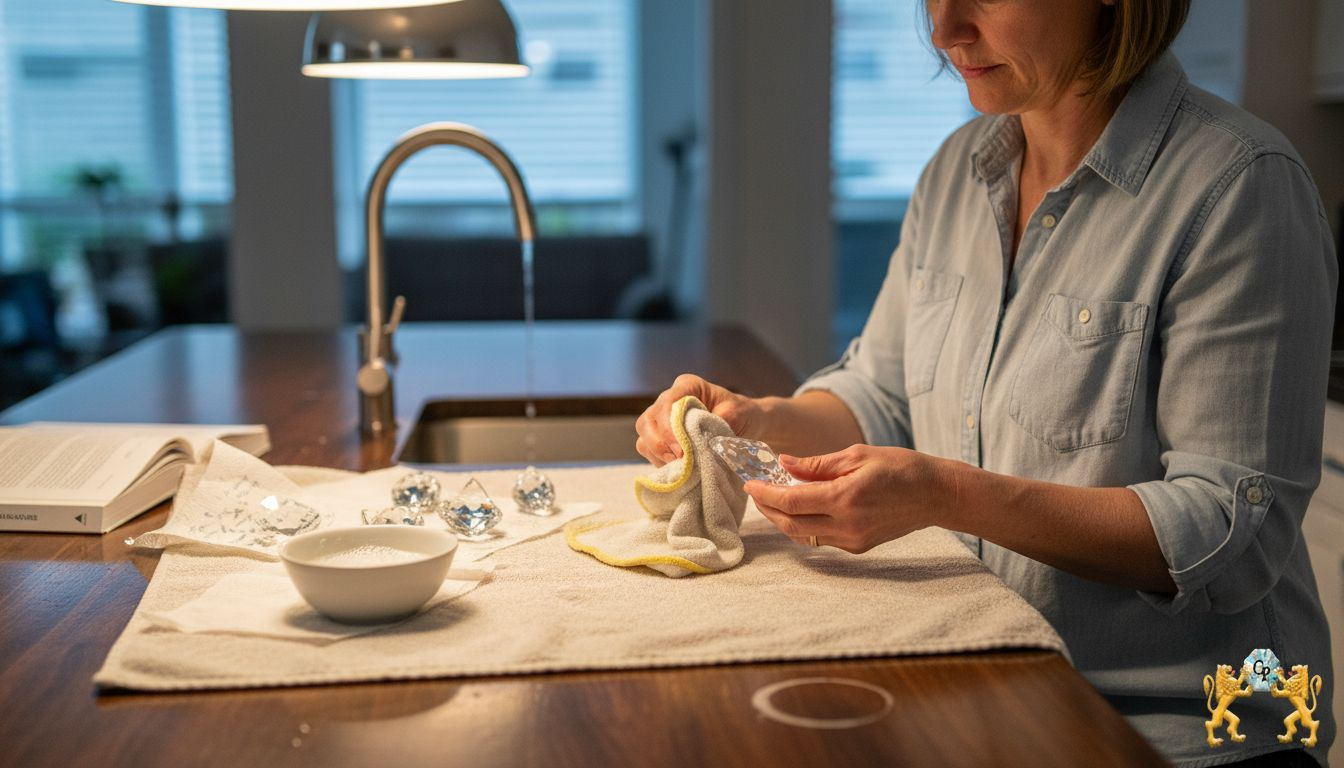
Clean the Crystal Carefully
Clean the replacement before installation so fingerprints and residue are not trapped around the connector.
For light dust, begin with a soft, lint-free cloth. Follow the manufacturer’s instructions before using water or cleaning products.
Swarovski’s official crystal-care guidance recommends avoiding harsh or abrasive materials and glass cleaners. For washable crystal décor, it recommends lukewarm water, mild pH-neutral dish detergent, minimal water contact, and thorough drying.
Do not spray cleaner onto an installed chandelier. Moisture must not enter sockets, wiring, connectors, or other electrical parts.
Install the Replacement
Attach the new crystal using hardware that matches the original connection.
For a jump ring
- Open the ring sideways rather than pulling its ends apart.
- Pass it through the crystal and the chandelier loop.
- Close the ring until its ends meet cleanly.
For a pin or clip
- Confirm that its size matches the crystal hole.
- Insert it without forcing it against the crystal.
- Secure it in the same position as the surrounding components.
Support the crystal until the connection is fully closed. Do not overtighten or twist against the crystal hole.
After installation, apply a very light downward check to confirm that the connection holds. Do not pull hard enough to stress the fixture. See our chandelier crystal installation guide for additional connector examples.
Complete the Final Inspection
Before restoring power:
- Confirm that every connector is closed
- Check that no crystal touches a bulb
- Remove tools and loose hardware
- Make sure all components are dry
- Step back and compare the repaired section with the rest of the chandelier
- Verify that the work has not disturbed any wiring or structural components
Only restore power after the work area is clear and the chandelier appears secure.
Common Repair Mistakes
Ordering by appearance alone
Product photographs do not provide reliable measurements. Record the exact dimensions and connection style before ordering.
Forcing a connector
A connector that does not fit may be the wrong size or shape. Forcing it can chip the crystal or damage the chandelier loop.
Reusing damaged hardware
Replace connectors that are badly bent, cracked, corroded, or unable to close securely.
Working from an unstable ladder
Do not place a ladder on furniture, boxes, or another raised surface. Reposition the ladder instead of leaning beyond its side rails.
Spraying an installed chandelier
Cleaning liquid can enter electrical components. Apply cleaning products to a cloth or clean detached crystals according to their manufacturer’s care instructions.
Attempting electrical repairs without proper qualifications
Decorative crystal replacement is different from repairing a socket, wire, canopy, or mounting bracket. Electrical and structural problems require appropriate professional help.
When to Call a Professional
Stop and request professional assistance if:
- The chandelier moves at the ceiling
- An arm or structural component is cracked
- Wiring is visible or damaged
- A socket is loose, scorched, or unusually hot
- The fixture flickers after bulbs have been checked
- The chandelier is too high or heavy to reach safely
- Several sections must be dismantled
- Antique or irreplaceable parts are involved
- You are uncertain about any electrical condition
The cost of professional assistance is easier to justify than risking personal injury or causing additional damage to the fixture.
Frequently Asked Questions
Can I replace one chandelier crystal myself?
Often, yes. A simple hanging crystal or connector can usually be replaced if the chandelier is securely mounted, the power is turned off, the area is safely accessible, and no electrical or structural work is required.
How do I find a matching replacement?
Photograph an intact crystal beside a ruler and record its height, width, thickness, shape, hole position, color, and connector style. These details are more useful than a photograph alone.
Can I use any connector that fits through the hole?
The connector must fit the crystal hole, close securely, support the crystal’s weight, and match the chandelier’s spacing. Do not force oversized hardware through a crystal.
Should I glue a broken chandelier crystal?
Glue is rarely the best solution for a hanging load-bearing connection. A repaired crystal may remain visibly damaged or fail later. Replacing the damaged crystal or connector is generally more dependable.
Can I clean crystals while they are attached?
Light dust can be removed carefully with a soft cloth. Avoid spraying an installed chandelier because liquid can reach electrical components. More thorough cleaning is usually safer when the crystal can be detached and handled according to the manufacturer’s care instructions.
When is an electrician necessary?
Use a qualified electrician when the problem involves wiring, sockets, the ceiling connection, the mounting bracket, flickering, overheating, or any uncertainty about whether the fixture is safely de-energized.
Final Advice
Successful chandelier repair begins with a clear boundary: decorative crystals and connectors may be manageable, but electrical and structural repairs require qualified help.
Work slowly, photograph each section, measure before ordering, and never force a component that does not fit. A carefully matched crystal and secure connector will restore the chandelier’s appearance without exaggerated promises or unnecessary risk.

Sources
- Electrical Safety Foundation International: 8 Life Saving Commitments
- OSHA: Portable Ladder Safety
- Swarovski: How to Care for Crystal Decorations