

Discover what crystal light enhancement is and how it transforms spaces with soft, radiant illumination. Elevate your home’s ambiance today!
TL;DR:
- Crystal light enhancement uses faceted crystals to scatter and refract light, creating a soft, radiant glow in interiors. Proper maintenance and high-quality materials amplify the effect, making rooms appear larger and more elegant without increasing energy use. Using wide-beam LED bulbs and regular cleaning preserves the crystals’ luminous and sparkling qualities over time.
Crystal light enhancement is the optical process where faceted crystal elements scatter and refract light to produce softer, more radiant illumination in interior spaces. Each crystal acts as a miniature prism, bending incoming light rays in multiple directions to eliminate harsh glare and replace it with a warm, uniform ambient glow. The result is a room that feels larger, more elegant, and more inviting without adding a single watt of extra power. Understanding what is crystal light enhancement, how it works, and how to maintain it gives homeowners and decorators a real edge in transforming any space.
What is crystal light enhancement and how does it work?
Crystal light enhancement is defined as the use of faceted crystal elements to diffuse and refract artificial or natural light across a room. The industry term for the underlying mechanism is light diffusion through refraction, and it explains why a crystal chandelier looks nothing like a bare bulb fixture of the same wattage.
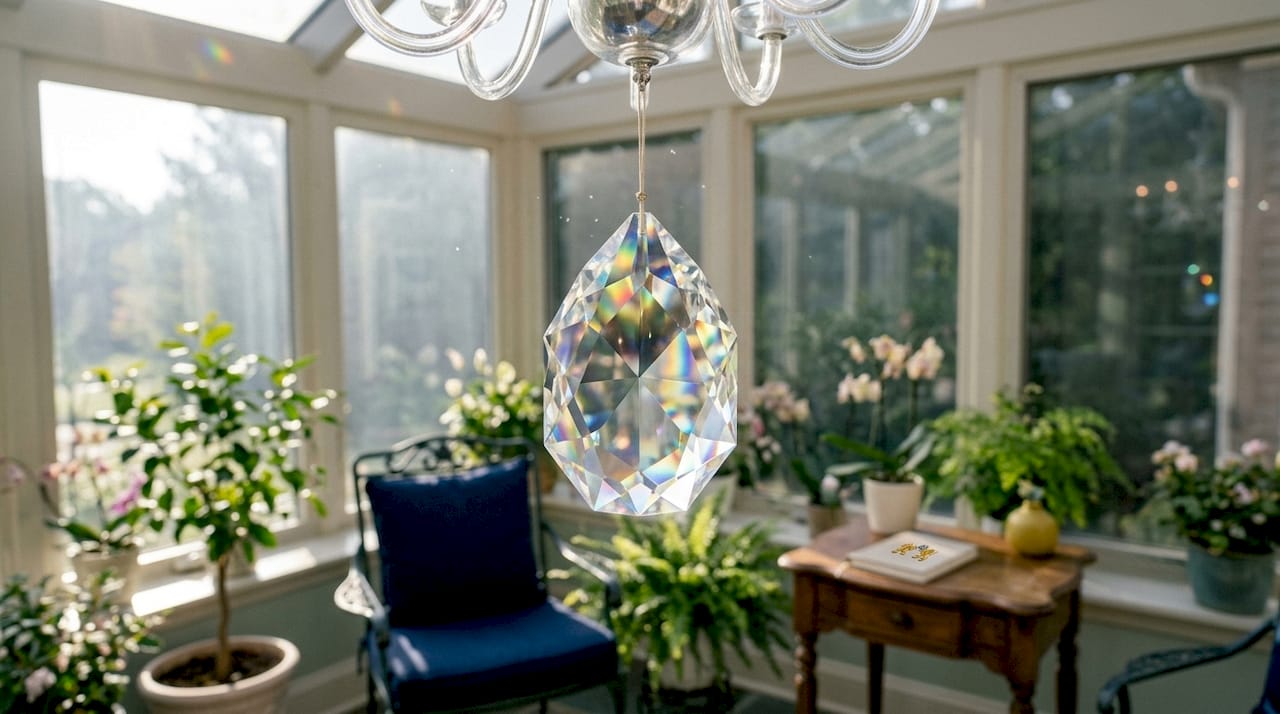
Faceted crystals act as tiny lenses, bending light rays at different angles and multiplying diffusion to intensify sparkle and rainbow effects. Each precisely cut facet redirects a portion of the incoming light beam, so one bulb effectively becomes dozens of soft light sources scattered across walls and ceilings. The more facets a crystal has, the more scattering points it creates, and the richer the ambient effect.
Material quality matters just as much as facet count. Lead crystal carries a higher refractive index than standard glass, which produces more pronounced light scattering and the signature rainbow prism effects that define quality crystal lighting. Standard glass bends light too, but the effect is noticeably flatter and less dynamic.
Premium crystal fixtures can deliver up to 30% more effective light output compared to standard glass fixtures without requiring additional electrical power. That gain comes entirely from better light distribution, not from drawing more energy.
Here is what separates high-performance crystal elements from average ones:
- Facet count: More facets create more scattering points and a richer glow.
- Refractive index: Lead crystal and high-grade optical crystal outperform standard glass.
- Surface clarity: Any cloudiness or micro-scratches reduce light transmission.
- Cut precision: Machine-cut facets produce sharper, more consistent light patterns than hand-cut alternatives.
- Crystal size: Larger crystals catch more light and project wider rainbow arcs.
Pro Tip: When selecting crystals for a fixture, hold a single piece up to a light source before buying. A high-quality crystal will throw a sharp, colorful rainbow. A low-quality piece will produce only a dull, diffuse glow with no color separation.
Where are the best uses of crystal light in interior design?
Crystal light enhancement makes interiors appear more elegant and inviting by softening glare and creating sparkling ambient effects that lift mood and perceived space size. The applications span every room type and nearly every design style, from traditional to contemporary.
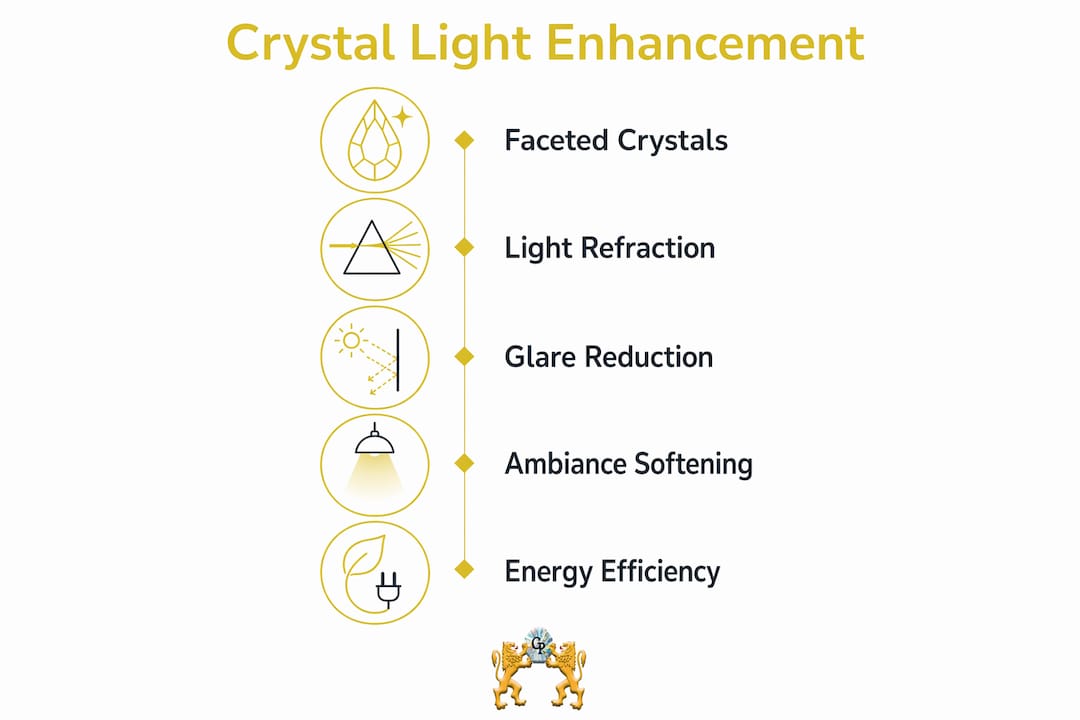
Chandeliers and pendant lights
Chandeliers are the most recognized application. A multi-tiered chandelier fitted with crystal prisms for chandeliers distributes light across an entire dining room or entryway, eliminating the flat, shadowless look of recessed lighting. Pendant lights with single crystal drops work equally well over kitchen islands or bathroom vanities, where a focused sparkle adds visual interest without overwhelming the space.
Wall sconces and table lamps
Wall sconces fitted with crystal bobeches or crystal bead chains create layered lighting that works alongside overhead fixtures. Table lamps with crystal bases or crystal-trimmed shades add a localized glow that warms reading corners and bedside areas. The key advantage in both cases is that the crystal element softens the direct light from the bulb, so the fixture itself never looks harsh.
Commercial and event spaces
Hotels, restaurants, and retail stores use crystal light enhancement to signal quality and create atmosphere. A hotel lobby chandelier loaded with Swarovski crystal elements communicates luxury before a guest reads a single word of signage. Event designers use hanging crystal suncatchers and crystal curtains to transform plain venues into spaces that photograph beautifully under any lighting condition.
Here are the most effective ways to apply crystal light enhancement by room type:
- Entryways: A crystal chandelier creates a strong first impression and fills vertical space with light.
- Dining rooms: Crystal pendants or chandeliers over the table soften overhead light and flatter faces.
- Living rooms: Crystal floor lamp accents or crystal-trimmed sconces add depth to ambient lighting schemes.
- Bedrooms: Small crystal pendant lights or table lamps with crystal bases create a calm, warm glow.
- Bathrooms: Crystal vanity fixtures reduce the clinical feel of bright bathroom lighting.
- Commercial spaces: Crystal ceiling fixtures and hanging crystal panels signal quality and elevate brand perception.
The role of crystals in lighting design extends beyond decoration. Crystal elements actively improve the functional quality of light in a space, making them a practical choice as much as an aesthetic one.
How do you maintain crystal light enhancement effects over time?
Maintenance is the most overlooked factor in crystal lighting performance. Dust buildup on crystal fixtures can dim brilliance by up to 30% because dust coats the facets and blocks the light diffusion process. A chandelier that looked stunning at installation can lose a third of its visual impact within months if left uncleaned.
Regular cleaning preserves the crystal’s ability to diffuse light and maintain illumination quality over time. The cleaning method matters as much as the frequency. Here is a practical maintenance schedule:
- Weekly: Use a clean, dry microfiber cloth or a soft feather duster to remove surface dust from crystal elements without disturbing their arrangement.
- Monthly: Wipe each crystal piece with a lint-free cloth lightly dampened with a crystal-safe cleaning solution. Dry immediately to prevent water spots.
- Annually: Remove crystals from the fixture for a full soak-and-rinse cleaning using a dedicated crystal chandelier cleaner. Rehang after complete drying.
- After renovation work: Clean immediately after any painting, sanding, or construction nearby. Fine particles settle on crystal surfaces and bond quickly.
Common mistakes that degrade crystal light quality include using paper towels (which scratch surfaces), applying household glass cleaners with ammonia (which cloud crystal over time), and leaving wet crystals to air dry (which causes mineral deposits from tap water).
Pro Tip: Place a soft towel or blanket directly under the chandelier before cleaning. Any crystal piece that slips during cleaning lands safely instead of shattering on a hard floor.
How does crystal light compare to standard lighting?
The difference between crystal-enhanced lighting and standard glass or bare-bulb fixtures is not subtle. The sparkle and soft ambient glow in crystal lighting come from expertly engineered light diffusion through many faceted crystals. Standard fixtures simply cannot replicate that effect because they lack the refractive geometry.
| Feature | Crystal-enhanced lighting | Standard glass lighting |
|---|---|---|
| Light output efficiency | Up to 30% more effective output | Baseline output only |
| Glare | Soft, diffused, no harsh hotspots | Direct, often harsh at the source |
| Ambiance | Warm, layered, with sparkle and rainbow effects | Flat, uniform, no visual depth |
| Shadow quality | Soft edges, gentle gradients | Hard shadows, sharp edges |
| Perceived room size | Appears larger due to scattered light | No size enhancement effect |
| Maintenance impact | Cleaning directly affects light quality | Cleaning affects appearance only |
The ambiance difference is the most commercially significant factor. Crystal lighting benefits include a measurable lift in how inviting and spacious a room feels, which is why hospitality designers specify crystal fixtures for spaces where atmosphere drives revenue. Standard lighting delivers adequate illumination. Crystal-enhanced lighting delivers an experience.
Energy efficiency also favors crystal. Because faceted crystals distribute light more widely, a lower-wattage bulb inside a crystal fixture can achieve the same perceived brightness as a higher-wattage bulb in a plain glass fixture. That translates to lower running costs over time without sacrificing visual quality.
Key Takeaways
Crystal light enhancement delivers measurably better light quality, ambiance, and perceived room size compared to standard glass fixtures, with maintenance being the single most critical factor in preserving those benefits long term.
| Point | Details |
|---|---|
| Core mechanism | Faceted crystals refract and scatter light to create soft, uniform ambient glow. |
| Material quality | Lead crystal and high-grade optical crystal outperform standard glass in light scattering. |
| Output advantage | Crystal fixtures can deliver up to 30% more effective light output at the same wattage. |
| Maintenance impact | Dust buildup can reduce crystal brilliance by up to 30%; regular cleaning is non-negotiable. |
| Best applications | Chandeliers, pendants, sconces, and table lamps all benefit from crystal light enhancement. |
Why I think most people underestimate crystal lighting
Most decorators treat crystal fixtures as a style choice. I think that misses the point entirely. Crystal light enhancement is a functional upgrade first and a decorative one second. The physics are real: more facets, better material, and clean surfaces produce genuinely better light. Style is just the bonus.
The detail I see overlooked most often is the pairing of crystal fixtures with LED bulbs. Older incandescent bulbs produced a warm, omnidirectional light that worked beautifully with crystal. Many LED replacements emit a narrower beam, which reduces the number of facets that actually catch light. The fix is simple: choose LED bulbs rated for wide beam angles (120 degrees or more) and a color temperature of 2700K to 3000K. That combination restores the full sparkle effect and keeps energy consumption low.
I also think people wait too long to clean their fixtures. A quick monthly wipe takes five minutes and preserves the full 30% light output advantage. Waiting for an annual deep clean means living with a noticeably dimmer fixture for most of the year. The chandelier crystals guide from Crystalplace covers this point well and is worth reading before you install anything new.
Crystal lighting rewards attention. The more care you put into selection, placement, and maintenance, the more the fixture gives back in terms of atmosphere and light quality.
— BCC
Crystalplace crystal prisms for your lighting space
Crystalplace has been sourcing authentic crystal products since 1992, and the difference between a genuine crystal prism and a generic glass substitute is immediately visible in how a fixture performs.
Crystalplace carries a full range of crystal prisms and hanging crystal decor sourced directly from authentic crystal brands, including Swarovski. Whether you are repairing an existing chandelier, building a new fixture from scratch, or adding crystal accents to pendant lights and sconces, the selection covers every size, cut, and mounting style. Free shipping applies to orders over $22 within the USA. For decorators and homeowners who want crystal lighting that actually performs, Crystalplace is the right starting point.
FAQ
What is crystal light enhancement in simple terms?
Crystal light enhancement is the process where faceted crystal elements refract and scatter light to replace harsh glare with a soft, sparkling ambient glow. Each crystal facet acts as a tiny prism, multiplying light sources across a room.
How does crystal light work differently from regular glass?
Lead crystal has a higher refractive index than standard glass, which produces more pronounced light scattering and vivid rainbow effects. Standard glass bends light but cannot replicate the depth and sparkle of quality crystal.
What are the main benefits of crystal light enhancement?
Crystal fixtures can deliver up to 30% more effective light output at the same wattage, reduce glare, soften shadows, and make rooms appear larger and more inviting.
How often should I clean crystal light fixtures?
A light dusting weekly and a damp wipe monthly keeps crystal facets clear and maintains full light diffusion. Dust buildup alone can reduce brilliance by up to 30%.
Can crystal light enhancement work with LED bulbs?
Yes. Choose LED bulbs with a wide beam angle of 120 degrees or more and a warm color temperature of 2700K to 3000K to maximize the sparkle and ambient glow effect from crystal facets.
Recommended
- Lighting Enhancement with Crystals: A Homeowner’s Guide – CrystalPlace
- Crystal lighting benefits: 30% brighter, elegant interiors – CrystalPlace
- Crystal Clarity Explained: Properties, Light, and Design – CrystalPlace
- Crystal lighting: 30% more brilliance for your space – CrystalPlace