

Learn how to identify real crystal with our buyer's guide! Discover essential tips and tests to avoid imitations and shop confidently.
TL;DR:
- Authentic crystals have an ordered atomic structure and natural imperfections that no factory process can fully replicate.
- Simple at-home tests, such as the temperature test, magnification examination, and specific gravity measurement, help verify authenticity.
Real crystal is defined as a solid material with an ordered internal atomic structure, distinct physical properties, and natural imperfections that no factory process can perfectly replicate. Knowing how to identify real crystal protects you from paying premium prices for glass, resin, or plastic imitations that flood both online marketplaces and physical stores. The difference between a genuine quartz point and a dyed glass replica is measurable, testable, and visible once you know what to look for. This guide walks you through four proven at-home methods, explains the difference between treated and synthetic stones, and gives you the confidence to buy with certainty.
How to identify real crystal using the temperature test
The temperature test is the fastest and most accessible first check for any crystal buyer. Genuine crystals conduct heat away from your skin and stay noticeably cool against the inner wrist for 30 seconds or more. That persistent coolness comes from the mineral’s thermal conductivity, a physical property that plastic and resin simply cannot match.
Here is how to perform the test correctly:
- Press the crystal firmly against the inside of your wrist, not your palm.
- Hold it still for at least 30 seconds without rubbing.
- A real crystal stays cool throughout. A plastic or resin fake warms to body temperature within 10 to 15 seconds.
- Glass also conducts heat, but it warms faster than most minerals and lacks the sustained coolness of quartz or amethyst.
- Repeat the test on a second piece if you are comparing items side by side.
The limitation here is that glass can pass a casual temperature check. Glass is a better thermal conductor than plastic, so it feels cooler than resin but still warms faster than true mineral crystal. This means the temperature test works best as a quick filter to eliminate obvious plastic fakes, not as a standalone verdict on glass versus mineral.
Pro Tip: Run the test in a room-temperature environment. If you have been holding the crystal for several minutes, set it down on a cool surface for 60 seconds before testing. A pre-warmed crystal will give you a false reading.
What visual clues reveal a genuine crystal under magnification?
A 10x jeweler’s loupe is the single most useful tool you can own as a crystal buyer. Under magnification, the internal world of a real crystal looks nothing like a manufactured imitation, and the differences are unmistakable once you train your eye.
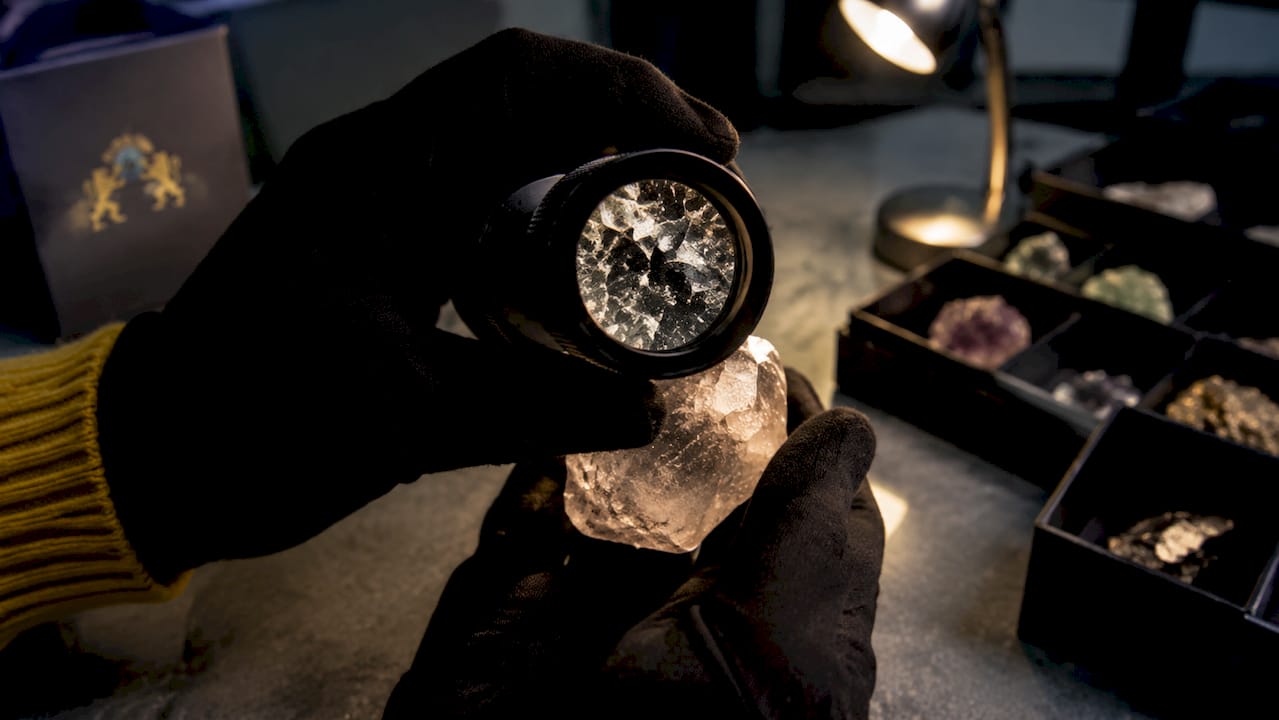
Natural crystals almost always contain imperfections such as color zoning, mineral inclusions, and tiny fractures called feathers. These are not defects. They are proof of natural formation, the mineral equivalent of a fingerprint. A crystal that looks completely flawless and uniformly colored under 10x magnification is almost certainly synthetic or glass.
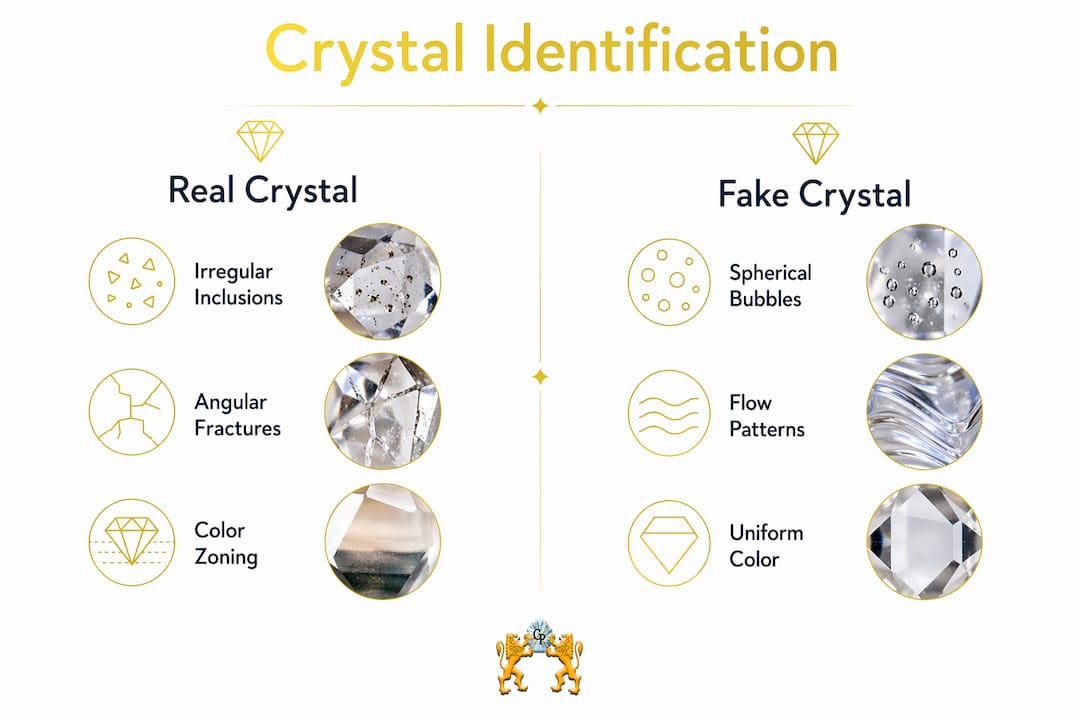
The most reliable visual indicator of a glass fake is the air bubble. Spherical air bubbles under magnification are definitive signs of glass or resin, because they form when liquid material cools in a mold. Natural minerals do not produce round bubbles. What you will find instead are angular mineral wisps, irregular fracture lines, and inclusions with jagged or needle-like shapes.
Here is a quick comparison of what to look for:
| Feature | Real crystal | Glass or resin fake |
|---|---|---|
| Inclusions | Irregular, angular, mineral wisps | Round or oval air bubbles |
| Color distribution | Uneven, zoned, gradual shifts | Uniform, consistent throughout |
| Internal fractures | Natural feathers, growth lines | Absent or perfectly smooth |
| Surface texture | Slight natural variation | Perfectly smooth, molded feel |
Natural inclusions are irregular and angular, while perfectly round or flow-pattern inclusions reveal glass or resin. Color zoning, where pigment concentrates in bands or patches, is another strong authenticity signal. Synthetic stones and dyed glass show color that is too even, too saturated, and too consistent from one end to the other.
Pro Tip: Examine the crystal from multiple angles under the loupe. Rotate it slowly. Natural inclusions shift in appearance as the light angle changes. Glass bubbles look the same from every direction.
How do hardness and specific gravity tests verify crystal authenticity?
Physical property tests move beyond visual inspection and give you quantitative data. Two tests stand out for home use: the Mohs scratch test and specific gravity measurement.
The Mohs scratch test
The Mohs hardness scale ranks minerals from 1 (talc) to 10 (diamond) based on their resistance to scratching. Quartz scratches glass because it has a Mohs hardness of 7, while glass sits at approximately 5.5. This difference is large enough to test at home with a piece of common glass.
Follow these steps:
- Find a piece of flat glass, such as a glass tile or the bottom of a glass bottle.
- Press the point or edge of your crystal firmly against the glass surface and drag it with moderate pressure.
- Wipe away any powder and examine the glass surface under good light.
- A genuine quartz crystal leaves a clear scratch in the glass. Glass or soft plastic leaves no mark or only a surface smear.
- Test the reverse as well. Press the glass edge against your crystal. If the crystal scratches easily, it is softer than glass and likely not quartz.
Specific gravity measurement
Specific gravity testing is the most definitive at-home method for non-professionals because it produces a number you can compare against known mineral values. Specific gravity is the ratio of a mineral’s weight in air to the weight of an equal volume of water.
| Mineral | Specific gravity |
|---|---|
| Quartz | 2.65 |
| Amethyst | 2.65 |
| Glass (common) | 2.4 to 2.8 |
| Resin or plastic | 1.1 to 1.4 |
To measure it at home, you need a digital scale accurate to 0.1 grams, a container of water, and a thin thread. Weigh the crystal in air, then suspend it fully submerged in water using the thread and weigh it again. Divide the air weight by the difference between air weight and submerged weight. Resin and plastic score well below 2.0, making them easy to eliminate. Glass overlaps with some minerals, which is why combining this test with the scratch test and magnification gives you the most reliable result.
What treatments and imitations should buyers know about?
Not every altered crystal is a fake, and this distinction matters for both value and care. The crystal market divides into three categories: untreated natural stones, treated or stabilized natural stones, and outright synthetic or glass imitations.
Treated stones are real minerals that have been modified to improve appearance or durability. Citrine sold in most crystal shops is actually heat-treated amethyst, a process that turns purple quartz golden-yellow. The stone is still genuine quartz, but it was not found in that color. Treatments like heat or resin stabilization do not make a stone fake, but they do affect its value and care requirements. Up to 90% of turquoise on the US market has been stabilized with resin, which hardens the stone and deepens its color. It is still turquoise, but it is not untreated turquoise.
Synthetic crystals present a more complex challenge. Lab-grown synthetic crystals have identical chemical composition to their mined counterparts but display perfect clarity and lack inclusions entirely. A lab-grown quartz crystal will pass the temperature test and the scratch test. Only the absence of inclusions under magnification, combined with suspiciously perfect clarity, reveals its origin.
Outright fakes, meaning glass or plastic sold as natural stone, are the easiest to catch. They fail the temperature test, show air bubbles under magnification, and score too low on specific gravity.
- Dyed stones: natural minerals soaked in dye to enhance or change color; look for color concentrated in surface cracks under magnification.
- Heat-treated stones: real minerals with altered color from controlled heating; nearly impossible to detect without lab equipment.
- Resin-stabilized stones: porous minerals hardened with resin; slightly lower specific gravity than untreated versions.
- Glass fakes: fail scratch test, show air bubbles, warm quickly.
- Plastic fakes: fail temperature test immediately, very low specific gravity.
Very low prices for rare stones are a reliable warning sign. Market value reflects rarity and processing costs, so a “natural” moldavite or larimar priced at a few dollars almost certainly is not genuine. Price alone is not proof of authenticity, but it is a useful filter before you invest time in testing.
Pro Tip: Ask sellers directly whether a stone has been treated. A reputable seller will tell you. Reluctance or vague answers about “natural enhancement” are red flags.
Key takeaways
Identifying real crystal requires combining at least three tests: temperature, magnification, and either hardness or specific gravity. No single test is conclusive on its own.
| Point | Details |
|---|---|
| Temperature test as first filter | Real crystals stay cool on the wrist for 30+ seconds; plastic fails within 15 seconds. |
| Magnification reveals the truth | Angular inclusions confirm authenticity; round air bubbles confirm glass or resin fakes. |
| Hardness confirms mineral identity | Quartz (Mohs 7) scratches glass (Mohs 5.5); a genuine crystal leaves a clear mark. |
| Specific gravity eliminates plastic | Resin and plastic score below 2.0; quartz consistently measures 2.65. |
| Treatments are not fakes | Heat-treated and stabilized stones are real minerals; ask sellers for full disclosure. |
Why perfection should make you suspicious
After years of handling decorative crystals, the single most reliable red flag I have encountered is not a failed scratch test or a warm temperature reading. It is perfection. A crystal that looks too good, too uniform, too flawless, and too consistent in color is almost always not what it claims to be.
Gemologists consistently emphasize that multiple tests together increase accuracy, and I have found this to be true in practice. Beginners tend to trust one test, usually the temperature check, and stop there. That works for plastic. It does not work for glass, and it does not work for lab-grown synthetics.
The other mistake I see constantly is trusting price as a proxy for authenticity. A high price does not guarantee a real stone. It guarantees that someone is confident you will not test it. The buyers who get burned are almost always the ones who skipped the loupe.
Natural imperfections are not flaws but validation of natural formation. Once you internalize that, your eye recalibrates. You stop seeing inclusions as damage and start seeing them as evidence. The crystal with the tiny fracture and the uneven color band is the one worth buying. The one that looks like it came out of a mold probably did.
Buy from sellers who welcome your questions, describe their sourcing, and do not flinch when you pull out a loupe. Transparency is the most authentic thing a crystal seller can offer.
— BCC
Authentic crystal prisms from a source you can trust
Crystalplace has sourced genuine crystal prisms and decorative crystal products directly from authentic manufacturers since 1992. Every piece in the collection meets strict standards for clarity, brilliance, and material authenticity, so you are never left guessing about what you are buying. Whether you are restoring a chandelier or adding light to a room, the crystal prisms and hanging decor at Crystalplace are backed by decades of direct sourcing expertise. For buyers who want to go deeper on material differences, the Crystalplace blog covers topics like crystal versus glass distinctions and spotting real Swarovski crystals to help you shop with confidence.
FAQ
How can I tell if a crystal is real at home?
Press the crystal against the inside of your wrist for 30 seconds. A real crystal stays cool, while plastic warms quickly. Follow up with a 10x loupe to check for natural inclusions versus round air bubbles.
What does a real crystal look like under magnification?
Genuine crystals show irregular, angular inclusions, color zoning, and natural fracture lines. Round or oval air bubbles indicate glass or resin fakes, not natural mineral formation.
Does real crystal scratch glass?
Quartz and most genuine crystals have a Mohs hardness of 7, which is high enough to scratch glass at approximately 5.5. If your crystal leaves a clear scratch on glass, that confirms it is harder than glass and likely genuine mineral.
Is a treated crystal still a real crystal?
Yes. Heat-treated amethyst and resin-stabilized turquoise are still genuine minerals. Treatments affect color and durability but do not change the mineral’s fundamental identity. Ask your seller for full disclosure on any treatments.
Can specific gravity testing be done without lab equipment?
Yes. A digital kitchen scale and a container of water are sufficient. Weigh the crystal in air, then submerged, and calculate the ratio. Plastic and resin score well below 2.0, while quartz consistently measures around 2.65.
Recommended
- What Is Crystal Repair? a Collector’s Practical Guide – CrystalPlace
- Crystal Ornament Types: A Home Décor Buyer’s Guide – CrystalPlace
- The Crystal Place: Where Chandelier Parts Get Easy – CrystalPlace
- Crystal Bead Types: Enhance Lighting and Style with Informed Choices – CrystalPlace