

Discover how prisms create rainbows in your home. Transform dull spaces into vibrant, colorful environments with simple light tricks!
TL;DR:
- Prisms create rainbows through the physical process of dispersion, which separates white light into its component colors. Proper placement near direct sunlight and clean, high-quality crystals are essential for achieving vivid, sharp indoor rainbows. Understanding these factors allows homeowners to deliberately design environments that display vibrant, intentional rainbow effects.
That streak of color dancing across your wall isn’t magic — it’s physics you can control. Understanding how prisms create rainbows turns a charming accident into a deliberate design tool. When white light enters a glass prism, it splits into red, orange, yellow, green, blue, indigo, and violet because each color bends at a slightly different angle. Once you know why that happens, you can place a crystal prism in exactly the right spot to fill a room with color, animate a dull corner, or give a space the kind of light that no lamp can replicate.
Key Takeaways
| Point | Details |
|---|---|
| Prism dispersion explained | Prisms split white light into colors because different wavelengths bend by different amounts when passing through glass. |
| Optimal placement matters | To get vivid rainbows, place prisms near south or west-facing windows with direct sunlight and light-colored walls. |
| Quality over size | High-quality, precisely cut crystal prisms create sharper and brighter rainbows than larger, poorly cut glass pieces. |
| Environmental factors count | Clean prisms, high ceilings, and unblocked light paths greatly improve indoor rainbow clarity and spread. |
| Prism rainbows mimic nature | Prisms create rainbows like raindrops by refracting light twice, but reflection inside prisms doesn’t add color dispersion. |
The physics behind how prisms split light into rainbows
White light looks like one thing, but it’s actually a mixture of every visible color traveling together. The moment that light hits the angled surface of a glass prism, it slows down and changes direction. That bending is called refraction, and it’s the engine behind every rainbow a prism throws onto your wall.
Here’s the key detail most explanations skip: refraction doesn’t affect all colors equally. Each color of light has a different wavelength, and glass bends shorter wavelengths more sharply than longer ones. Violet light has a short wavelength and bends the most. Red light has a long wavelength and bends the least. That difference in bending is called dispersion, and it’s what physically separates the colors from each other inside the prism.
“A triangular prism disperses white light because glass’s refractive index increases as wavelength decreases, bending violet up to twice as much as red light, creating an angular spread of 1 to 3 degrees.”
The process actually happens twice. Light bends once when it enters the prism and again when it exits. That second refraction amplifies the color spread significantly. By the time the light leaves the glass, the colors are fanned out wide enough to project a visible rainbow spectrum onto your wall or ceiling. Shorter wavelengths always emerge in the same order — red, orange, yellow, green, blue, indigo, violet — because physics, not chance, determines the sequence.
What this means for prism rainbow formation at home:
- A steeper prism angle creates a wider color spread
- The more direct and concentrated the light source, the sharper the rainbow bands
- Thicker, denser glass bends light more aggressively, producing more vivid color separation
- The best crystal prisms for rainbow light are cut with precision angles specifically calibrated to maximize that 1 to 3 degree color spread
How rainbows form in nature and how prisms mimic raindrops
To really understand the science behind prisms and rainbows, it helps to compare what a prism does to what a raindrop does. They’re more similar than most people realize.
A natural rainbow forms through three steps:
- Sunlight enters a spherical raindrop and refracts, separating into colors as it slows down in the water
- The separated colors reflect off the back interior wall of the raindrop
- The colors refract a second time as they exit the front of the drop, spreading the spectrum wide enough to become visible across the sky
A prism skips the internal reflection entirely. It produces rainbows using only those two refractions, entering and exiting the glass. That’s actually why prism rainbows are often sharper than natural rainbows — no reflection means less scattering and less blurring of the color bands.
“Reflections inside prisms do not disperse light; dispersion is caused only by refractions at air-glass interfaces.”
This is what Isaac Newton demonstrated in the 1660s: a prism doesn’t add color to white light. It separates colors that were already there, hiding inside the white light all along. A second prism, flipped the opposite direction, will recombine the separated colors back into white light. That experiment — violet bending more sharply than red because of its shorter wavelength — is still one of the most elegant demonstrations in all of physics.
For decorators, the takeaway is practical: a crystal prism hung in a sunny window acts like an indoor raindrop. It is doing exactly what the atmosphere does during a summer storm, just in miniature, in your living room. Understanding that connection helps you use crystal prisms to transform your home from a place that catches rainbows accidentally into one designed to display them intentionally.
Factors that influence prism rainbow quality and placement in your home
Knowing why prisms create rainbows is half the picture. The other half is knowing how to position them so the rainbow lands where you want it, stays sharp, and looks vivid rather than washed out.
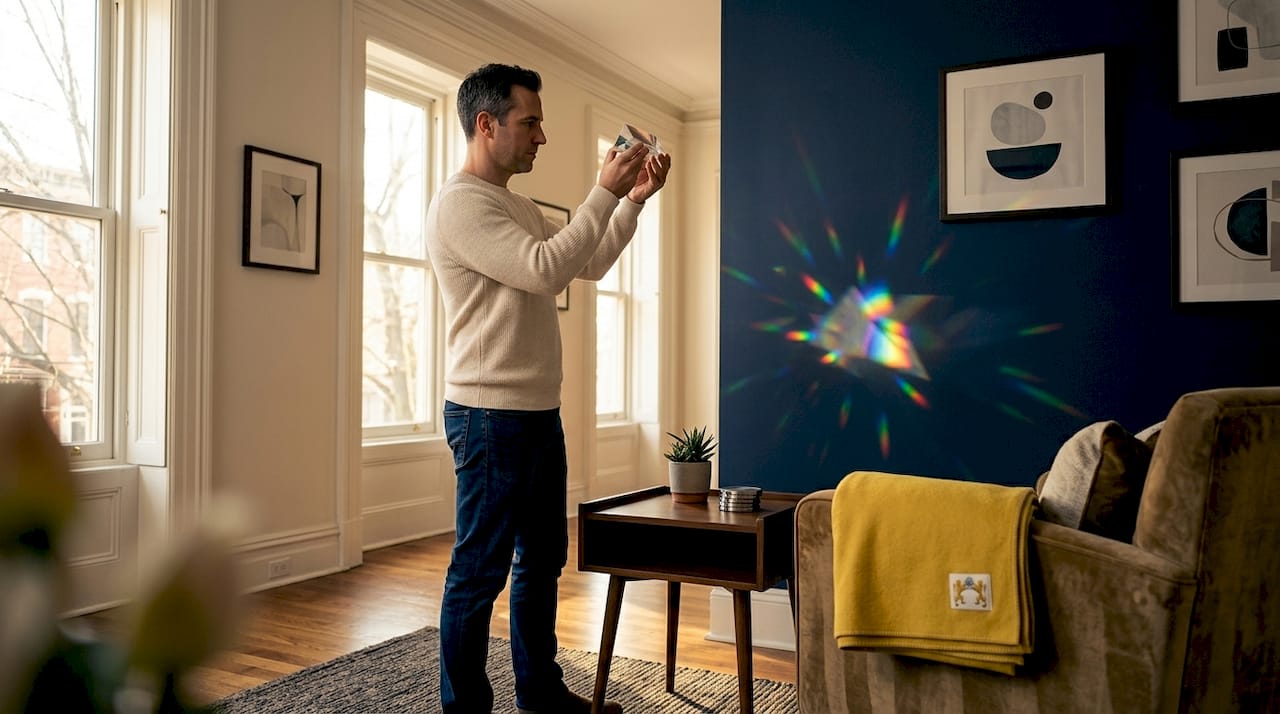
Window direction is the single biggest factor. South and west-facing windows deliver the strongest and most direct sunlight, giving your prism the unfiltered light it needs to produce a full spectrum. North-facing windows rarely get direct sun and typically won’t produce a strong rainbow at all.
Wall color and finish change everything. Matte white or light neutral walls act like a projection screen for rainbow light. Dark walls absorb too much light. Glossy surfaces reflect it unevenly. If you want crisp, saturated color bands, paint the target wall a flat, pale color.
Here’s a comparison of placement variables and their impact on rainbow quality:
| Variable | Best for rainbows | Avoid |
|---|---|---|
| Window direction | South or west facing | North facing |
| Wall finish | Flat or matte | Glossy or dark |
| Distance from wall | 12 to 24 inches | More than 48 inches |
| Prism apex angle | 60 degrees | Below 45 or above 75 degrees |
| Ceiling height | 9 feet or higher | Below 8 feet with limited wall space |
A 60-degree apex angle inside a prism maximizes color dispersion. Smaller angles compress the color spread; larger angles start to blur it. That’s why triangular prisms cut to exactly 60 degrees have been the standard in both scientific instruments and decorative crystals for centuries.
Distance matters too. Hang your prism 12 to 24 inches from a light-colored wall and the projected rainbow will be sharp and well-defined. Move it much farther and the colors begin to overlap and wash out into white again. Clean prisms free of dust and fingerprints maintain crisp projections and can throw colors up to 20 feet on light walls. Even a thin film of oils from handling can reduce rainbow sharpness noticeably.
Pro Tip: To find a prism’s best position quickly, hold it at different angles in direct sunlight and watch where the rainbow lands. Move it closer to or farther from the wall until the color bands look sharpest, then mark the hanging position. That 30-second test saves a lot of repositioning later.
Explore mini crystal prism suncatchers if you want to place rainbow sources in multiple rooms without a large investment, or consider premium hanging crystal prisms for a more dramatic, room-filling effect.
Choosing the right prism: types, cuts, and materials for vibrant rainbows
The rainbow effects of prisms vary enormously depending on the shape, cut precision, and material. Not all crystals perform the same, and understanding why helps you avoid buying a prism that disappoints.
Common prism shapes and what they do:
- Triangular prisms: The most efficient rainbow makers. A clean 60-degree apex and flat polished faces project one strong, defined spectrum band
- Octagonal drops: Project multiple smaller rainbows in different directions simultaneously, good for filling a corner with scattered color
- Star and snowflake faceted drops: Create layered rainbow patterns that shift and move as the sun tracks across the sky
- Sphere prisms: Scatter light in every direction, producing floating rainbow dots across walls and ceilings
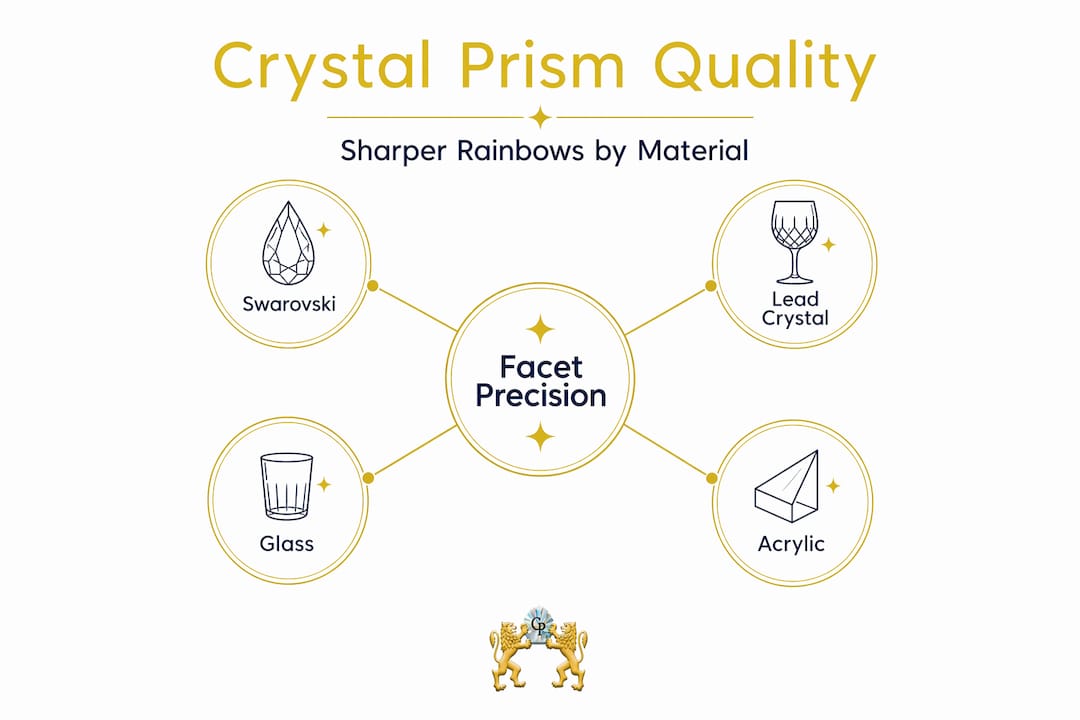
Swarovski and lead crystal produce the brightest and sharpest rainbow projections compared to ordinary glass. The reason is density and purity. Higher-density glass bends light more aggressively, widening the color spread. Optical-grade purity means no tiny bubbles or inclusions scattering the light before it reaches the surface.
Here’s a comparison of common crystal materials and their rainbow performance:
| Material | Light refraction | Rainbow sharpness | Best use |
|---|---|---|---|
| Swarovski crystal | Very high | Excellent | Focal point display |
| Lead crystal | High | Very good | Chandeliers, window prisms |
| Standard glass | Moderate | Fair | Budget decorating |
| Colored glass | Selective | Limited spectrum | Mood lighting only |
Facet precision outweighs prism size in every case. A small 32-facet precision cut prism will outperform a large, roughly cut piece of decorative glass. Each facet is another opportunity for light to refract and scatter, so more facets generally means more rainbow coverage per square inch of wall space.
Pro Tip: If you want a focused, defined rainbow band for a specific wall area, choose a triangular prism. If you want a whole room dancing with scattered light and color, a multi-faceted drop or sphere will do that far better.
Browse top crystal suncatchers for rainbows to see how different shapes perform, or explore hanging crystal prism decor ideas for room-by-room placement inspiration.
What most homeowners and decorators miss about prism rainbows
Here’s the honest truth after decades of working with crystal prisms: the biggest obstacle isn’t choosing the wrong prism. It’s expecting the physics to cooperate without setting up the environment correctly.
Most people hang a prism, see nothing, and blame the product. The prism is almost never the problem. Direct sunlight at a 40 to 60 degree incidence angle is what drives the whole effect. Without it, you simply do not get a usable rainbow. North-facing rooms and shaded windows will disappoint regardless of what crystal you choose.
The second most common mistake is neglecting maintenance. A prism that hasn’t been cleaned in a few months can lose a striking amount of its brilliance. Oils from handling and fine dust accumulate on the facets and interrupt the clean air-to-glass interface that refraction depends on. That invisible film between you and a perfect rainbow is almost always fingerprints.
Window treatments are also far more disruptive than most decorators expect. Curtains can block 70 to 90 percent of usable direct sunlight, which reduces the prism effect dramatically. Sheer curtains cut the light enough that rainbows appear dull and narrow. If you want the full rainbow effects of prisms in your space, those windows need unobstructed sunlight for at least part of the day.
A less obvious insight: high ceilings are underrated as a decorating asset with prisms. When a prism hangs at eye level in a room with a 10-foot ceiling, the rainbow has room to travel upward and spread across a large surface. In a low-ceilinged room, the rainbow fills quickly and has nowhere to grow. If you have a tall living room or stairwell, that’s the most impactful location in your home for a statement prism.
One more thing most guides won’t tell you: the time of year matters as much as window direction. In winter, the sun tracks low across the horizon, sending light into south-facing rooms at a shallower angle and for fewer hours. In summer, south windows can actually get less direct sunlight midday because the sun is overhead. West-facing windows tend to be the most consistent year-round performers for prism placement. Knowing your home’s sun pattern before you hang anything will save a lot of trial and error. Explore the best crystal prism tips to build on this knowledge with specific product guidance.
Bring vibrant rainbows into your home with premium crystal prisms
You now understand how light dispersion in prisms creates those vivid color bands, and why crystal quality, window direction, and clean surfaces determine whether your rainbow is stunning or barely visible. Putting that knowledge into practice is where things get genuinely exciting.
At Crystal Place, we’ve been sourcing authentic Swarovski and lead crystal prisms directly from the world’s top manufacturers since 1992. Our premium crystal prisms are chosen specifically for their optical precision, facet quality, and ability to project sharp, full-spectrum rainbows indoors. Whether you’re starting with a single window prism or designing a light-filled room around multiple hanging crystals, our mini crystal prism suncatchers guide and hanging prism decor ideas give you everything you need to place them perfectly. Free shipping on orders over $22 within the USA.
Frequently asked questions
Why do prisms create rainbows when they bend light?
Prisms separate white light into its component colors because each wavelength bends differently as it passes through the glass, spreading the colors into the visible ROYGBIV spectrum. The colors were always present in white light; the prism simply reveals them by pulling them apart.
How important is prism placement near windows for indoor rainbows?
Placement near south or west-facing windows with direct sunlight is essential, since northern or shaded windows lack the light angle and intensity needed to produce vivid color bands. Even a well-cut crystal prism won’t perform in insufficient light.
Does the prism size affect how vibrant the rainbow is?
Size matters far less than cut quality. Facet precision outweighs size consistently, which means a smaller, well-cut crystal prism will throw sharper, more vivid rainbows than a larger piece of poorly cut glass.
Can colored crystal prisms create full rainbows indoors?
No. Colored prisms filter out parts of the visible spectrum rather than separating all of them, so they produce mood-specific color effects rather than a complete ROYGBIV rainbow. They’re beautiful for atmosphere, but not for full-spectrum prism rainbow formation.
Recommended
- Best Crystal Prisms for Rainbow Light – CrystalPlace
- Crystal prisms: transform your home with vibrant light – CrystalPlace
- Crystal prism selection guide: elevate your lighting – CrystalPlace
- Crystal Prism Basics: Lighting, Decor, and Brilliance – CrystalPlace