

Discover the teardrop crystal pendant explained. Learn how to choose the perfect piece for your fixture, ensuring stunning light reflection.
A teardrop crystal pendant is an elongated, pear-shaped crystal component that hangs from a chandelier or decorative fixture and refracts light into prismatic patterns across walls and ceilings. Before you order a single piece, match the cut style and hole type to your existing fixture — shape alone won’t get you there.
The single most important buying rule: cut (facet pattern) controls the quality and drama of light projection far more than the teardrop shape itself. Measure length, hole diameter, and note the facet style before placing any order.
What is a teardrop crystal pendant, and where is it used?
The industry term is pendalogue (sometimes spelled pendeloques), and a teardrop pendant is one specific pendalogue shape: wider at the bottom, tapering to a narrow top, with a drilled hole for hanging. You’ll also see it listed on spec sheets as a pear prism, pear drop, Swedish drop, or simply a pendant drop.
Not every teardrop is faceted. As chandelier terminology guides note, “teardrop” can describe both smooth, unfaceted pendants and fully faceted drops depending on the manufacturer. The faceted versions are the ones that produce prismatic light; smooth teardrops add shape and weight but minimal rainbow dispersion.
Common placement positions on fixtures:
- Bottom drops on multi-tier chandeliers, where they catch the most direct light
- Garland terminals, anchoring the end of a crystal strand
- Focal pendants on entryway and foyer fixtures, where the elongated silhouette reads clearly from a distance
- Accent drops on sconces and wall brackets for secondary sparkle
Teardrop shapes add elegance and a cascading visual effect that designers favor for formal dining rooms, grand foyers, and entryway fixtures where a romantic, refined ambiance is the goal.
How does cut style change the light a teardrop pendant throws?
Cut is where the real decisions live. Two teardrops can be identical in size and material yet produce completely different wall patterns depending on their facet count, facet angle, and symmetry.
French cut teardrops carry denser, finer facets arranged in a more complex geometric pattern. The result is a tighter, more intricate web of light on surrounding surfaces — smaller individual light spots, more of them, and a layered shimmer that reads as “busy” in the best sense. Standard pear cuts use broader, fewer facets that throw larger, more defined light patches and a classic, bold sparkle. The Swedish drop is a wide teardrop with diamond-shaped facets, similar to a pear but slightly less detailed than a French cut.
Lighting designers confirm: cut style, not shape, dictates the drama of light projection. A French cut teardrop in a foyer creates a dramatically different ceiling pattern than a standard pear of the same size and material.
For restoration work, this distinction matters practically. If the original fixture used French cut pendants and you replace them with standard pear cuts, the light pattern changes noticeably even if the size matches perfectly.
Pro Tip: Photograph a sample pendant against a white wall with a single bare bulb at roughly 12 inches. The wall pattern you see is exactly what the fixture will project. Do this before committing to a full order.
What materials and grades should you know before buying?
Crystal quality runs a clear spectrum, and the material directly affects brilliance, weight, sound, and price.
| Material | Lead Content | Refractive Index | Best Use |
|---|---|---|---|
| Swarovski/Strass | Proprietary formula | Very high | Premium fixtures, restorations requiring maximum brilliance |
| Egyptian high-lead crystal | significant lead oxide content | High | Heirloom-quality chandeliers |
| K9 borosilicate glass | moderate lead oxide content | Moderate (a moderate refractive index) | Mid-range fixtures, budget restorations |
| Soda-lime glass | None | a typical refractive index for glass | Decorative accent use only |
| Acrylic/plastic | None | Low | Not recommended for serious fixtures |
Crystal’s higher refractive index (a higher refractive index for true lead crystal) bends and scatters light into prismatic rainbows; glass at roughly 1.46 produces a softer, more uniform glow without the same color separation. Weight and sound confirm the difference: real crystal feels heavier than glass of the same size and produces a clear bell-like ring when tapped lightly.
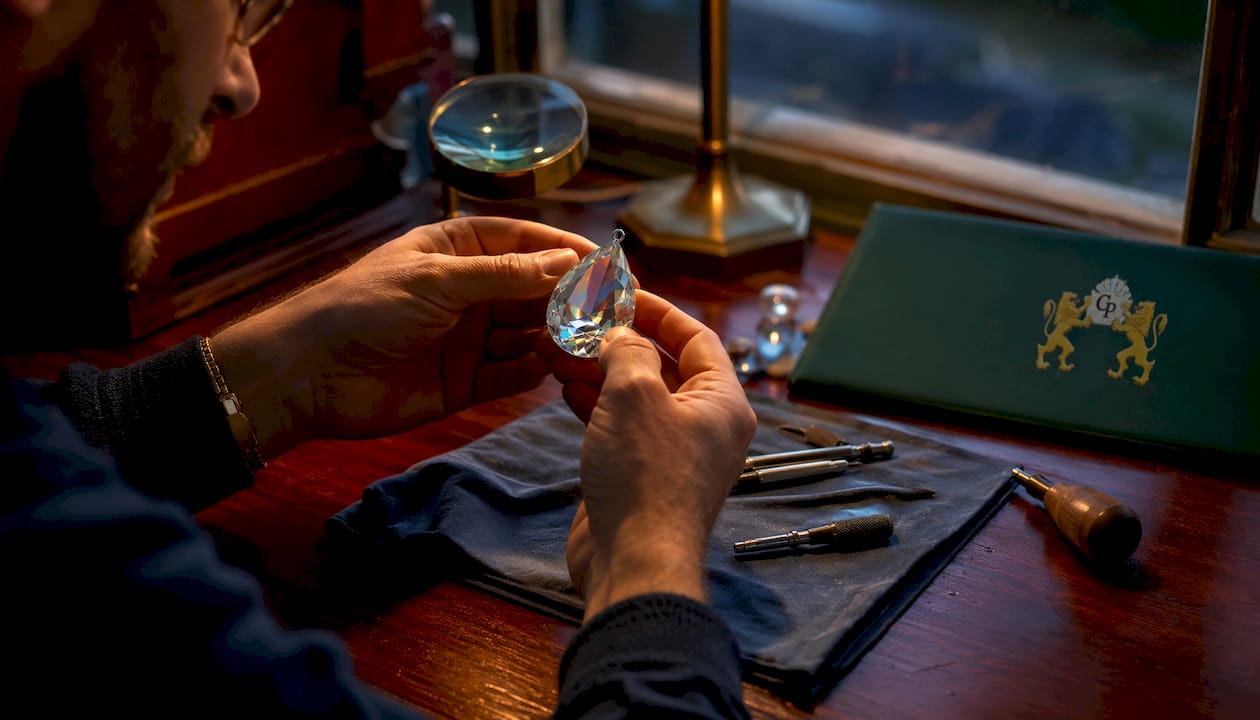
Quick field test: Hold the pendant to a light source. True crystal throws distinct rainbow colors. Tap it gently — crystal rings; glass thuds. Cold-to-touch feel and sharp, precise facet edges are additional quality signals.
Judging crystal quality comes down to five checks: clarity (no cloudiness or visible streaks), facet sharpness (crisp edges, not rounded), absence of air bubbles, cold-to-touch feel, and a clean ring tone. Swarovski crystals are widely regarded as the benchmark for precision-cut brilliance, produced with a proprietary formula that maximizes light refraction. K9 is reliable and affordable but won’t match the fire of high-lead or Swarovski pieces on the same fixture.
How do you measure a teardrop pendant for a correct fit?
Getting the measurements right before ordering saves time and return shipping costs. Record these five dimensions:
- Overall length from the top of the hole to the bottom tip
- Widest width at the broadest point of the pear
- Neck width just below the hole (relevant for pin-style hardware)
- Hole type: top-drilled, side-drilled, or eye-drilled
- Hole diameter in millimeters
Hole type determines which hardware works. Here’s how they map:
| Hole Type | Compatible Hardware |
|---|---|
| Top-drilled | Jump rings, wire loops, head pins |
| Side-drilled | Bead caps, wire wraps, specialty pins |
| Eye-drilled (through-hole) | Eye pins, wire through-loops |
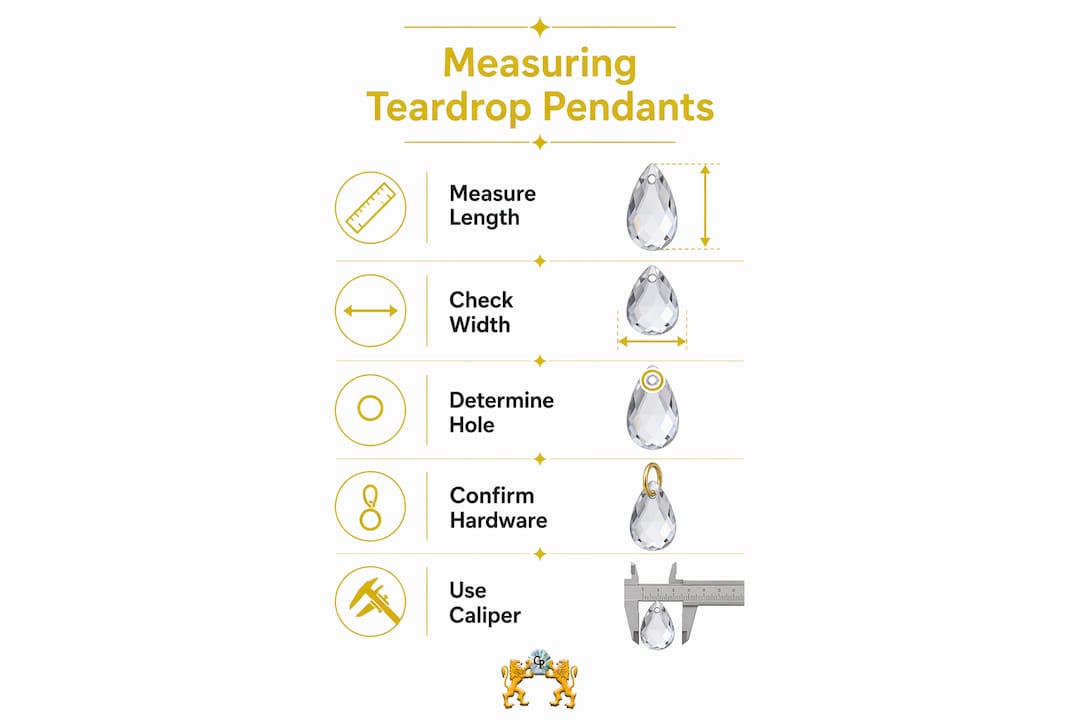
Drop/pendalogue crystals are designed for specific hanging hardware, so a mismatch here means the pendant either won’t hang straight or won’t attach at all.
Pro Tip: Use a digital caliper for hole diameter — a visual estimate is almost always off by 0.5mm or more, which can mean the wrong pin size. Photograph the hole close-up with a coin or ruler in frame and send that image to your supplier.
How do you choose or match a teardrop for restoration?
Work through this checklist in order. Skipping steps is where mismatches happen.
- Confirm the material class. Use the field tests above (ring, weight, cold-to-touch) to identify whether the originals are true crystal, K9, or glass. Replacing crystal with K9 on a premium fixture will be visible.
- Match the facet style. Identify French cut, standard pear, or Swedish drop by comparing facet count and pattern against a reference image or sample.
- Verify all five measurements. Length, width, neck width, hole type, and hole diameter must all match within tight tolerance (±0.5mm for hole diameter; ±1mm for length on pieces under 2 inches).
- Check tint and color temperature. Even “clear” crystals vary from bright white to warm champagne. Hold the original next to the sample in natural light.
- Weigh a sample against the original. Weight confirms material class and ensures the fixture’s balance isn’t disrupted.
When contacting a supplier, send: a photo with a ruler in frame, a close-up of the hole, a close-up of the facet pattern, and your five measurements. Ask specifically about batch variation tolerance, sample availability, and lead time for volume orders. Red flags include hole diameter tolerance stated as ±1mm or more, no sample option, and any description of the facets as “similar to” rather than an exact match.
How do you clean and maintain teardrop crystal pendants?
Crystal and glass require different handling. For crystal pendants, the safest approach is hand-washing with lukewarm water and a mild, ammonia-free cleaner. Never use a dishwasher — the heat and detergent etch the surface and dull facets permanently.
Maintenance schedule: light dusting weekly, a visual inspection monthly, and a deep clean every 3–12 months depending on the environment. Kitchens and high-humidity spaces need more frequent attention.
Dos and don’ts at a glance: do use soft lint-free cloths and crystal-specific cleaners like Brilliante chandelier cleaner; don’t soak metal hardware in water, use paper towels (they scratch), or spray cleaner directly onto a mounted fixture without protecting the electrical components. For large antique chandeliers or fixtures with gilded hardware, a professional cleaning service is worth the cost.
Pro Tip: When removing pendants for cleaning, photograph the fixture first so you know exactly where each piece goes back. Teardrop pendants on multi-tier chandeliers are often graduated in size, and reinstalling them out of order changes the fixture’s silhouette.
Where should you buy authentic teardrop pendants?
The ordering process matters as much as the product itself. A few practical rules:
Sample first, always. Request a physical sample before committing to a volume order. A photo on a screen cannot confirm tint, weight, or facet sharpness — only holding the piece can.
Ask your supplier about minimum order quantities, volume pricing tiers, and how they package fragile parts for shipping. Crystals shipped without individual wrapping arrive broken; a supplier that uses bubble wrap per piece and double-boxes is worth paying slightly more for.
Crystalplace has operated as a California-based specialty retailer since 1992, carrying both authentic Swarovski Strass teardrop prisms and its own Magnificent Crystal Brand line. The catalog includes clear and colored options, and the site offers tiered volume discounts (Buy 2/6/12) alongside free US shipping on orders over $22. For restoration projects, the Swarovski 3.5" vintage drop is a useful measurement and style reference even if you’re comparing against a different piece.
Pro Tip: Order one sample of your top two or three candidates and photograph them side by side against your existing pendant before placing the full order. The cost of two samples is far less than a return shipment of 50 wrong pieces.
Key Takeaways
The cut style (facet pattern) of a teardrop crystal pendant controls light projection more than shape does — always confirm facet style, hole type, and all five measurements before ordering replacements or restoration stock.
| Point | Details |
|---|---|
| Cut beats shape | Facet pattern and density determine wall/ceiling light patterns; match cut style first. |
| Material signals quality | True crystal rings, feels cold and heavy; K9 is reliable but lower fire than high-lead or Swarovski. |
| Five measurements required | Record overall length, widest width, neck width, hole type, and hole diameter (±0.5mm tolerance). |
| Sample before volume orders | Always request a physical sample to verify tint, weight, and facet sharpness before committing. |
| Crystalplace for sourcing | Crystalplace carries Swarovski Strass and Magnificent Crystal Brand teardrops with volume discounts and free US shipping over $22. |
The cut is what most buyers get wrong
Most restoration mistakes I see come down to one thing: buyers match the shape and the size, then assume the job is done. They order 40 pieces, mount them, and wonder why the fixture looks slightly off. The light pattern is different. The sparkle doesn’t match. The culprit is almost always the facet style.
The teardrop shape is a starting point, not a specification. A French cut and a standard pear of identical dimensions will throw completely different light patterns in the same room. For a foyer chandelier that’s been in a family for decades, that difference is visible to anyone who knew the fixture before.
My practical advice: prioritize cut compatibility and hole type over brand when budget is tight. A well-cut K9 pendant with the correct facet style will look more cohesive on the fixture than a Swarovski piece with the wrong cut. Brand matters most when you’re restoring a fixture that originally used Swarovski and the owner wants to maintain that standard. In those cases, don’t substitute — the difference in fire is real and noticeable under direct light.
Crystalplace has the parts you need to get it right
Crystalplace stocks both authentic Swarovski Strass teardrops and the Magnificent Crystal Brand line, so you can match a premium original or spec a new fixture without compromising on cut quality or hole compatibility.
The catalog covers clear and colored pear prisms in multiple sizes, with tiered volume pricing (Buy 2, 6, or 12) and free US shipping on orders over $22. For restoration projects, send Crystalplace your five measurements, a photo with a ruler, and a close-up of the facet pattern — the team can point you to the closest match in stock.
Browse the full selection and place a sample order at Crystalplace to confirm fit and finish before committing to a full run.
Useful sources and further reading
The following references informed this guide and are worth bookmarking for ongoing restoration and specification work:
- Crystal Chandelier Shapes: Teardrops, Pendants, and Spheres — designer perspective on shape selection and cut impact
- Chandelier Crystal Types, Cuts, and Care — LightsOnline — terminology reference for pendalogue cuts including pear and Swedish drop
- Crystal vs. Glass for Chandeliers — Brilliante — refractive index comparison and cleaning schedules
- How to Judge Lighting Crystal Quality — Smile Lighting — quality grading table covering K9, Egyptian, and branded crystals
- Chandelier and Sconce Terms — Chandelier.com — definitions for smooth vs. faceted teardrop terminology
- Crystalplace pear-shape parts guide — internal reference for ordering and matching pear/teardrop components
- Crystalplace crystal interior lighting guide — placement and styling advice for teardrop pendants in residential interiors
For pendant hardware and finish context, gold plated pendant hardware is worth reviewing when matching metal finishes on restoration projects where the original mounting hardware is gilded or gold-toned.
Recommended
- Crystal Terminology Explained: A Decorator’s Guide – CrystalPlace
- Octagon Crystals vs Teardrop Prisms – CrystalPlace
- How to Identify Real Crystal: A Buyer’s Guide – CrystalPlace
- Measure Crystal Drops the Right Way – CrystalPlace