

Discover why authentic crystal matters for your chandelier. Learn key differences, benefits, and how to choose the perfect centerpiece!
For statement chandeliers and formal fixtures, authentic crystal is not interchangeable with ordinary glass. The difference shows up immediately: genuine crystal, whether traditional lead crystal at ≥24% lead oxide or modern lead-free formulations using barium or zinc, carries a refractive index of roughly 1.56–1.61 versus soda-lime glass at ~1.52. That gap produces the prismatic “fire” you see dancing across a dining room ceiling. For secondary or supporting fixtures, quality pressed glass is a reasonable call. For your main chandelier or foyer centerpiece, it is not.
Key signals that separate genuine crystal from glass at a glance:
- Refractive index: Crystal has a higher refractive index than soda-lime glass, producing stronger color dispersion
- Weight and ring: Authentic crystal feels heavier and produces a clear, sustained tone when tapped
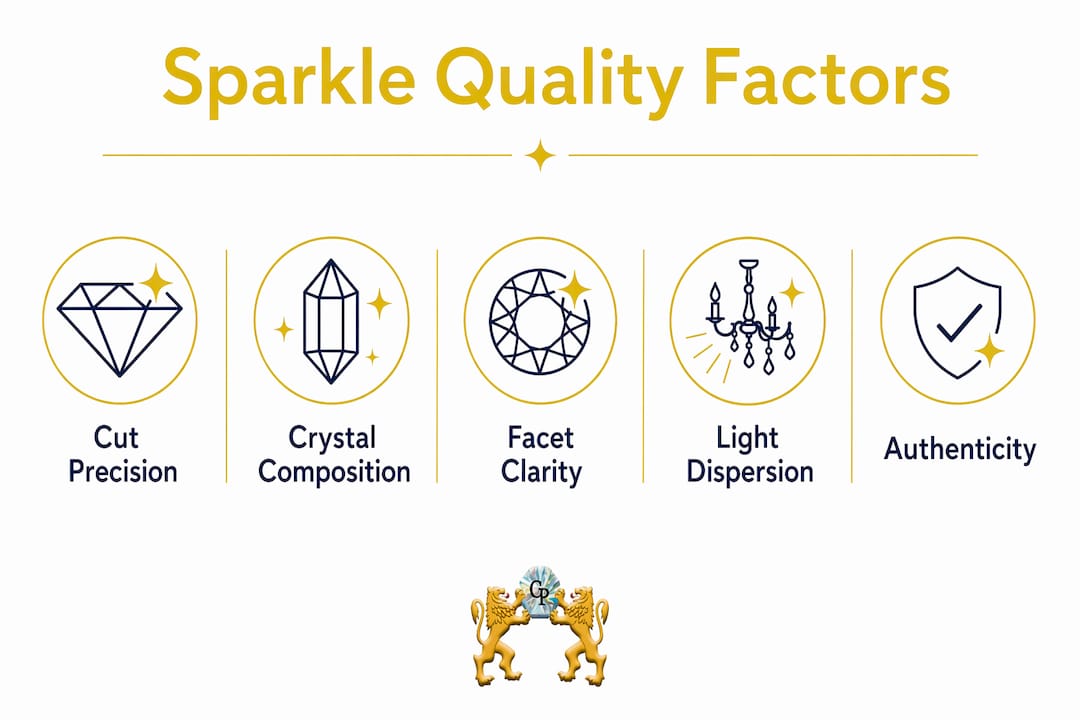
- Cut precision: Premium crystal grades use machine-cut, near-flawless facets; glass often shows rounded or uneven edges
- Branded markers: Swarovski components carry laser-etched logos visible under 10× magnification
- Seller documentation: Authorized dealers provide certificates or provenance statements
Crystalplace stocks authenticated Swarovski prisms and its own Magnificent Crystal Brand line, giving buyers a direct path to verified components.
Why authentic crystal matters: the optical science behind the sparkle
Authentic crystal’s visual advantage comes down to two physical properties: refractive index and dispersion. A higher refractive index means light bends more sharply as it enters and exits each facet. Dispersion then separates that bent light into its spectral colors, producing the rainbow “fire” that makes a chandelier look alive rather than merely lit.
Traditional lead crystal achieves this through lead oxide content. Modern lead-free alternatives use barium oxide or zinc compounds to reach comparable optical performance, which is why material-spec statements matter more than a generic “crystal” label when you’re shopping online.
Cut precision amplifies everything. A facet that is slightly off-angle scatters light instead of directing it, dulling the effect. Premium manufacturers use precision machine cutting for consistent, near-flawless facets that maximize refraction across every drop.
Pro Tip: When product specs are missing online, look for stated refractive index values or explicit “lead-free crystal” ingredient lists naming barium or zinc. A seller who cannot state the material formula is likely selling pressed glass.
Small internal seeds or cord marks in high-lead artisanal crystal are not defects. According to Brilliante Crystal Cleaner’s guide, these tiny irregularities are evidence of traditional hand production and should be read differently from the bubbles or flaws you find in mass-produced pressed glass.
- Lead crystal: Historically contains significant lead oxide, highest refractive index, heavier, produces a clear ring when tapped
- Lead-free crystal: Barium/zinc formulations, optical performance close to lead crystal, increasingly common in premium components
- Pressed soda-lime glass: Lower refractive index (~1.52), lighter, less dispersion, often sold under vague “crystal-style” labels
How real crystal changes what you actually see in a room
Side by side, the difference between authentic crystal and pressed glass is not subtle in a statement fixture. Crystal produces distinct color separation, visible depth within each drop, and moving light patterns across walls and ceilings as the fixture shifts. Glass reflects light but rarely breaks it into color.
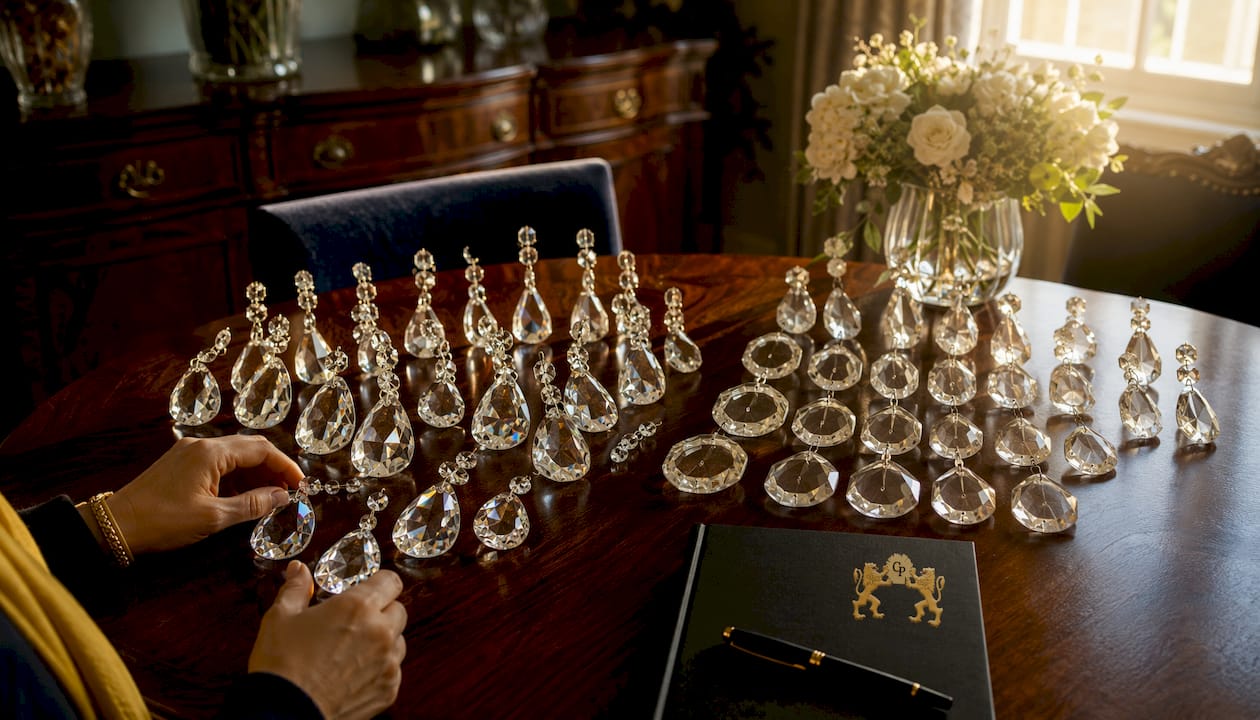
Scale matters enormously. In a dining room with a main chandelier, dozens of crystal drops work together to multiply the prismatic effect. A foyer with a single large fixture benefits most from high-grade crystal because every drop is visible and close to eye level. In a ballroom or large open-plan space, the cumulative effect of authentic crystal across a wide fixture creates a visual field that pressed glass simply cannot replicate.
That said, frame finish, fixture scale, ceiling height, and light color all affect perceived luxury. A chandelier with premium crystal can still look muted against a poor frame or under the wrong bulb temperature. Warm white bulbs (2700K–3000K) tend to enhance crystal’s warmth; cool white can flatten the effect.
Design elements that amplify crystal’s advantage:
- Higher facet count per drop: More surfaces to refract and disperse light
- Larger drops: Greater surface area for prismatic separation
- Mixed shapes: Combining pendalogues, octagons, and teardrops creates layered light patterns
- Density of drops: More drops per arm means more overlapping light effects
For chandelier sparkle, cut quality is the single biggest variable within the crystal category itself.
How to identify authentic crystal when buying online
Buying crystal components online without handling them first requires a systematic approach. Work through these steps before placing an order.
- Check for laser-etched logos. Swarovski components carry a laser-etched logo on larger crystals, visible under 10× magnification. Ask the seller for close-up photos or request confirmation in writing.
- Read the material spec, not the label. Look for explicit composition language: “lead crystal,” “barium crystal,” or named lead-free compounds. “Crystal-style” or “crystal-look” almost always means pressed glass.
- Examine facet photos. High-resolution images should show sharp, clean facet edges. Rounded or uniform-looking edges suggest molded glass.
- Verify weight and size data. Authentic crystal is denser than glass. If weight is not listed, ask. A missing weight spec is a yellow flag.
- Request seller documentation. Authorized dealers provide certificates of authenticity or reference serial numbers for branded components. No documentation for a premium-priced item is a red flag.
- Confirm return policy and warranty. A seller confident in their product’s authenticity will stand behind it with a clear return window.
Pro Tip: For Swarovski components specifically, Crystalplace’s guide on spotting real Swarovski crystals walks through each marker step by step — useful to bookmark before you shop anywhere.
Red flags to watch for:
- “Swarovski-cut” or “Swarovski-style” language without brand authorization
- No material formula, no weight data, no close-up facet photography
- Suspiciously uniform small crystals (possible plastic or low-grade molded glass)
- Premium-branded pricing with no certificate or provenance statement
When paying more for authentic crystal is worth it
Not every fixture in your home needs premium crystal. The decision comes down to visibility, use, and how long you expect the piece to last.
| Tier | Typical use | What you get |
|---|---|---|
| Entry-level | Secondary hallway, bathroom, or accent fixtures | Quality pressed glass; adequate sparkle for low-visibility positions |
| Mid-tier | Guest rooms, secondary dining, transitional spaces | Good-quality lead-free crystal; noticeably better dispersion than glass |
| Top-tier | Main dining chandelier, foyer, ballroom, statement pieces | Branded or precision-cut crystal (Swarovski, high-grade machine-cut); maximum fire and longevity |
On price: pressed glass typically costs significantly less than comparable authentic crystal components, while true premium branded crystal can command substantially higher prices than mid-grade alternatives. For a statement fixture you plan to keep for decades, that premium pays back in sustained visual impact and resale value.
Lead times for premium or custom-cut crystals are longer than for standard glass. Authentication documents and certificates may add a processing step. Budget an extra week or two for branded components, and confirm shipping timelines with the seller before ordering for a deadline-sensitive project.
Care and maintenance: keeping authentic crystal at its best
Authentic crystal is durable but not indestructible. A consistent cleaning routine protects both the crystal and any plated metal finishes on the fixture.
- Turn off and cool the fixture before touching any component.
- Dust first. Use a soft, lint-free cloth or a clean natural-bristle brush to remove loose dust before applying any liquid.
- Apply a crystal-specific cleaner. Products like Brilliante crystal chandelier cleaner are formulated for this purpose. Crystalplace carries crystal care products designed to protect both the crystal surface and plated finishes.
- Wipe or allow to drip-dry. Many spray-on crystal cleaners are designed to drip off, carrying dust with them. Follow the product instructions.
- Dry thoroughly before restoring power. Moisture near sockets is a safety issue.
Safety notes:
- Avoid ammonia-based cleaners on gold or silver-plated finishes; ammonia strips plating
- Never use abrasive cloths on crystal surfaces; micro-scratches dull facets permanently
- Kitchen fixtures need more frequent cleaning due to grease and airborne particles; formal rooms may only need cleaning once or twice a year
For a full restoration or when removing individual drops for deep cleaning, label each drop’s position before removal. Reassembly in the original configuration preserves the fixture’s intended light pattern.
Where to buy authentic crystal online safely
A trustworthy seller meets a short but non-negotiable list of criteria:
- Explicit authenticity statements on product pages, not just in marketing copy
- Certificate availability for branded components (Swarovski and similar)
- Detailed, high-resolution photography showing facets, edges, and any laser-etch marks
- Clear material and composition specs (lead%, barium, or named lead-free formula)
- Stated return policy and warranty with specific terms, not vague language
- Responsive to pre-purchase questions about origin, material formula, and documentation
Crystalplace meets all of these. The company has sold authenticated Swarovski prisms and its own Magnificent Crystal Brand components since 1992, with explicit authenticity verification and a full range of chandelier crystal types across clear and colored options. Before buying from any seller, ask: Can you confirm the laser-etch is present? What is the stated refractive index or material formula? What are the exact return terms if the product does not match the description?
Environmental and ethical considerations in sourcing authentic crystal
Traditional lead crystal production raises legitimate environmental questions. Lead oxide is a regulated substance, and its use in manufacturing has declined significantly as lead-free formulations have improved. Modern premium crystal using barium or zinc compounds removes the lead-handling concern from both production and end-of-life disposal.
When sourcing authentic crystal, look for manufacturers who disclose their material formulas and production origins. Vague country-of-origin labeling or no disclosure at all is a signal worth noting. Authentic crystal components, properly cared for, last decades, which means fewer replacements and less material waste over time compared to lower-grade glass that dulls or chips more readily.
Common counterfeit markers beyond the obvious fakes
The most sophisticated counterfeits are not plastic. They are low-grade pressed glass sold under premium-sounding names, sometimes with packaging that mimics branded presentation. A few markers that go beyond the basics:
Genuine crystal has a specific weight and density. Plastic imitations feel noticeably light. Low-grade pressed glass sits between the two but lacks the optical depth of true crystal. When you hold a genuine crystal drop at an angle to a light source, you see layered color separation inside the piece. Pressed glass produces a flatter, more uniform reflection.
Counterfeit “Swarovski” components often skip the laser-etch entirely or use a printed sticker. Under magnification, a sticker has visible edges and no depth; a genuine laser-etch is part of the glass surface. Facet edges on counterfeits tend to be slightly rounded or show mold lines, a sign of casting rather than cutting.
Price is a useful but imperfect signal. Genuine Swarovski components have a floor price that reflects production cost. Listings priced dramatically below that floor, with no documentation and vague specs, are almost always not what they claim to be.
Long-term value retention and resale considerations
Authentic crystal holds its visual performance far longer than pressed glass. The facets do not dull under normal use, and the material does not yellow or cloud the way some glass formulations do over years of exposure to light and heat. For a fixture you plan to sell with a home or pass on, this matters.
Antique and vintage chandeliers with original, documented crystal components command meaningful premiums in the resale market. Provenance documentation, including certificates of authenticity and records of any restoration work, directly supports resale value. A fixture with a paper trail is worth more than an identical-looking piece without one.
For buyers investing in premium components today, keeping purchase receipts, authenticity certificates, and any branded packaging is straightforward insurance. It costs nothing and protects the value of a piece that, with proper care, should outlast the fixture it came with.
Key Takeaways
Authentic crystal delivers measurably better light dispersion, longer aesthetic life, and stronger resale value than pressed glass, making it the right investment for any statement fixture.
| Point | Details |
|---|---|
| Optical advantage is real | Crystal’s refractive index (1.56–1.61) vs. glass (~1.52) produces the prismatic fire that defines premium chandeliers. |
| Invest where it shows | Top-tier authentic crystal pays off in main dining, foyer, and ballroom fixtures; pressed glass is acceptable for secondary positions. |
| Verify before you buy | Laser-etched logos, explicit material specs, and seller certificates are the non-negotiable authenticity checks. |
| Care extends the investment | Crystal-specific cleaners and ammonia-free maintenance protect both facets and plated finishes for decades of performance. |
| Crystalplace is the verified source | Crystalplace has supplied authenticated Swarovski and Magnificent Crystal Brand components since 1992, with full documentation available. |
The case for authenticity, from experience
There is a tendency in the lighting market to treat crystal grade as a secondary detail, something to optimize after the frame and finish are chosen. That framing gets it backward. As Tyson Lighting notes, the crystal is the soul of the fixture. The frame holds it; the crystal does the work.
What most buyers underestimate is how unforgiving a statement fixture is. A mediocre frame with excellent crystal still looks good. Excellent frame, mediocre crystal: the fixture looks flat, and no amount of repositioning or relamping fixes it. The optical properties are either there or they are not.
The counterintuitive part: lead-free crystal, when properly formulated with barium or zinc, now performs close enough to traditional lead crystal that the material debate matters less than the cut quality and the seller’s transparency. A well-cut, well-documented lead-free crystal component from a reputable source beats a poorly cut “lead crystal” piece with no provenance every time. Buy the documentation as much as the drop.
Crystalplace: your source for verified authentic crystal
Crystalplace has been supplying authenticated crystal components from its California base since 1992. For buyers who want genuine Swarovski prisms or the Magnificent Crystal Brand line without the guesswork, the catalog covers everything from individual Swarovski chandelier crystals to full restoration parts: bobeches, connectors, finials, garlands, and Brilliante crystal cleaner.
Every order ships free within the U.S. on purchases over $22, with volume discounts at the 2, 6, and 12-piece tiers. Authenticity verification, detailed product photography, and material specs are standard, not optional extras. Browse the full catalog at crystalplace.com and find the authenticated components your fixture deserves.
References and further reading
- Do You Know Crystal Grade Differences? — Tyson Lighting — used for crystal grade hierarchy, cut precision, and the “soul of the fixture” framing
- What Is the Difference Between Crystal and Glass Chandeliers? — IB Lighting — source for refractive index ranges and lead oxide content
- How to Tell If Your Chandelier Has Genuine Swarovski Crystals — Uboze Lighting — laser-etch authentication and certificate guidance
- Crystal Cut Glass Lamp Shades: Lead Crystal vs. Pressed Glass — JX Lamp Shade — price tier comparisons and lead-free formulation notes
- What Is Lead Crystal? Guide — Brilliante Crystal Cleaner — artisan production markers and seed/cord interpretation
- Why Some Crystal Chandeliers Look Cheap — NES Lighting — frame, scale, and placement context
- Authenticity Verification for Swarovski Crystals — Crystalplace — internal verification steps and seller documentation guide
- How to Spot Real Swarovski Crystals Fast — Crystalplace — step-by-step branded marker checklist
Recommended
- How to Choose Authentic Crystal Chandelier Parts – CrystalPlace
- Chandelier Crystals for Sale: What to Buy – CrystalPlace
- Vintage Chandelier Crystals for Sale Guide – CrystalPlace
- Are Swarovski Chandelier Crystals Authentic? – CrystalPlace