

Discover the physics behind crystal sparkle and learn practical placement tips to create stunning rainbow displays in your home with authentic hanging crystals.
Hanging crystals don’t just catch light, they transform it into dancing rainbows that fill your room with magic. Many homeowners assume any glass ornament will create these effects, but the truth is far more specific. The sparkle you see depends on precise physics, material quality, and strategic placement. This guide reveals the science behind why certain crystals create brilliant displays while others fall flat, plus practical tips to maximize their decorative impact in your home. Understanding these principles helps you choose and position crystals that deliver stunning visual effects year after year.
Key takeaways
| Point | Details |
|---|---|
| Light bending creates sparkle | Crystals refract and disperse light into rainbow spectrums through precise optical physics |
| Facets multiply brilliance | More faceted cuts generate additional refraction points for intense, scattered sparkle |
| Material quality matters | Lead crystal with high refractive index outperforms glass or acrylic significantly |
| Sunlight angle is critical | Direct sunlight at 40-60° produces strongest rainbows and sparkle intensity |
| Maintenance preserves beauty | Regular cleaning and proper placement sustain long-term crystal brilliance |
The physics behind why hanging crystals sparkle
When sunlight enters a crystal, it doesn’t pass straight through. The light bends at the surface boundary, a phenomenon called refraction. This bending follows Snell’s Law, which describes how light changes direction when moving between materials with different densities. As the light travels through the crystal and exits, it bends again, creating the foundation for sparkle.
What makes crystals truly magical is dispersion. White sunlight contains all colors of the rainbow mixed together. When light refracts through crystal, shorter wavelengths like blue and violet bend more sharply than longer wavelengths like red and orange. This separation splits white light into its component colors, projecting vibrant rainbows across your walls and floors. Hanging crystals sparkle due to refraction and dispersion of light, following Snell’s Law to separate sunlight into a rainbow spectrum.
The refractive index measures how much a material bends light. Lead crystal, containing 24-30% lead oxide, has a refractive index around 1.70-1.80. Regular glass sits closer to 1.50, while acrylic hovers near 1.49. This difference might seem small, but it dramatically affects sparkle intensity. Higher refractive indices bend light more sharply, creating stronger color separation and more brilliant displays.
Prism geometry also plays a role. The apex angle, where two faces meet, influences how effectively the crystal disperses light. Angles around 60° optimize dispersion quality, balancing color separation with light transmission. Too narrow or too wide, and the effect weakens. Quality manufacturers engineer these angles precisely to maximize visual impact.
Pro Tip: Understanding refraction and dispersion explained helps you recognize why premium crystals cost more. The physics demands precision manufacturing that budget alternatives skip.
The sparkle you admire isn’t random. It’s the result of carefully controlled optical physics that transforms ordinary sunlight into extraordinary visual displays.
Key factors in crystal sparkle:
- Material density determines refractive index and bending power
- Wavelength separation creates visible rainbow effects
- Surface angles control light entry and exit paths
- Crystal clarity ensures light travels without internal scattering
How crystal cuts and materials influence sparkle intensity
A smooth crystal ball produces gentle, diffuse light. A faceted crystal explodes with sparkle points. The difference lies in surface geometry. Each facet acts as an independent prism, refracting light at slightly different angles. Faceted cuts create multiple refraction points, producing more intense and scattered sparkles compared to smooth surfaces. More facets mean more opportunities for light to bend, split, and create dazzling effects.
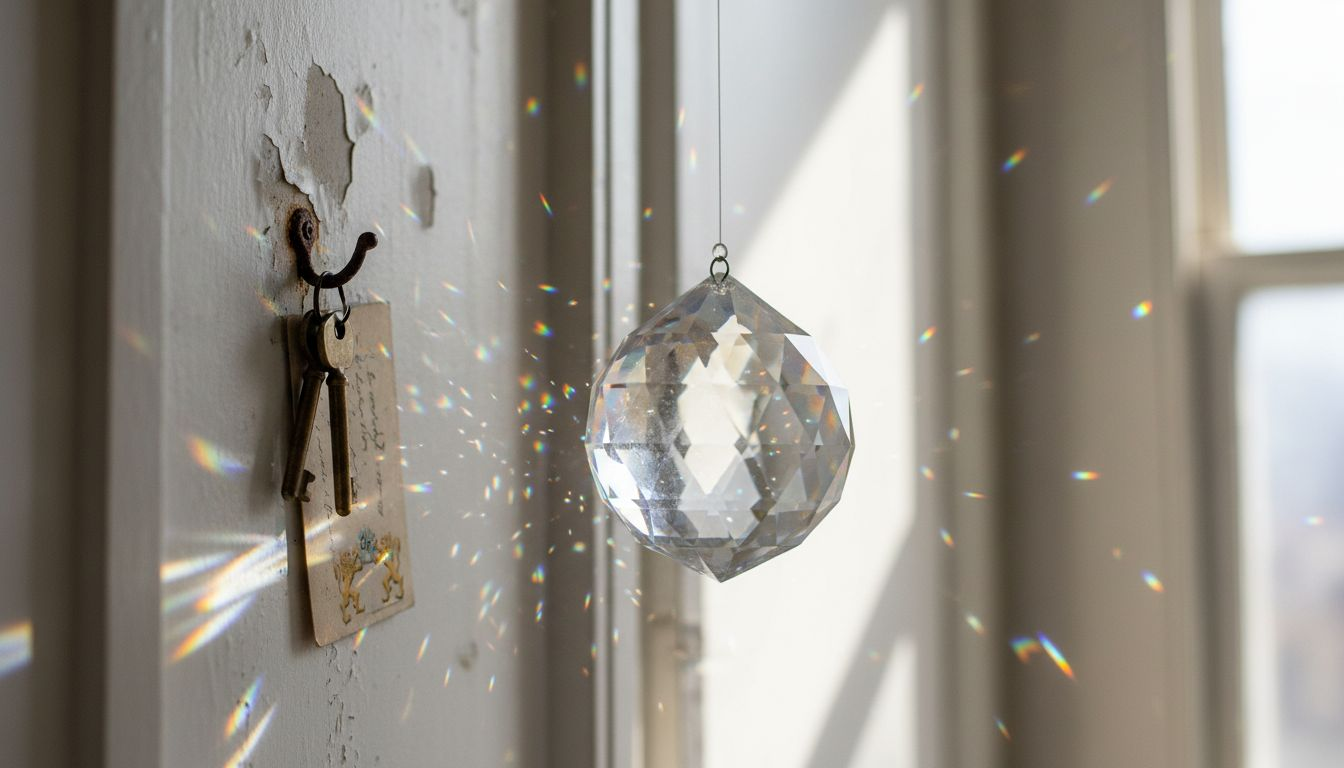
Material composition separates premium crystals from cheap imitations. Lead crystal contains 24-30% lead oxide, boosting its refractive index to 1.70-1.80. This higher index bends light more dramatically than standard glass at 1.50 or acrylic at 1.49. The result is sharper color separation, brighter rainbows, and more intense sparkle. When comparing Swarovski vs generic crystals, the lead content makes the difference immediately visible.
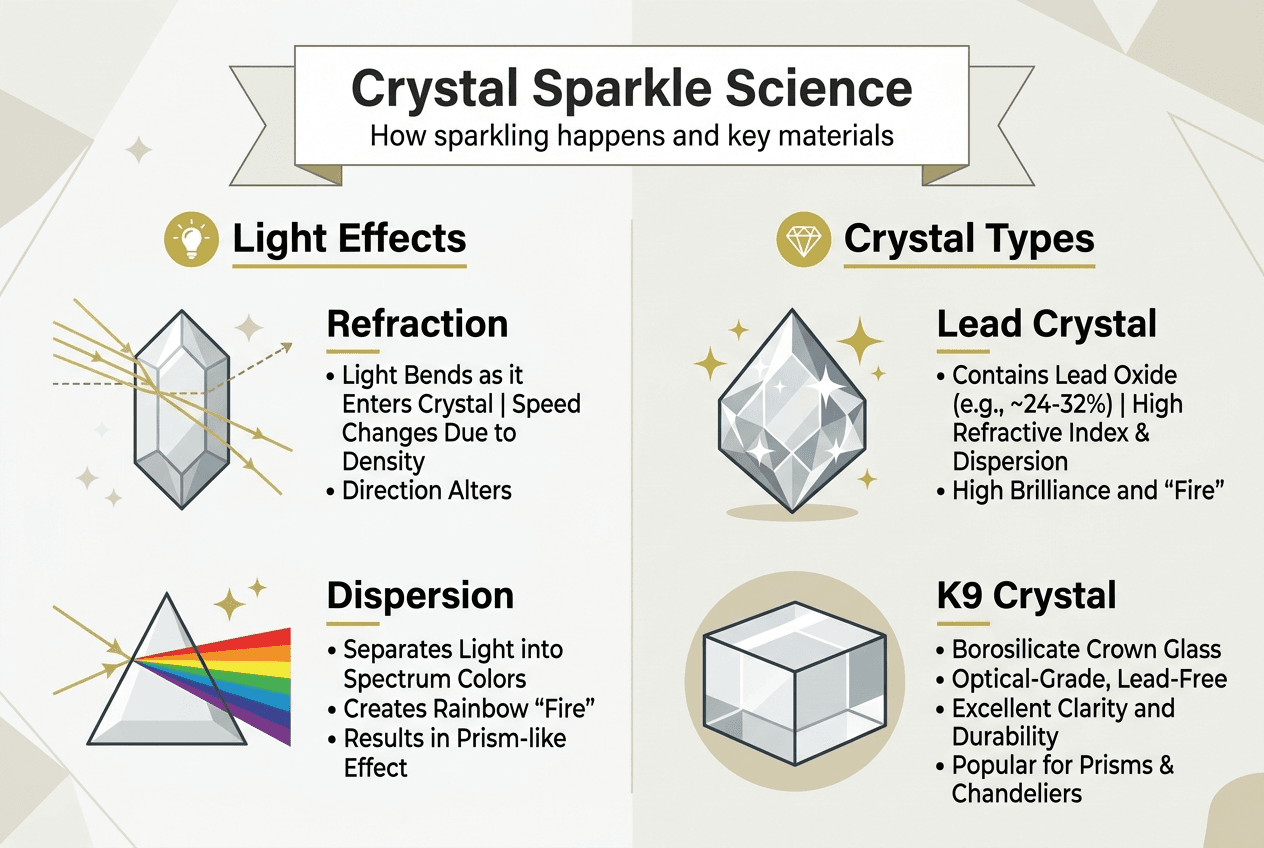
Low-lead or lead-free alternatives sacrifice optical performance for safety regulations. K9 crystal, a popular Chinese alternative, contains less lead and delivers weaker sparkle. Acrylic crystals, while lightweight and shatterproof, produce dull, barely visible rainbows. The physics doesn’t lie: lower refractive indices mean less dramatic light bending. For decorative impact, material quality directly determines visual results. Understanding Swarovski vs K9 crystals helps you make informed purchasing decisions.
Precision cutting matters as much as material. Facets must align within 0.1° tolerance to control light paths effectively. Sloppy cuts allow light to leak or scatter randomly, reducing sparkle intensity. Premium manufacturers like Swarovski use computer-controlled cutting to achieve this precision consistently. Each facet angle is calculated to optimize refraction and dispersion, maximizing the visual payoff.
| Material Type | Refractive Index | Sparkle Quality | Durability |
|---|---|---|---|
| Lead Crystal (24-30% PbO) | 1.70-1.80 | Brilliant, sharp rainbows | Excellent, scratch resistant |
| Standard Glass | 1.50 | Moderate, softer colors | Good, prone to chips |
| K9 Crystal (low lead) | 1.55-1.60 | Fair, muted sparkle | Good, less brilliant |
| Acrylic | 1.49 | Poor, barely visible | Scratches easily, yellows |
Pro Tip: Run your finger across the facets. Premium crystals feel sharp and precise. Budget versions have rounded, inconsistent edges that scatter light poorly.
Factors affecting cut quality:
- Facet angle precision controls light path accuracy
- Surface polish eliminates micro-scratches that diffuse light
- Symmetry ensures balanced sparkle distribution
- Edge sharpness maximizes refraction at boundaries
The role of lighting and environment in achieving optimal sparkle
Even the finest crystal won’t sparkle without proper lighting. Direct sunlight between 40° and 60° incidence angle yields the strongest rainbows and most intense sparkle. This angle range provides enough light intensity while allowing the crystal’s geometry to work effectively. Optimal sparkle requires direct sunlight at 40-60° incidence angle; artificial lights produce muted spectra. Shallow angles below 40° glance off surfaces without sufficient refraction, while steep angles above 60° pass through too directly.
Window orientation dramatically affects your crystal’s performance. South-facing windows in the Northern Hemisphere receive consistent, direct sunlight throughout the day. West-facing windows catch strong afternoon sun, creating dramatic late-day displays. East-facing windows offer morning sparkle but lose direct light by midday. North-facing windows rarely provide the direct sunlight needed for brilliant effects. Understanding hanging crystals interior light principles helps you choose ideal locations.
Artificial lighting disappoints compared to natural sunlight. Indoor bulbs, whether LED, incandescent, or fluorescent, lack the full spectrum balance of sunlight. Most artificial lights emphasize certain wavelengths, typically reds and yellows, while underrepresenting blues and violets. When crystals disperse this incomplete spectrum, the resulting rainbows appear faint and red-heavy. The physics works the same, but the input light quality limits the output beauty.
Environmental factors also matter. Dust accumulation on crystal surfaces diffuses light before it can refract properly, dulling sparkle significantly. Scratches scatter light randomly rather than directing it through designed paths. Diffuse light from cloudy days or sheer curtains lacks the intensity needed for strong dispersion. Even air quality affects performance: humid air can create condensation that temporarily clouds surfaces.
Optimal placement considerations:
- Measure sunlight angles at different times using a protractor or smartphone app
- Position crystals 12-18 inches from the window glass for best light capture
- Avoid locations where furniture or walls block direct light paths
- Consider seasonal sun angle changes when planning permanent installations
- Test positions during peak sunlight hours before final mounting
Pro Tip: Hang crystals slightly away from the window rather than directly against it. This spacing allows light to refract fully before projecting rainbows into your room.
Lighting factors that maximize sparkle:
- Full spectrum light provides all colors for complete dispersion
- Direct beams concentrate energy for intense refraction
- Consistent angle maintains predictable rainbow patterns
- Clean air prevents diffusion and surface contamination
Maintenance and placement tips for lasting crystal brilliance
Crystals lose their sparkle gradually as dust and airborne oils accumulate on surfaces. These contaminants scatter incoming light before it reaches the crystal’s interior, reducing refraction efficiency. Cleaning regularly and selecting south-facing windows with 40-50mm crystals balance sparkle and size for homes. Monthly cleaning with distilled water and microfiber cloths removes buildup without scratching. Avoid harsh chemicals that can etch surfaces or leave residues.
Size selection balances visual impact with practical considerations. Crystals around 40-50mm diameter create strong sparkle without overwhelming smaller rooms. Larger crystals project bigger rainbows but require more direct sunlight to achieve the same intensity per unit area. Smaller crystals concentrate light more effectively but produce subtler effects. Consider your room size and available sunlight when choosing dimensions.
Placement strategy extends beyond window orientation. Height affects where rainbows project. Crystals hung at eye level send rainbows across walls and furniture. Lower positions project upward onto ceilings. Higher positions cast rainbows downward onto floors. Experiment with different heights to find patterns that complement your space. Understanding why clean chandelier crystals enhance brilliance applies equally to hanging decorative pieces.
Material longevity varies significantly. Lead crystal maintains clarity and brilliance indefinitely with proper care. Glass holds up well but chips more easily. Acrylic yellows under UV exposure within 6-12 months, permanently degrading optical quality. This yellowing results from polymer breakdown and cannot be reversed. For long-term installations, invest in real crystal rather than plastic alternatives that degrade quickly.
Rotation prevents uneven wear patterns. Crystals facing constant direct sunlight may develop slight discoloration on one side over many years. Rotating them quarterly distributes exposure evenly. This practice also lets you discover new sparkle patterns as different facets catch light from varying angles. Following a chandelier cleaning checklist adapted for hanging crystals ensures thorough maintenance.
Pro Tip: Create a maintenance schedule on your phone. Monthly cleaning takes five minutes but preserves sparkle quality for decades.
Maintenance best practices:
- Use distilled water to prevent mineral deposits from tap water
- Dry immediately with lint-free microfiber cloths to avoid water spots
- Inspect hanging hardware quarterly for wear or corrosion
- Store seasonal crystals in soft cloth pouches to prevent scratches
- Document optimal placement positions with photos for reinstallation
Statistic spotlight: Proper maintenance can preserve crystal brilliance at 95% of original intensity for over 20 years, while neglected crystals lose 40% of sparkle within just 2 years due to surface contamination and micro-scratches.
Learning to elevate your home with hanging crystals transforms ordinary spaces into enchanting environments. The combination of quality materials, strategic placement, and consistent care creates lasting beauty that enhances your home’s ambiance daily.
Discover the magic of premium hanging crystal decor
Now that you understand the science behind crystal sparkle, it’s time to experience it firsthand. Premium lead crystal prisms transform your living spaces with vivid rainbows and brilliant light displays that budget alternatives simply cannot match. The difference between authentic crystal and imitations becomes immediately obvious when direct sunlight hits properly faceted surfaces.
Explore premium crystal prisms crafted from authentic lead crystal with precision-cut facets engineered for maximum sparkle. Choose from diverse sizes perfectly suited to your home’s lighting conditions and room dimensions. For ultimate brilliance, discover Swarovski crystal suncatchers featuring world-renowned optical quality that delivers unmatched rainbow intensity. Each piece comes with guidance on optimal placement and care, helping you achieve the stunning effects you’ve learned about in this guide.
Frequently asked questions
Why do hanging crystals sparkle more in sunlight than artificial light?
Sunlight contains a full, balanced spectrum of all visible wavelengths from red through violet. Artificial lights, whether LED or incandescent, emphasize certain wavelengths while underrepresenting others, typically lacking strong blues and violets. When crystals disperse incomplete spectra, the resulting rainbows appear faint and color-limited. Sunlight’s complete spectrum allows crystals to separate all colors fully, creating vivid, complete rainbow displays that artificial lighting cannot replicate.
How does the number of facets affect the sparkle of hanging crystals?
Each facet functions as an independent refraction surface, creating its own light-bending pathway through the crystal. More facets generate additional refraction points that scatter light in multiple directions simultaneously, multiplying sparkle intensity and rainbow variety. Precision matters equally: facets cut within 0.1° tolerance prevent light leakage and optimize refraction angles. Poorly cut facets with inconsistent angles scatter light randomly, reducing overall sparkle quality despite higher facet counts.
What is the best placement for hanging crystals to maximize sparkle indoors?
Position crystals near south or west-facing windows where direct sunlight enters at 40-60° incidence angles for optimal refraction and dispersion. Hang them 12-18 inches from the window glass at heights that project rainbows onto your preferred surfaces, whether walls, floors, or ceilings. Avoid locations with diffuse light from sheer curtains or obstructions like furniture that block direct sun paths. Test positions during peak sunlight hours before permanent installation to ensure consistent, brilliant displays throughout the day.
Can I restore sparkle to old, cloudy crystals?
Surface contamination from dust and oils causes most cloudiness and responds well to cleaning with distilled water and microfiber cloths. Deep scratches or etching from harsh chemicals cannot be reversed and permanently reduce sparkle quality. Acrylic crystals that have yellowed from UV exposure suffer irreversible polymer breakdown. Lead crystal and glass maintain their optical properties indefinitely, so thorough cleaning typically restores original brilliance. Regular maintenance prevents buildup that becomes harder to remove over time.
Recommended
- Hanging Crystals for Chandeliers: Elevate Decor 2025 – CrystalPlace
- Hanging Crystals: Transforming Light and Elegance – CrystalPlace
- 12 Hanging Crystal Prism Decor Ideas That Glow – CrystalPlace
- Why Hanging Crystals Change a Room’s Energy – CrystalPlace