

Explore safe options for a stunning crystal chandelier and ceiling fan combo. Learn essential parts and tips for your perfect fandelier.
TL;DR:
- A crystal chandelier and ceiling fan combo is safe if a purpose-built fan or proper rating verification occurs before installation. Factory-made fandeliers with integrated crystals and DC motors offer the most reliable and balanced option. Retrofitting crystals onto existing fans requires careful check of weight, balance, and junction box ratings to ensure safety and performance.
A crystal chandelier and ceiling fan combo is safe and worth doing — with one firm condition: use a purpose-built fandelier or confirm that your fan is rated for crystal add-ons before you hang a single drop. For most homeowners, the right call is buying a factory-made fandelier with integrated crystal accents and a DC motor. If you’re a builder or restorer who wants custom crystals on an existing fan, you’ll need to verify the junction box rating, the fan’s weight tolerance, and use factory-balanced parts. Crystalplace carries Swarovski prisms, Magnificent Crystal Brand drops, connectors, and fan pulls sized for exactly this kind of project.
Is a fandelier or a retrofit right for your project?
The core decision comes down to risk tolerance and how much customization you want. A factory-made fandelier is engineered as a single unit: the motor, housing, blade pitch, and crystal mounts are designed for balance from the start, much like the style options found in the Fulton Six Light Ceiling Mount from Crystorama. You get a warranty, integrated lighting, and no guesswork about weight distribution.
Retrofitting crystals onto an existing fan costs less upfront and lets you match a specific finish or crystal style. The catch is that fan motors and housings are not engineered for extra mass or rotational stress. A few heavy vintage-style drops can throw a blade assembly out of balance and stress the motor over time.
| Factor | Factory fandelier | Crystal retrofit |
|---|---|---|
| Best for | Small to mid-sized rooms, design-focused spaces | Existing fans with confirmed weight ratings |
| Motor/noise | DC preferred; often under 25 dB on low | Depends on existing motor |
| Crystal compatibility | Rated and factory-balanced | Requires weight and balance verification |
| Installation difficulty | Moderate; follow manufacturer steps | Higher; may need an electrician |
| Estimated cost | $150–$600 for the fixture | $30–$150 for parts; labor varies depending on professional |
| Maintenance needs | Standard dusting and biannual deep clean | Same, plus periodic connector checks |
Room size matters too. For rooms of 75–150 sq ft, a blade span in the 42"–50" range is generally recommended; for 150–300 sq ft, choose a 52" or larger fan. Crystal-style fans prioritize appearance, so be sure to check CFM ratings in addition to blade span before making your decision.
What fan features actually matter when you add crystals?
DC motors are the right choice for a crystal ceiling fan. They run up to 70% more efficiently than older AC models and often stay under 25 dB on low settings. Less vibration means crystals clink less and stay seated longer.
Statistic: DC motors in ceiling fans can be up to 70% more energy-efficient than AC models and often operate under 25 dB on low settings — a meaningful difference when crystals amplify every vibration.
Here’s the full checklist before you commit to a fan:
- Motor type: DC over AC for quieter, lower-vibration operation.
- Weight capacity: Confirm the fan’s light-kit mount is rated for the total crystal load you plan to add.
- Factory balancing: The fan should ship pre-balanced; never assume you can correct imbalance after adding crystals.
- Blade design: Shorter or hidden blades reduce visual conflict with crystal tiers and lower the risk of a blade striking a hanging drop.
- Junction box rating: The ceiling box must be fan-rated for dynamic loads, not just static weight.
- UL listing: Verify UL or ETL listing for the combined fan-and-light assembly.
- CFM vs. Sones: Balance airflow output against noise rating; a beautiful fan that sounds like a dishwasher defeats the purpose.
- Dimmer compatibility: Many standard dimmers are designed for lights only. Mismatched dimmers cause flicker, buzz, and motor stress — use manufacturer-recommended controllers.
Pro Tip: After the first 24 hours of operation, re-torque all blade screws and check every crystal connector. New fixtures go through a break-in period where minor settling can loosen hardware that felt tight at install.
Which crystals and connectors should you use?
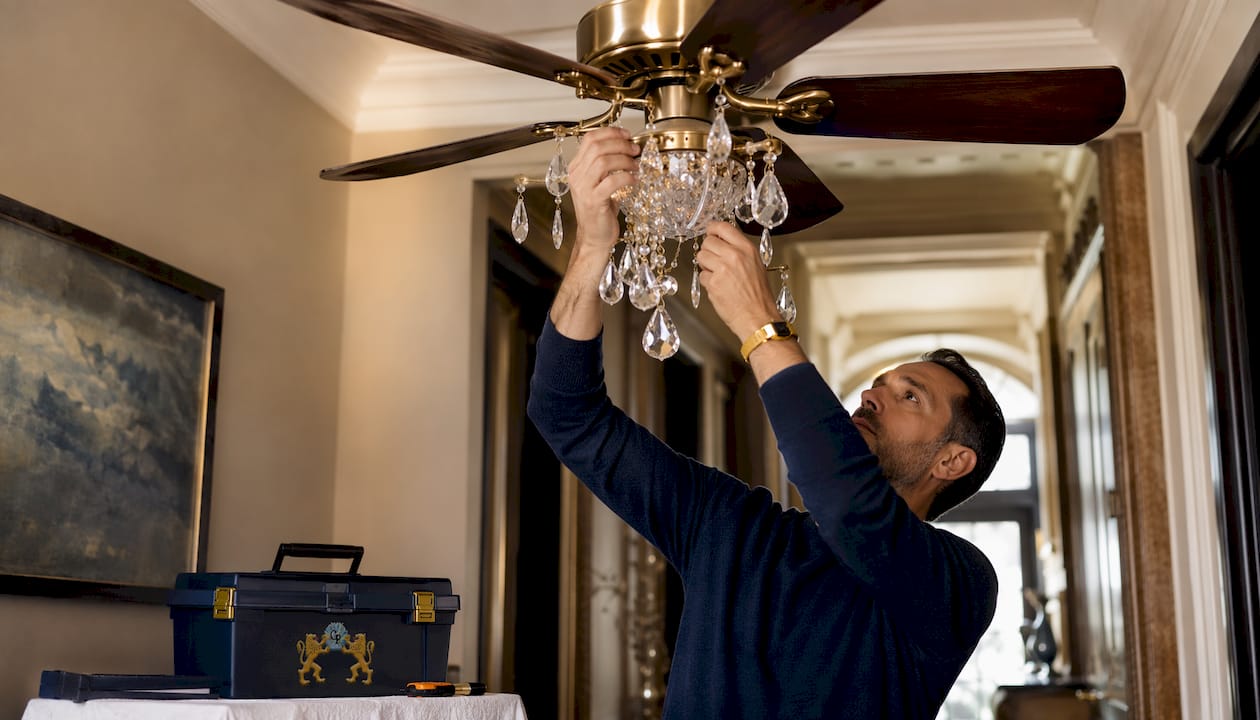
Pick crystals sized and weighted for a rotating fixture. K9 glass and lead-free glass prisms are the practical choice: they deliver excellent light refraction, weigh less than hand-cut lead crystal, and won’t stress a fan’s light-kit mount. Heavy multi-tier chandelier drops are fine on a static fixture but belong on a fandelier that’s specifically engineered for them.
For a chandelier ceiling fan or retrofit, these crystal types work well:
- Pendalogues and teardrop drops: Low profile, light weight, minimal wind resistance from blade rotation.
- Octagon prisms: Classic look, available in small sizes that stay within safe weight bands.
- Short strands and garlands: Effective for adding sparkle around a light kit without adding significant mass.
- Bobeches and finials: Decorative accents that sit close to the fixture body and don’t swing freely.
- Fan pulls: Purpose-made for ceiling fans; they add a crystal accent without any structural load concern.
Style harmony matters as much as weight. Match metallic finishes across the fan body, canopy, and crystal connectors — brushed nickel crystals on an oil-rubbed bronze fan look like an afterthought. Keep drops short enough that blade sweep won’t contact them; in modern rooms, hidden or minimalist blades keep the look cohesive with crystal tiers.
Crystalplace carries authentic Swarovski crystal prisms, Magnificent Crystal Brand drops in clear and color, plus connectors, bobeches, and fan pulls. You can browse the chandelier crystal installation guide for sizing and spacing reference before you order.
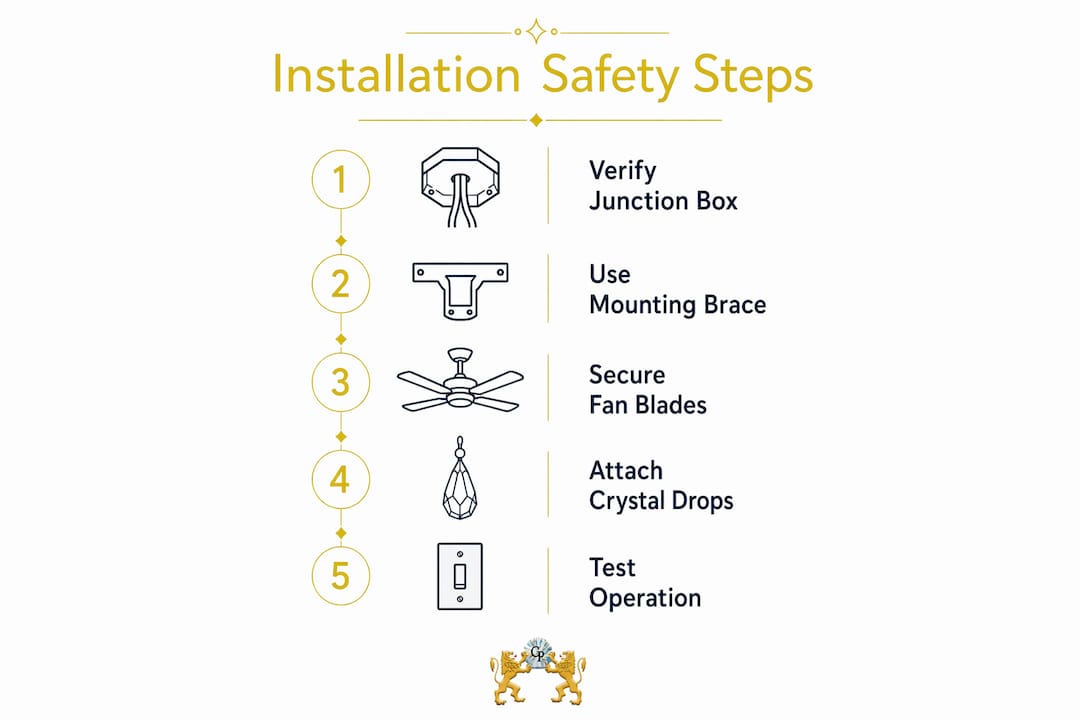
Step-by-step safety checklist for installation
Never hang unsupported weight from a non-fan-rated box. That’s the single rule that prevents the most serious failures. Everything else follows from it.
- Measure and plan. Calculate total crystal weight, confirm blade span suits the room, and check ceiling height (minimum 7 ft floor-to-blade clearance).
- Verify the junction box. If the existing box isn’t fan-rated, hire an electrician to replace it or install a rated brace before proceeding.
- Choose the right fixture. A purpose-built fandelier for most installs; a fan with confirmed crystal weight rating for retrofits.
- Factory-balance check. Inspect blade brackets and crystal mounts before power-on. Don’t assume the box was perfect in shipping.
- Wire per manufacturer instructions. Use compatible dimmers or manufacturer-recommended remote controllers only.
- Test run and 24-hour re-check. Run the fan for 24 hours, then re-torque screws and check every crystal connector.
For mounting on drop or non-standard ceilings, Crystalplace’s suspended fixture mounting guide covers the additional bracing steps.
Typical U.S. cost ranges:
| Scope | Estimated cost |
|---|---|
| Crystal parts only (drops, connectors, fan pulls) | $30–$150 |
| Factory fandelier fixture | $150–$600 |
Timeline: parts arrive in 3–7 business days for most U.S. orders; professional install typically takes 1–3 hours for a standard ceiling swap.
How to care for crystals on a moving fixture
Dust lightly every few weeks and do a thorough deep clean every six months. That schedule keeps crystals bright without letting grime build up to the point where cleaning becomes a project.
- Weekly or biweekly: Wipe drops and strands with a dry microfiber cloth while the fan is off and stationary.
- Every 6 months: Remove drops if the design allows, clean with a manufacturer-approved crystal cleaner, and dry completely before reattaching.
- Never spray directly onto the fixture. Apply cleaner to the cloth first to keep liquid away from motor housings and wiring.
- Grease-prone areas (kitchen, open-plan spaces near cooking zones): increase cleaning frequency to every 3 months.
Crystalplace’s Brilliante crystal chandelier cleaner is formulated for exactly this use. For a full chandelier maintenance checklist with product recommendations, that resource covers schedules and safe application methods.
Common problems and how to fix them
Most post-install problems are mechanical, not motor failure. Before you return anything or call for warranty service, work through this list:
- Wobble: Check blade bracket screws and re-seat the hanger ball. A single loose screw is the most common cause.
- Clinking or swinging crystals: Shorten drop length or add a small rubber grommet at the connector point to dampen movement.
- Crystals falling: Replace any connector showing stress marks or deformation. Use only connectors rated for dynamic load.
- Motor hum: Confirm the dimmer is fan-compatible. An incompatible dimmer is the leading cause of motor hum on otherwise healthy fans.
- Flicker: Same root cause as hum — swap to a manufacturer-recommended controller.
- Persistent wobble after hardware checks: Stop and call a licensed electrician. Continued operation risks motor damage and crystal loss.
For part-level troubleshooting and replacement connector sourcing, the crystal chandelier repair guide at Crystalplace walks through diagnostic steps and compatible parts.
Where to buy crystals and connectors in the U.S.
Buy purpose-made crystals and fan-rated connectors from sellers who publish weight specs and mounting instructions. A listing that shows only a photo and a price is a red flag for a fan application.
- Verify crystal material: K9 glass and lead-free glass are the practical standards for fan use. Acrylic is lighter but scratches easily and looks cheap under direct light.
- Confirm connector tensile ratings: The connector is the failure point, not the crystal. Ask for rated load data before ordering strands.
- Request weight per strand: Total strand weight times the number of strands gives you the load your fan’s light-kit mount must carry.
- Check finish match notes: Many sellers list compatible fan finishes in the product description. Use that information.
Crystalplace ships free within the U.S. on orders over $22 and offers volume discounts on tiered orders. The catalog includes authentic Swarovski prisms, Magnificent Crystal Brand drops, connectors, bobeches, and fan pulls with weight and sizing specs listed. For replacement parts guidance, the chandelier arm replacement resource covers compatible fixings and connector sizing.
Key Takeaways
A factory-made fandelier with a DC motor, a fan-rated junction box, and purpose-built crystal connectors is the safest and most reliable approach to combining crystal chandelier style with ceiling fan function.
| Point | Details |
|---|---|
| Factory fandelier first | Purpose-built fandeliers are safer than retrofits for most installs; use a retrofit only with confirmed weight ratings. |
| DC motor and fan-rated box | DC motors run quieter and can be significantly more efficient; always verify the junction box is fan-rated before install. |
| 24-hour re-check | Re-torque all screws and inspect every crystal connector after the first 24 hours of operation. |
| 6-month deep clean | Clean crystals thoroughly every 6 months; apply cleaner to cloth, never directly to the fixture. |
| Crystalplace for parts | Crystalplace stocks Swarovski prisms, Magnificent Crystal Brand drops, connectors, and fan pulls with weight specs listed, with free U.S. shipping over $22. |
What installers and sellers actually see
The conventional wisdom says a crystal fan is just a decorative upgrade. In practice, the calls that go sideways almost always trace back to one skipped step: nobody checked the junction box. A standard light-fixture box is rated for static weight. A ceiling fan generates dynamic load every time it starts, stops, or changes speed. Add crystal drops to that equation and the margin for error shrinks fast.
Crystalplace has been supplying crystal components since 1992, and the pattern is consistent: buyers who measure twice, confirm their box rating, and use purpose-made connectors rarely have problems. Buyers who assume their existing hardware is “probably fine” are the ones back on the phone two weeks later. The parts themselves are not the risk. The mounting system is.
If you’re uncertain about any step, hire a licensed electrician for the box verification and initial mount. The cost is modest relative to the fixture, and it removes the one failure mode that can’t be fixed with a replacement connector.
Crystalplace has the parts you need

Crystalplace is the direct source for premium crystal components built for chandelier and fan applications. The catalog covers authentic Swarovski crystal prisms, Magnificent Crystal Brand drops in clear and color, fan pulls, connectors with published tensile specs, bobeches, finials, and Brilliante crystal cleaner. A practical starter kit for a crystal ceiling fan project runs to crystal drops, a set of connectors, and a fan pull. Free U.S. shipping applies on orders over $22, and volume discounts kick in at the 2, 6, and 12-unit tiers.
Browse the full catalog at Crystalplace and check the Swarovski and Magnificent Crystal Brand sections for drops sized specifically for fan applications. Every order ships with the weight and sizing specs you need to confirm compatibility before you install.
Useful sources
Verify motor specs, UL listings, and local electrical codes with your fixture manufacturer and local authority before installation. The sources below informed the technical and design guidance in this article:
- Fandelier vs. ceiling fan decision guide — airflow, lighting, and room-sizing comparisons
- DC motor efficiency and noise data — up to 70% efficiency gain and sub-25 dB operation
- Crystal ceiling fan buying guide — factory balancing, dimmer compatibility, and maintenance schedules
- Retrofit safety warning — why standard fans are not engineered for added chandelier weight
- Fan-rated junction box guidance — electrician advice on box replacement and bracing
- Break-in and re-torque guidance — 24-hour post-install check procedure
- Style harmony for chandelier and fan pairings — finish matching and blade visibility recommendations
Recommended
- Crystal Chandelier Repair 2026: 95% Satisfaction Guide – CrystalPlace
- Chandelier Parts Checklist That Prevents Mistakes – CrystalPlace
- 7 Steps to a Complete Crystal Chandelier Checklist – CrystalPlace
- Chandelier maintenance checklist: keep crystals sparkling – CrystalPlace