

Understand the practical benefits and trade-offs of crystal lighting, including visual impact, flexible styles, maintenance, installation, and cost.
Crystal lighting can do more than illuminate a room. It can introduce movement, reflected color, texture, and a focal point that remains visible even when the fixture is turned off.
Those are genuine benefits. Claims that every crystal fixture makes a room a specific percentage brighter, lowers energy use, or increases property value are not reliable. The result depends on the bulbs, crystal quality, fixture design, placement, room surfaces, and installation.
Here are the practical advantages—and trade-offs—to consider before choosing crystal lighting.
Crystal Creates Visual Movement
Faceted crystals catch light from different angles. As daylight changes or hanging pieces move slightly, the reflections change with them.
Depending on the crystal and its placement, you may see:
- Small flashes across nearby walls
- Rainbow colors in direct sunlight
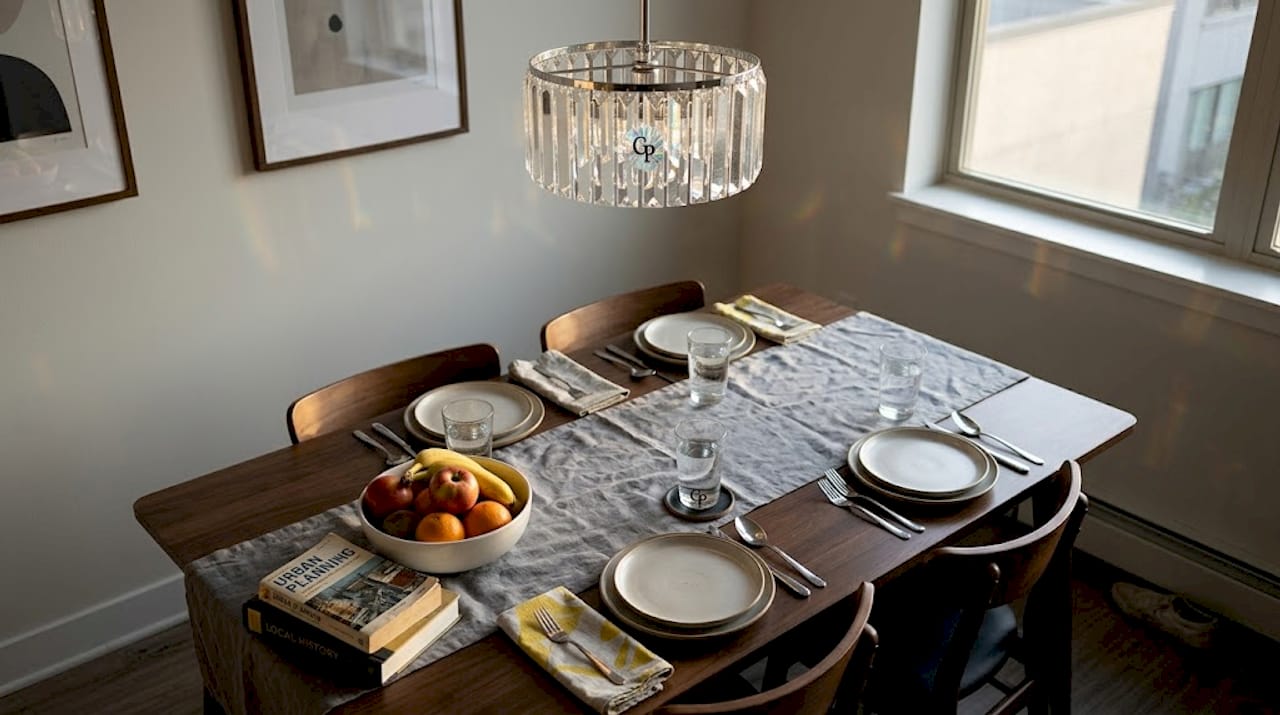
- Reflections around a dining table
- Highlights that change as you move through the room
- More visual depth around the chandelier
This does not mean the crystal creates additional lumens. It changes how the available light is reflected, redirected, and experienced.
For a closer look at this distinction, read our guide to using crystal lighting in modern interiors.
It Gives the Room a Clear Focal Point
A chandelier naturally draws attention upward. Crystal adds another layer of detail through its shape, transparency, and interaction with light.
This can be useful in rooms that otherwise lack a strong visual center:
- An entryway without artwork
- A dining room with simple furniture
- A living room with a high ceiling
- A bedroom needing one decorative element
- A staircase or landing visible from several levels
A fixture does not need to be enormous or heavily ornamented to create an effect. A restrained crystal pendant can provide just as much character when its scale suits the room.
Crystal lighting does not guarantee a higher property value. Its value is primarily visual and personal: it can make a room feel more finished when the style and proportions are right.
Crystal Works With More Than Traditional Décor
Crystal is often associated with formal chandeliers, but the frame determines much of the fixture’s character.
Modern options include:
- Linear fixtures
- Waterfall arrangements
- Compact pendants
- Open geometric frames
- Mixed metal and crystal designs
- Simple rows of identical prisms
- Clear or colored crystal accents
Traditional crystal chandeliers also work in contemporary rooms when the contrast is intentional. An ornate chandelier can become the one detailed element in an otherwise quiet interior.
The benefit is flexibility. The same crystal material can feel classic, glamorous, minimal, romantic, or architectural depending on how it is used.
Individual Parts Can Often Be Replaced
Many crystal fixtures are made from separate hanging components. If one prism, connector, or strand becomes damaged, it may be possible to replace that part without replacing the entire chandelier.
This makes accurate documentation valuable. Keep photographs, measurements, product information, and spare components when possible.
Before ordering a replacement, record:
- Crystal height and width
- Thickness
- Shape
- Color
- Hole size and position
- Connector type and finish
- Placement on the chandelier
A carefully matched replacement helps preserve the fixture’s symmetry and makes future repairs easier.
Our safe chandelier crystal repair guide explains the replacement process and when professional help is necessary.
You Can Personalize the Effect
Clear crystal is the most flexible choice, but colored crystals can change the mood of a fixture or room.
A few color accents can:
- Repeat a room’s existing palette
- Add warmth to a neutral fixture
- Create seasonal interest
- Personalize a restored chandelier
- Make a window or pendant display more distinctive
Before changing an entire fixture, test several pieces under its normal lighting. A color that looks subtle in a product photograph may appear much stronger once it is illuminated.
If the goal is restoration rather than redesign, matching the original color, shape, and spacing is usually the safer choice.
The Bulbs Still Determine Brightness
The crystals are only one part of the lighting system. The bulbs determine how much light is produced.
The U.S. Department of Energy advises comparing bulbs by lumens rather than watts. Lumens describe brightness, while watts describe electricity use.
Also consider:
- Bulb shape and socket
- Maximum permitted wattage
- Color temperature in Kelvin
- Dimming compatibility
- Heat near the crystals
- Manufacturer requirements
Lower Kelvin values appear warmer and more yellow. Higher Kelvin values appear cooler and bluer. The preferred color depends on the room, surrounding finishes, and the atmosphere you want to create.
Do not exceed the chandelier manufacturer’s bulb specifications in an attempt to create more sparkle.
Quality Is Easier to Judge Side by Side
Words such as “premium,” “brilliant,” and “high quality” are not standardized descriptions of how a crystal will look on your chandelier.
Inspect the details:
- Are the facets even?
- Are the edges clean?
- Is the material consistently clear?
- Are there visible bubbles or flaws?
- Is the hole smoothly finished?
- Does the crystal match neighboring pieces?
- Does it hang correctly from the available connector?
Brand information may matter to collectors and restoration professionals, but it should be supported by clear product identification. Phrases such as “Swarovski-style” describe an appearance and do not prove that an item is manufactured by Swarovski.
When authenticity matters, keep the product description, invoice, packaging, and available manufacturer information.
Practical Trade-Offs to Consider
Cost
Crystal fixtures and replacement components vary widely in price. Cost depends on the manufacturer, material, cutting, size, design, hardware, and availability.
Do not assume that the most expensive option is automatically the best fit. A moderately priced crystal that matches the chandelier correctly may be more useful than a premium component with the wrong dimensions or color.
Weight and installation
Crystal can add substantial weight to a fixture. The ceiling support, mounting hardware, and electrical box must be suitable for the complete installed weight.
A qualified installer should evaluate the mounting conditions for heavy or complex chandeliers.
Cleaning
Facets show dust, grease, and fingerprints more readily than plain glass shades. The fixture will need gentle periodic care, but there is no universal cleaning schedule.
A chandelier near a kitchen may require attention sooner than one in a quiet bedroom. Inspect it under normal lighting and clean it when buildup becomes visible.
Fragility
Crystal edges and drilled holes can chip if they strike metal, another crystal, or a hard surface. Handle pieces individually and support them while opening connectors.
Matching older pieces
Crystals from an older chandelier may have dimensions, cuts, colors, or finishes that differ from modern replacements. A perfect match is not always available.
Ordering a sample before replacing an entire section can prevent an expensive mismatch.
Caring for Crystal Lighting
Begin with a soft, lint-free cloth or brush. Follow the fixture and crystal manufacturer’s instructions before using water or cleaning products.
Swarovski’s official care guidance recommends avoiding harsh or abrasive materials and glass cleaners. For suitable washable crystal décor, Swarovski recommends lukewarm water, mild pH-neutral dish detergent, minimal water contact, and thorough drying.
When working around an installed chandelier:
- Turn off the power and allow bulbs to cool.
- Keep moisture away from sockets and wiring.
- Support each hanging crystal.
- Avoid twisting against the connector.
- Allow cleaned components to dry completely.
See our updated crystal chandelier maintenance guide for complete care instructions.
When Crystal Lighting Is a Good Choice
Crystal lighting may suit your room when:
- You want the fixture to become a focal point.
- The room receives direct light that can reach the crystals.
- You enjoy changing reflections and small flashes of color.
- Replacement components are available.
- You are comfortable with periodic cleaning.
- The ceiling and mounting system can support the fixture.
- The design complements the room rather than overwhelming it.
Another material may be more practical when the fixture is in a high-impact area, difficult to access, exposed to heavy grease or dust, or unlikely to receive regular care.
Frequently Asked Questions
Does crystal lighting make a room brighter?
Crystal reflects and redirects available light, which may make the fixture appear more brilliant. It does not guarantee a specific increase in measurable room brightness. The bulb output and fixture design remain essential.
Is crystal lighting difficult to maintain?
Not necessarily, but faceted surfaces show dust and fingerprints. Gentle cleaning when buildup becomes visible is usually more useful than following a rigid schedule.
Does a crystal chandelier increase home value?
There is no guaranteed increase. A well-chosen fixture may improve a room’s appearance and appeal, but property value depends on many factors.
How can I tell whether a crystal is good quality?
Inspect its clarity, facets, edges, hole quality, dimensions, and appearance under your normal lighting. For a large order, compare a sample with the existing fixture.
Is every crystal described as Swarovski genuine?
No. “Swarovski-style” and similar phrases do not establish authenticity. Review the exact product description and available manufacturer information.
Can one missing chandelier crystal be replaced?
Often, yes. Measure an intact matching crystal and record its shape, size, hole placement, color, and connector before ordering.
Final Advice
The real benefits of crystal lighting are visual movement, design flexibility, replaceable components, and the ability to give a room a memorable focal point.
Choose it with realistic expectations. Crystal will not automatically increase measurable brightness, save energy, or raise property value. Its success depends on the complete fixture, suitable bulbs, correct scale, safe installation, and thoughtful maintenance.
CrystalPlace has supplied chandelier crystals and replacement components since 1992. Our team can help identify suitable parts using clear photographs and accurate measurements.
Sources
- U.S. Department of Energy: Consumer Guide to Energy-Efficient Lighting
- ENERGY STAR: Choosing Bulb Brightness and Color
- Swarovski: How to Care for Crystal Decorations
- Swarovski: Brand Protection and Authenticity