

Discover why crystal lighting delivers up to 30% more brilliance, how to choose the right fixture, and expert placement tips to transform any space.
Crystal lighting carries a reputation for grand ballrooms and formal estates, but that assumption undersells what it can do for everyday spaces. Up to 30% more brilliant light output separates real crystal from ordinary glass fixtures, and that difference shows up in dining rooms, hotel lobbies, and even well-proportioned bedrooms. This guide walks you through the science, the aesthetics, the selection process, and the placement strategies that help you get the most from crystal lighting, whether you’re refreshing a single fixture or designing a room from scratch.
Key Takeaways
| Point | Details |
|---|---|
| 30% more brilliance | Crystal lighting produces up to 30% more brilliant light thanks to superior refraction. |
| Enhances luxury appeal | Crystal fixtures create elegant ambiance and visual depth in formal settings. |
| Choose the right crystal | Selecting K9 or Swarovski crystals optimizes sparkle and value for your space. |
| Placement maximizes effect | Direct light and warm bulbs make crystal lighting shine brightest—scale fixtures to your room size. |
| Not for every room | Crystal lighting is best for formal and spacious areas, not casual or low-ceiling spaces. |
What makes crystal lighting uniquely brilliant?
Crystal’s brilliance is not a marketing claim. It comes from the material’s internal structure. Unlike standard glass, which has a random, amorphous arrangement of molecules, true crystal has an ordered atomic structure that bends and splits light with far greater precision. That process is called refraction, and the more precisely a material refracts light, the more sparkle and color it throws into a room.
The key measurement here is the refractive index, a number that describes how much a material slows and bends light. The higher the index, the more dramatic the light play.
| Material | Refractive index | Light dispersion |
|---|---|---|
| Standard glass | 1.45 to 1.52 | Low |
| K9 crystal | 1.52 to 1.59 | Medium to high |
| Lead crystal | 1.60 to 1.70 | Very high |
| Swarovski crystal | Up to 1.70 | Exceptional |
Premium crystal also contains lead oxide or alternative mineral compounds that increase density and clarity. That added density is what gives crystal its satisfying weight and its ability to split white light into a full spectrum of color, the rainbow effect you see dancing across walls and ceilings. Crystal mechanics rely on crystallography, producing superior refraction and rainbow effects that standard glass simply cannot replicate.
Here is what sets quality crystal apart from cheap imitations:
- Clarity: No visible bubbles, streaks, or cloudiness
- Cut precision: Facets are sharp and uniform, maximizing light entry and exit angles
- Weight: Denser material produces richer light dispersion
- Color neutrality: True crystal does not add a yellow or green tint to reflected light
“The difference between real crystal and glass is immediately visible once you see both under the same light source. Crystal throws color; glass just glows.”
Premium crystals provide superior clarity and sparkle compared to standard glass, and that gap widens significantly in larger fixtures where dozens of individual pieces interact with each other. You can explore the full range of crystal lighting brilliance and review the types of chandelier crystals to understand which cut and grade suits your project.
How crystal lighting enhances aesthetics and ambiance
Understanding the science takes us to its visible impact. Crystal fundamentally changes the look and feel of your space in ways that go beyond simple brightness.
When light passes through crystal, it does not just illuminate a room. It multiplies across surfaces, bouncing off walls, ceilings, and furnishings to create a layered, dynamic environment. Crystal lighting multiplies light, making spaces feel brighter and more elegant, which is why it works so well in formal areas like dining rooms, foyers, and hotel lobbies.

| Room type | Effect of crystal lighting | Best fixture style |
|---|---|---|
| Formal dining room | Adds warmth, depth, and occasion | Multi-tier chandelier |
| Grand foyer | Creates a dramatic first impression | Large pendant or tiered chandelier |
| Hotel lobby | Signals luxury and scale | Statement chandelier |
| Master bedroom | Softens the room with gentle sparkle | Smaller flush or semi-flush |
| Commercial event space | Elevates the atmosphere for guests | Cascading or cluster design |
Beyond brightness, crystal adds visual depth. A well-placed fixture draws the eye upward, making ceilings feel higher and rooms feel larger. Crystal creates luxury appeal and visual depth that no painted surface or fabric treatment can match.
Key aesthetic benefits include:
- Perceived increase in room brightness without adding more fixtures
- A focal point that anchors the room’s design
- Seasonal versatility since crystal works in both warm and cool color palettes
- Timeless elegance that does not date the way trend-driven lighting can
Pro Tip: If your dining room feels flat or lacks a focal point, a crystal chandelier hung at the right height above the table will immediately give the room a sense of occasion, even before you add any other decor.
“Crystal lighting is one of the few design choices that improves both the function and the feeling of a room simultaneously.”
For specific inspiration, browse crystal prisms for dining spaces and consult the crystal chandelier guide for style matching advice.
Selecting the right crystal lighting for your space
To fully leverage crystal lighting’s benefits, it’s crucial to select the right fixture for each space. The wrong choice can feel overwhelming or out of place, so a few practical criteria go a long way.
Start with room function and scale. A grand foyer can handle a multi-tier chandelier with hundreds of crystal drops. A breakfast nook cannot. The fixture should feel proportional, not like it was borrowed from a different building.
Next, consider the crystal type:
- K9 crystal is a high-quality optical glass with a refractive index close to lead crystal. It offers excellent sparkle at a more accessible price point and is a strong choice for larger installations where you need many pieces.
- Swarovski crystal is precision-cut with proprietary formulas that maximize light dispersion. It is the benchmark for luxury residential and commercial projects.
- Egyptian crystal sits between K9 and Swarovski in quality and price, offering good clarity for mid-range budgets.
- Genuine lead crystal delivers exceptional brilliance but is heavier and less common in new fixtures due to environmental regulations.
Select K9 or Swarovski for the best balance of quality and value, and avoid crystal entirely in low-ceiling or casual settings where it will feel forced.
| Crystal type | Best for | Price range |
|---|---|---|
| K9 | Large installations, budget-conscious projects | Moderate |
| Swarovski | Luxury residential, high-end commercial | Premium |
| Egyptian | Mid-range residential | Mid |
Pro Tip: For rooms with ceilings under 8 feet, skip the chandelier and use crystal pendant lights or wall sconces instead. You still get the sparkle without the scale problem.
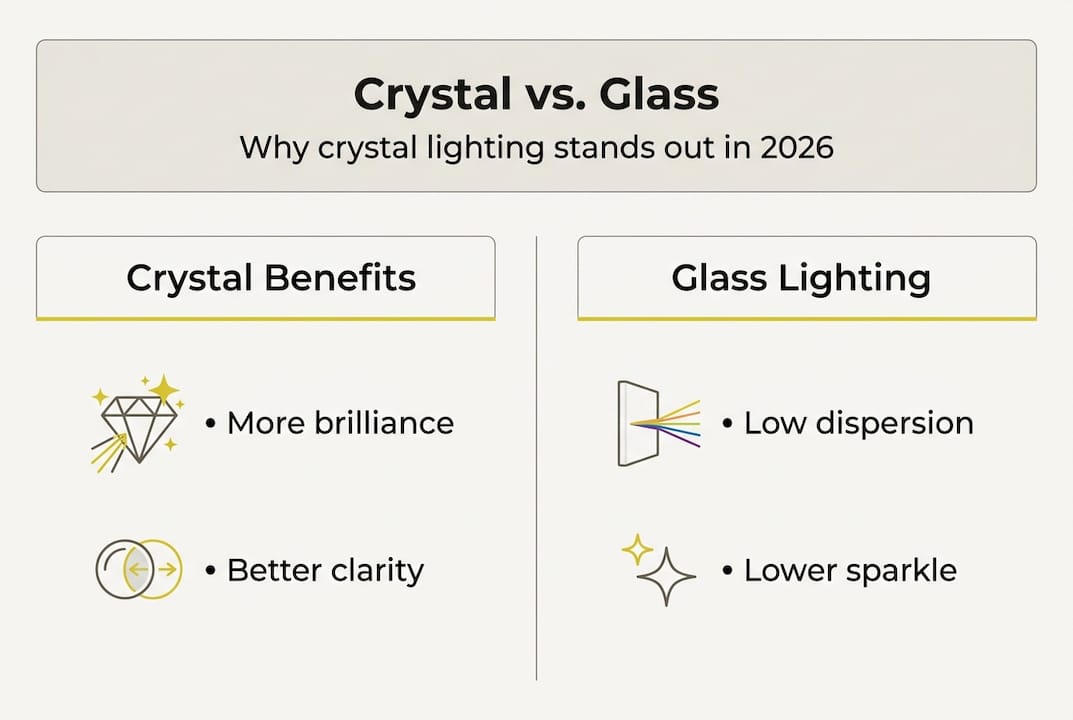
Premium crystals like Swarovski provide superior rainbow effects that justify the investment in spaces designed to impress. See real-world examples with Swarovski crystal chandeliers and browse chandelier crystal examples to compare styles side by side.
Placement and optimization tips for crystal lighting
Once you’ve selected the ideal fixture, maximizing its impact comes down to placement and setup. Even the finest crystal chandelier will underperform if it’s hung in the wrong spot or paired with the wrong bulb.
Here are the core placement principles:
- Position for direct light exposure. Crystal needs a light source shining through it, not just around it. Center the fixture under a ceiling light source or ensure bulbs are positioned inside the crystal arrangement.
- Use warm bulbs. Optimal placement involves bulb warmth in the 2700K to 3000K range. Cooler bulbs (4000K and above) make crystal look harsh and flatten the rainbow effect.
- Scale the fixture to the room. A common formula: add the room’s length and width in feet, then use that number in inches as your fixture’s diameter. A 12 by 14 foot room suits a 26-inch diameter chandelier.
- Hang at the right height. In dining rooms, the bottom of the fixture should sit 30 to 34 inches above the tabletop. In foyers, allow at least 7 feet of clearance from the floor.
- Avoid placement near air vents. Moving air causes crystal to sway and click, which is distracting and can cause wear on the fittings over time.
Pro Tip: Place a crystal fixture where morning or afternoon sunlight can reach it directly. Natural light through crystal creates rainbow projections that move across the room as the sun shifts, turning your lighting into a living design element.
For detailed guidance, review crystal lighting placement tips and the custom chandelier design guide if you’re building a fixture from scratch.
A fresh perspective: Is crystal lighting always the right choice?
Here is the honest answer: no. Crystal lighting is exceptional in the right context, but it is not a universal solution, and pretending otherwise does a disservice to good design.
We have seen homeowners install large crystal chandeliers in open-plan kitchens or casual family rooms, and the result is almost always the same. The fixture looks out of place, and the room feels like it is trying too hard. Some experts see crystal as ‘tacky’ in non-grand settings, and while that word is harsh, the underlying point is valid. Crystal carries a visual weight and formality that not every space can absorb.
Minimalist interiors, in particular, often benefit more from simple glass pendants or matte metal fixtures. The clean lines of a Scandinavian or industrial design scheme can be disrupted by the visual complexity of a crystal chandelier. That is not a failure of crystal. It is a mismatch of design language.
The smarter approach is to treat crystal as a deliberate statement rather than a default upgrade. Use it where formality, luxury, and light drama are genuinely desired. Skip it where simplicity and calm are the goals. A well-chosen crystal fixture in crystal chandeliers at home settings that suit it will always outperform a mismatched one in a space that fights it.
Explore exquisite crystal lighting options
If you’re ready to elevate your space with crystal lighting, Crystal Place has been sourcing and supplying authentic crystal products since 1992, with direct access to Swarovski and other premium brands. Whether you need a statement chandelier for a formal dining room, individual crystal drops for a repair project, or a fully custom fixture designed around your space, the selection covers every need and budget.
Browse crystal suncatchers and ornaments for accent pieces that add sparkle without a full fixture commitment. For larger projects, explore the full crystal chandelier decor collection and take advantage of free shipping on orders over $22 within the USA. Our team is ready to help you find the right crystal solution for your specific space.
Frequently asked questions
What types of crystals are best for lighting fixtures?
Swarovski and K9 are the most popular choices for clarity, sparkle, and value. Swarovski’s superior clarity and precision cutting deliver more intense rainbow effects, making it the top choice for luxury settings.
How should I scale a crystal fixture to room size?
Add the room’s length and width in feet and use that sum as the fixture diameter in inches. Scale fixture diameter to room size to ensure the chandelier feels proportional rather than overwhelming or undersized.
Does crystal lighting work in every room?
Crystal works best in formal areas with adequate ceiling height, such as dining rooms, foyers, and lobbies. Avoid crystal in low-ceiling or casual spaces where it tends to feel out of place.
Which bulbs should I use in crystal fixtures?
Use warm white bulbs rated between 2700K and 3000K. Warm bulbs best enhance the sparkle and color tones that make crystal lighting so distinctive.
Are there any drawbacks to crystal lighting?
Crystal can overpower small or informal rooms and may look out of place outside traditional or luxury settings. Some experts see crystal as ‘tacky’ in casual environments, so always consider the room’s overall design language before committing.
Recommended
- Crystal lighting: 30% more brilliance for your space – CrystalPlace
- How crystal affects lighting: enhance your space with sparkle – CrystalPlace
- Why upgrade chandelier crystals for brilliance in 2026 – CrystalPlace
- Types of crystal prisms for stunning home lighting in 2026 – CrystalPlace